Among all of the possible chemical compounds, it’s estimated that between 10 20 and 10 60 may hold potential as small-molecule drugs. Evaluating each of those compounds experimentally would be far too time-consuming for chemists. So, in recent years, researchers have begun using artificial intelligence to help identify compounds that could make good drug candidates. One of those researchers is MIT Associate Professor Connor Coley PhD ’19, the Class of 1957 Career Development Associate Professor with shared appointments in the departments of Chemical Engineering and Electrical Engineering and Computer Science and the MIT Schwarzman College of Computing. His research straddles the line between chemical engineering and computer science, as he develops and deploys computational models to analyze vast numbers of possible chemical compounds, design new compounds, and predict reaction pathways that could generate those compounds. “It’s a very general approach that could be applied to any application of organic molecules, but the primary application that we think about is small-molecule drug discovery,” he says. The intersection of AI and science Coley’s interest in science runs in the family. In fact, he says, his family includes more scientists than non-scientists, including his father, a radiologist; his mother, who earned a degree in molecular biophysics and biochemistry before going to the MIT Sloan School of Management; and his grandmother, a math professor. As a high school student in Dublin, Ohio, Coley participated in Science Olympiad competitions and graduated from high school at the age of 16. He then headed to Caltech, where he chose chemical engineering as a major because it offered a way to combine his interests in science and math. During his undergraduate years, he also pursued an interest in computer science, working in a structural biology lab using the Fortran programming language to help solve the crystal structure of proteins. Af
At any given time, technology does two things to employment: It replaces traditional jobs, and it creates new lines of work. Machines replace farmers, but enable, say, aeronautical engineers to exist. So, if tech creates new jobs, who gets them? How well do they pay? How long do new jobs remain new, before they become just another common task any worker can do? A new study of U.S. employment led by MIT labor economist David Autor sheds light on all these matters. In the postwar U.S., as Autor and his colleagues show in granular detail, new forms of work have tended to benefit college graduates under 30 more than anyone else. “We had never before seen exactly who is doing new work,” Autor says. “It’s done more by young and educated people, in urban settings.” The study also contains a powerful large-scale insight: A lot of innovation-based new work is driven by demand. Government-backed expansion of research and manufacturing in the 1940s, in response to World War II, accounted for a huge amount of new work, and new forms of expertise. “This says that wherever we make new investments, we end up getting new specializations,” Autor says. “If you create a large-scale activity, there’s always going to be an opportunity for new specialized knowledge that’s relevant for it. We thought that was exciting to see.” The paper, “ What Makes New Work Different from More Work ?” is forthcoming in the Annual Review of Economics . The authors are Autor; Caroline Chin, a doctoral student in MIT’s Department of Economics; Anna M. Salomons, a professor at Tilburg University’s Department of Economics and Utrecht University’s School of Economics; and Bryan Seegmiller PhD ’22, an assistant professor at Northwestern University’s Kellogg School of Management. And yes, learning about new work, and the kinds of workers who obtain it, might be relevant to the spread of artificial intelligence — although, in Autor’s estimation, it is too soon to tell just how AI will aff
MIT and the Commonwealth of Massachusetts announced plans to establish the Quantum Systems Laboratory (QSL) at MIT, which will be open to researchers across the region. With the new funding from the state, which will match federal funding for quantum research already underway at MIT, the Institute aims to begin construction on the QSL facility this summer. The QSL will host specialized facilities that will enable Massachusetts scientists to undertake impactful work applying quantum research across practical domains, including life sciences and national defense. Quantum technologies promise transformative changes in fields from computing, security, and navigation to health sciences, defense technologies, and space exploration. But how do we ensure Massachusetts stays on the leading edge of our nation’s coming quantum leap? Doing so is vital to the prosperity and security of our Commonwealth and country, serving to protect and advance America’s technological leadership in a world that has been upended by geopolitical rivalries. On Thursday, May 28, Governor Maura Healey joined President Sally Kornbluth at MIT to announce a new effort aimed at establishing Massachusetts as a national hub for quantum innovation and catalyzing next generation quantum technologies. MIT and the Commonwealth of Massachusetts announced plans to establish the Quantum Systems Laboratory (QSL) at MIT, a new shared-use facility that will serve as a quantum toolbox for the region, aimed at accelerating quantum research, innovation, and growth in this critical field. The QSL seeks to be the first facility in the world to bring together state‑of‑the‑art quantum computers with quantum sensors and peripherals, joined by quantum interconnects (physical channels that transfer quantum information). The facility will provide researchers from MIT and other institutions hands‑on access to significant quantum hardware and specialized experimental capabilities that a
To accelerate and refine decision-making in a fast-paced, global marketplace, enterprises may deploy generative artificial intelligence models to help summarize and interpret the charts that often fill market summaries and financial reports. But even the latest vision-language models sometimes struggle with this task, since it requires a model to integrate visual, numerical, and linguistic understanding. A company that invests in a state-of-the-art model might still receive inaccurate or incomplete information. To fill this performance gap, researchers from MIT and the MIT-IBM Computing Research Lab developed a multifaceted resource for AI users that is specifically designed to teach vision-language models (VLMs) how to effectively interpret charts. They used a novel data generation method to build a state-of-the-art dataset that includes more than a million varied charts. The dataset also encodes many visual, linguistic, and numerical components of each chart image, which enable models to robustly reason about the information in a chart. The researchers used this dataset, called ChartNet , to train a series of open-source VLMs. Many of these smaller models significantly outperformed orders of magnitude larger, commercial models on tasks like data extraction and chart summarization. By enabling open-source models to outperform their commercial counterparts, ChartNet could allow small firms with limited budgets to more readily utilize AI. The open-source dataset can be used to improve the capabilities of AI models for tasks like business trend analysis and scientific figure interpretation. “We developed ChartNet to be a one-stop shop for chart understanding, covering basically anything that an AI model and a practitioner who is training that model might need. We hope our work motivates researchers to achieve state-of-the-art performance with smaller models that don’t require infinite amounts of computation,” says Jovana Kondic, an MIT electrical engi
Tod Machover, the Muriel R. Cooper Professor of Music and Media, faculty director of the MIT Media Lab, and director of the Opera of the Future research group, will receive the George Peabody Medal for Outstanding Contributions to Music and Dance in America — the highest honor bestowed by the Peabody Institute of the Johns Hopkins University. As a composer and music tech pioneer, Machover has helped expand music’s possibilities for artists and audiences alike through his work in participatory opera, artificial intelligence, and creative technologies. He joins a roster of previous George Peabody Medal recipients that includes Stevie Wonder, Misty Copeland, Herbie Hancock, Renée Fleming, Yo-Yo Ma, Wynton Marsalis, Ella Fitzgerald, and Leonard Bernstein. In the citation for the Peabody Medal, Peabody Institute Dean Fred Bronstein writes: “The breadth and depth of Tod Machover’s career — his work in participatory opera, as an educator and faculty director of the MIT Media Lab, his genuinely groundbreaking and prescient work at the intersection of music and technology, along with an overall and broad impact on the American music scene — make him an ideal recipient for the Peabody Medal … Machover continues to provide inspiration especially in the fast-evolving relationship between AI and the creative process. We are honored to welcome to campus a true pioneer and thought leader.” Hailed as a “musical visionary” and “America’s most wired composer,” Machover is recognized as one of the most innovative composers active today. He is praised for creating music that breaks traditional artistic and cultural boundaries and for developing technologies that expand music’s potential for everyone. Machover was the first director of musical research at Pierre Boulez's IRCAM in Paris and was inducted as a fellow of the American Academy of Arts and Sciences in 2024. His work has been recognized by organizations including the American Academy of Arts and Letters, the Na
On April 30, the MIT Schwarzman College of Computing’s Social and Ethical Responsibilities of Computing (SERC) initiative hosted a full-day research symposium examining how artificial intelligence is shaping the world and its implications for society. The symposium included research talks by SERC’s latest seed grant recipients on topics such as air pollution forecasting and responsible computer vision deployment, panels on AI alignment and AI in education, and a keynote address by Jon Kleinberg PhD ’96, the Tisch University Professor of Computer Science and Information Science at Cornell University. The event also featured a poster session, where student researchers showcased projects they worked on throughout the year as SERC Scholars . “There is so much amazing research being done at MIT on how AI and computing can be forces for good that benefit humanity. It was inspiring to see so much community interest in all this cutting-edge work,” said Brian Hedden, co-associate dean of SERC and professor of philosophy, who holds an MIT Schwarzman College of Computing shared position with the Department of Electrical Engineering and Computer Science (EECS). “As computing and AI become increasingly embedded in nearly every dimension of society, SERC’s mission is to help ensure that ethical reflection and technical progress advance together,” said Nikos Trichakis, co-associate dean of SERC and the J.C. Penney Professor of Management. “This year’s symposium highlights the extraordinary range of work underway across MIT, and creates a forum for our community to engage deeply with the responsibilities that come with shaping the future of computing.” Aligning AI with human values — and what values those might be The challenges with AI alignment and moral meshing lie in the ethical questions of how to instill “human values” onto a very powerful and rapidly changing technology. Who makes the decision on what values and rational
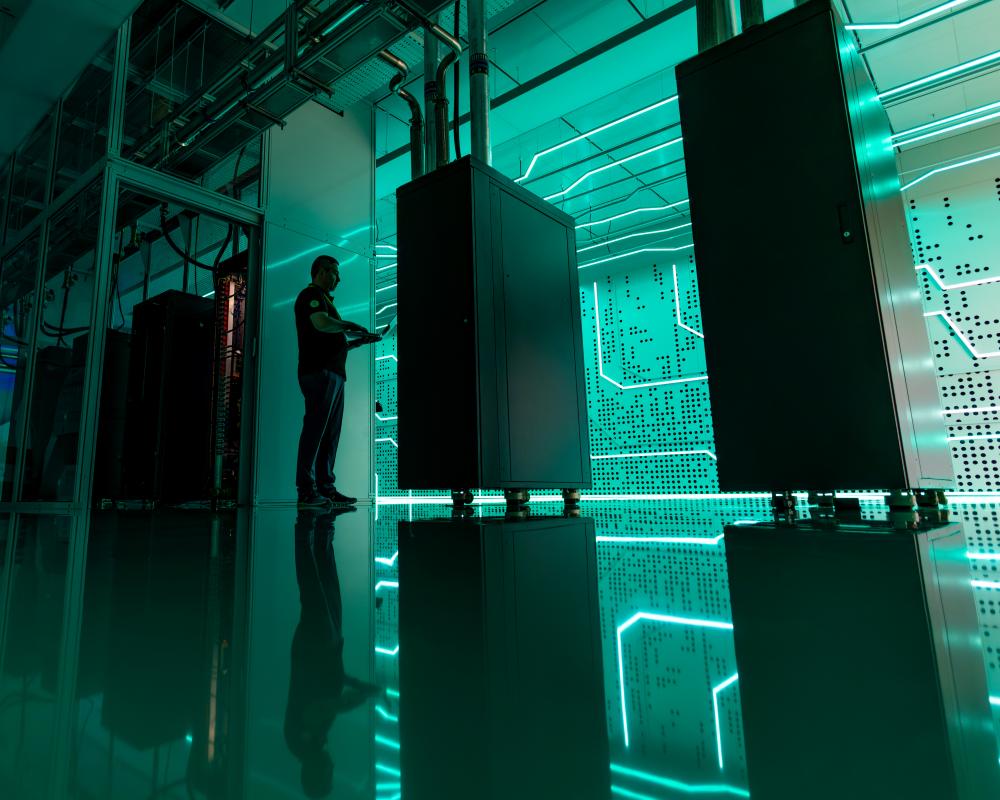
The rise of artificial intelligence is riding on the back of an enormous data center expansion. Data centers are projected to account for anywhere from 9 to 17 percent of total electricity usage in the U.S. by the end of the decade. Today, around a third of data center electricity is devoted to cooling the chips that run AI models. That’s the process Ferveret is working to make more efficient. The startup, founded by Reza Azizian, a former MIT postdoc in nuclear engineering, and Matteo Bucci, MIT’s Esther and Harold E. Edgerton Associate Professor in the Department of Nuclear Science and Engineering, is adapting an approach from nuclear reactors to cool chips using no water and significantly less electricity. The company’s cooling system submerges computer servers in a specialized liquid that absorbs heat much more efficiently than air from a fan. What makes the solution different from other liquid cooling systems are the bubbles: Ferveret’s Adaptive Phase Cooling (APC) solution produces much smaller bubbles at the surface of the server, which detach more frequently, accelerating the heat transfer process. Ferveret is already testing its solutions with companies including CleanSpark, the data center developer and operator, as well as FuriosaAI, an AI accelerator company, and Switch, one of the largest data center operators in the U.S. In a recent study in collaboration with the Samueli Computer Science Department at the University of California at Los Angeles, Ferveret found its APC solution led to a 15 percent improvement in computational power efficiency compared to state-of-the-art liquid cooling solutions. By combining those savings with Ferveret’s power control system to optimize operating conditions, the company says it allows data centers to get 35 percent more tokens — small pieces of text or data — from their AI models with the same amount of power. “Our goal is to make data centers as sustainable as possible and help them use every single watt of power to
In his 1927 paper, “A law of comparative judgment,” the American psychologist L. L. Thurstone proposed that when people select one option among multiple alternatives, they are picking the one that has the highest value to them, even though they cannot assign a particular number to that choice. Thurstone was a pioneer of “psychometrics” — a field built upon the premise that mental processes, which we cannot see, can nevertheless be measured and quantified. His 1927 paper laid the groundwork for what are now called random utility models, which provide a mathematical framework for describing human preferences — information that can be relied upon, in turn, to make predictions about various hypothetical situations. Random utility models (RUMs) are so named because they assess the “utility,” or benefit, that can be obtained from a given choice — such as deciding which book to read first among the stack of novels you brought back from the library. “These models are inherently random,” explains Gabriele Farina, an assistant professor in MIT’s Department of Electrical Engineering and Computer Science (EECS) and principal investigator at the Laboratory for Information and Decision Systems (LIDS), “because people are different. Everyone has their own preferences, and even those preferences can vary from time to time.” For example, someone who normally picks coffee over tea in the morning, and prefers tea after dinner, may, upon occasion, mix up that order entirely. RUMs, to be sure, are frequently used within government and industry in situations of far greater consequence than the selection of a hot (or iced) beverage. The models routinely facilitate predictions regarding what people will elect to do in so-called counterfactual (“what-if”) scenarios such as: How will they get to work or school if a major thoroughfare is shut down for construction? What routes and modes of transport will they take? Or, if a city suddenly receives a windfall of $20 million, how shou
Jinhua Zhao MCP ’04, SM ’04, PhD ’09 has been appointed head of the Department of Urban Studies and Planning (DUSP), effective July 1. Zhao is the Class of 1941 Professor of Cities and Transportation at MIT. In making the announcement, dean of the MIT School of Architecture and Planning Hashim Sarkis noted that Zhao is a renowned transportation planner, educator, and scholar, and a world leader in imagining and shaping better futures for mobility. “Jinhua is one of those rare scholars who moves seamlessly between cutting-edge research and real-world policy,” says Sarkis. “His work with governments and transportation agencies around the world is a model for what MIT’s impact can look like beyond our campus.” Zhao succeeds Professor Christopher Zegras, who has served as department head since 2020. Under his leadership, DUSP expanded opportunities for students to engage directly with communities and policymakers around the world and continued to strengthen its long-standing connection between research and practice. “I want to extend my gratitude to Chris Zegras for his excellent and level-headed leadership, especially in challenging times,” says Sarkis. After earning advanced degrees at MIT, Zhao joined the DUSP faculty. He says he found the Institute’s lack of conventionality and its culture of sharing ideas across disciplines stimulating. “MIT is a small school in the best sense of the word,” says Zhao. “We have fewer boundaries than other universities — intellectually and physically. Our ‘infinite corridor’ literally connects us to so many disciplines.” Shaping mobility systems worldwide That connectivity has been key for Zhao’s research and programs he has founded at MIT. Respected as a global authority on mobility, his research has been put into practice across some of the world's most complex mobility challenges. He and his team have shaped policy for Transpo
In May, the Initiative for New Manufacturing (INM) marked its first anniversary with MIT Manufacturing Week, four days of events that attracted more than 800 registrants including students, faculty, industry leaders, investors, entrepreneurs, and government officials to explore topics ranging from how companies are using AI on factory floors to the role of startups in introducing innovation to new workforce solutions to address the worker shortage. “INM launched a year ago with the premise that strengthening the industrial base needed a coordinated response, and MIT has a responsibility to lead it,” says Paula T. Hammond, dean of MIT’s School of Engineering and co-chair of INM’s Steering Committee. “The response and participation level has been huge. MIT Manufacturing Week proved that the appetite for change — from students to chief executives — is real and urgent.” The week opened with a cybersecurity workshop co-led by INM and Google Cloud for the initiative’s industry members. It continued with the MIT MIMO (Machine Intelligence for Manufacturing Operations) symposium focused on deploying artificial intelligence on factory floors, alongside discussions on workforce development, emerging technologies, startups, and industrial transformation. The week closed with a regional research showcase and competition that drew more than 140 graduate students and postdocs from across New England. Over the past year, INM has also continued its distinguished speaker series featuring manufacturing leaders including Keith Flynn, senior vice president of manufacturing at Anduril; Roland Busch, president and CEO of Siemens; and Venky Alagirisamy, COO of Nike. Inspiring a new generation of manufacturing startups A central goal of INM is to help more students see manufacturing as a frontier for scientific discovery, technological innovation, entrepreneurship, and societal impact. To support that effort, INM is launching and leading programs to help move early-stage ideas and ne
An auto factory worker can remember the storage bin where she left a partly assembled component the night before, and quickly return to that spot to pick it up. But robots that may work side-by-side with her would struggle to develop and access this same type of “spatiotemporal” memory. Now, MIT researchers have developed a long-term memory framework that allows robots to rapidly form and recall a detailed mental model of complicated, large-scale environments. In the future, this advance could allow the factory worker to send a robotic assistant to fetch the item, simply by asking it to “go and grab the component we started assembling last night.” This new method combines advanced map representations with rich descriptions of the environment that the robot gathers as it travels over a long period of time. The robot can quickly access this memory to answer complex queries about its environment in plain language. This memory framework, which answers questions more accurately than state-of-the-art methods, runs fast enough for a mobile robot to use in real-time. In addition to its potential uses in robotics, this method could have applications in augmented reality systems that aid maintenance workers in anomaly detection or assist commuters in wayfinding. “If we want robots to work side-by-side with humans and interact better with humans, they must speak the same language. The robot must be able to reason about time and space the same way humans do. That is essentially what our method is doing. It is turning a traditional map into a language-based map that is easier for the robot to think about and access using language,” says Luca Carlone, an associate professor in MIT’s Department of Aeronautics and Astronautics (AeroAstro), principal investigator in the Laboratory for Information and Decision Systems (LIDS), and director of the MIT SPARK Laboratory. He is joined on the paper by lead author Nicolas Gorlo, an MIT graduate student; and Lukas Schmid, a former research s
Whether you’re playing poker against a single opponent or find yourself in a bidding war over a home purchase with another prospective buyer, you are operating under conditions of imperfect information. You know what cards you’re holding in the poker game, and you also know how much above the home’s asking price you can afford, but you don’t know your opponent’s hand in the card game or how high the other home buyer is willing to go. A paper co-authored by MIT researchers and presented in April at the International Conference on Learning Representations in Rio De Janeiro won’t tell you what to do in these situations, specifically. But it does offer new insights into so-called imperfect-information games that involve two contestants facing off in a “zero-sum” competition, where one player’s gain means the other player’s loss. MIT researchers on the project include Sobhan Mohammadpour, a PhD student in MIT’s Department of Electrical Engineering and Computer Science (EECS) and the Laboratory for Information and Decision Systems (LIDS); and Gabriele Farina, an assistant professor in EECS and a principal investigator at LIDS. Additional co-authors include Max Rudolph of the University of Texas at Austin (UT), Nathan Lichtlé of the University of California at Berkeley (UCB), Alexandre Bayen of UCB, J. Zico Kolter of Carnegie Mellon University (CMU), Amy X. Zhang ’11, MNG ’12 of UT; Eugene Vinitsky of New York University; and Samuel Sokota of CMU. The focus of the new work is on algorithms that could be used to train neural networks to participate in imperfect-information games. The assumption, long-held in the field, was that algorithms grounded in principles of game theory would, in this setting, clearly outcompete a general-purpose variety of algorithms called policy gradient methods, which came into use for decision-making in the 1990s. The term “policy” in this context basically means strategy, whereas “gradient” refers to a path that leads in the directio
On June 9, The Boston Globe released its 2026 “Tech Power Players” list , recognizing 50 influential local leaders in technology and business across Massachusetts. The list includes eight MIT affiliates including President Sally Kornbluth, Prof. Daniela Rus (director of CSAIL), Prof. Regina Barzilay, Prof. Yet-Ming Chiang, Prof. Max Tegmark, Ana Bakshi (executive director of the Martin Trust Center for MIT Entrepreneurship), Katie Rae CEO and Managing Partner of Engine Ventures), and Senior Lecturer Brian Halligan, along with a number of MIT alumni. In addition to recognizing individual leaders, the Power Players coverage highlights MIT’s research labs, its culture of innovation and entrepreneurship, industry connections, new AI initiatives, and the Institute’s deep commitment to maintaining Massachusetts’ technological leadership. “Massachusetts can absolutely lead in this next wave,” says President Kornbluth , noting that the future is bright with burgeoning opportunities to advance technologies in fields from manufacturing, life and health sciences to quantum technologies and energy in service of Americans across the country. Advancing AI and entrepreneurship When it comes to AI, MIT is “working to drive artificial intelligence forward in sectors where the region is strongest, from biotechnology and robotics to defense and clean energy. It’s also trying to broaden entrepreneurship through a ‘dorm-to-startup’ push, creating a pipeline of support services — from hack-a-thons to venture funding — to help students to start companies between classes,” writes Robert Weisman for The Globe . Looking ahead, The Globe highlights how MIT aims to remain a central driver of AI advancement within higher ed. “President Sally Kornbluth is reinvigorating the school’s support of the local innovation ecosystem,” writes Aaron Pressman , noting how MIT is “unveiling new online classes dedicated to AI — with free entry-level classes for anyone — and encour
Companies working at the frontier of aerospace, energy, and computing are constantly looking for new materials to improve performance. But in order to understand how those materials will actually behave once they’re inside rockets or on computer chips, companies first have to make the material and then test it. That’s because even the most powerful simulation techniques struggle to model the complex chemical arrangements in most of today’s solid materials. The problem adds costs and time to materials innovation. Now a team of MIT researchers has created a way to accurately model the behavior of metals, regardless of the complexity of their chemical arrangement. At the center of the approach are machine-learning models that make simulations of materials faster and more accurate. The researchers improved those models by building training datasets that capture the diversity of atomic environments in chemically disordered materials. In a new paper in Sciences Advances , the researchers showed their approach could be used to accurately predict material properties for a diverse group of metal alloys under a range of conditions. They also showed how the approach could be used to develop new materials, especially in scenarios where experimentation is expensive. “The focus of the paper is metallic alloys, which is the field I work in, but this could be adapted to other types of materials, like semiconductors,” says senior author Rodrigo Freitas, MIT’s TDK Career Development Professor in Materials Science and Engineering. “This is not specific to any one application — you could use this approach to create new sustainable steels, new materials for aerospace, and more. That’s what makes this exciting.” Joining Freitas on the paper are first author Killian Sheriff PhD ’26; MIT PhD students Daniel Xiao and Yifan Cao; and University of Sheffield Senior Lecturer Lewis R. Owen. Modeling metals Material properties are mostly determined by the internal arrangement of their chemical el
A new chip developed by MIT researchers could help tiny, low-power UAVs avoid obstacles as they zip around tight corners inside an industrial HVAC system to check for gas leaks. The chip allows small autonomous robots and other battery-limited devices to construct detailed 3D maps of their environments in real-time using only about as much power as a single LED. A robot could use such a map to plan a collision-free path to reach its goal. Typically, generating such thorough maps requires power-hungry systems and a great deal of memory to build and store 3D representations of the obstacles in a robot’s environment. The MIT researchers took a different approach by combining an extremely efficient mapping algorithm with specialized hardware designed to accelerate its workload, which minimizes memory and power consumption. This system-on-a-chip consumes only about 6 milliwatts of power, a fraction of the power required by other systems. This low-power operation could also make the chip well-suited for lightweight augmented reality headsets that can be worn for extended periods, for applications like educational medical simulation or detailed repair and assembly work. “This paper showcases a key example of how you can leverage co-design of the algorithm and hardware to really push energy efficiency. While there has been a lot of work looking into compact 3D maps, what stands out about this work is that it also ensures that the process to generate those maps is as efficient as possible. Our chip allows you to store very large maps in a very small space, and do it in a very energy efficient manner,” says Vivienne Sze, a professor in the Department of Electrical Engineering and Computer Science (EECS), a member of the Research Laboratory of Electronics (RLE), and senior author of a paper on the chip . She is joined on the paper by co-lead authors and MIT graduate students Zih-Sing Fu and Peter Zhi Xuan Li as well as Sertac Karaman, a professor of aeronautics and
At the recent AI and Society Forum at MIT , experts from across the Institute discussed the potential benefits and dangers of technological innovation on labor, the nature of work, civil discourse, election administration, and other topics. The event featured individual research presentations and panel discussions, as well as a musical performance exploring the use of generative artificial intelligence in the arts. The forum was co-organized by the School of Humanities, Arts, and Social Sciences (SHASS) and the Social and Ethical Responsibilities of Computing (SERC). It was presented in collaboration with two of MIT’s strategic initiatives: the MIT Generative AI Impact Consortium (MGAIC) and the MIT Human Insight Collaborative (MITHIC). Agustín Rayo , the Kenan Sahin Dean of SHASS, and Dan Huttenlocher , dean of the MIT Schwarzman College of Computing, provided opening remarks. Rayo said bringing scholars from across MIT together was intentional because understanding AI’s impact requires expertise from disciplines throughout the Institute. “Paying attention to the societal consequences of AI is not a departure from MIT’s mission; it’s a way of ensuring that our technical leadership has maximum impact,” Rayo said. Huttenlocher added that computing and AI’s rapid growth makes it critical to support interdisciplinary conversations and research. “Understanding where AI excels and where it falls short is essential not only to unlocking its benefits, but also to avoiding critical errors, overreliance, and unintended consequences,” Huttenlocher said. Jobs and AI Held in the Tull Concert Hall in MIT’s Linde Music Building, the May 12 forum opened with a keynote presentation from economist David Autor , the Daniel (1972) and Gail Rubinfeld Professor in the MIT Department of Economics. Autor challenged the common narrative that AI will simply eliminate jobs by proposing instead that technology's impact depends on how it affects th
Agentic workflows are artificial intelligence-powered software systems that chain together multiple models and external tools to tackle complicated tasks, like analyzing a video and answering questions about it. But the way these highly fragmented systems are designed and deployed often causes inefficiencies that can lead to wasted computation, energy, and cost. To improve efficiency, researchers from MIT and Microsoft developed an intelligent system that streamlines the process of designing agentic workflows and automatically optimizes how those workflows are implemented. With this new method, a developer can describe what they want the agentic workflow to do in plain language, without needing to specify all the details of their application in advance. The system automatically figures out the best models and tools to use, as well as the ideal hardware configuration and computational resource allocation when the workflow is executed by a cloud provider. It adjusts those configurations on the fly based on each user’s priorities, such as minimizing costs or maximizing speed. When tested on several agentic workloads, this new system reduced the number of computational units needed for deployment, significantly cutting energy requirements and costs compared to traditional approaches without hampering performance. “Agentic workflows are getting very complicated and quickly becoming the backbone of what cloud providers are doing. Energy usage is a huge concern, so we need to be very careful about how efficient these workflows are. It is very easy to over-allocate resources, wasting energy and money. Enabling a cloud provider to intelligently make these workflows more resource-optimal is a win for everyone involved,” says Gohar Chaudhry, an electrical engineering and computer science (EECS) graduate student and lead author of a paper on this system . He is joined on the paper by Adam Belay, an associate professor of EECS and a member of the MIT Computer S
Over the past 80 years, America’s bold, sustained investment in scientific research, and the discoveries, ideas and innovations that flowed from it made America a world leader. The nation’s scientific leadership has been essential to our shared prosperity and national security, and delivered real benefits for all Americans. On June 16, Scientific American released a special section, “ The Young American Scientists ,” which celebrates early-career professionals actively engaged in scientific research, and features commentary from MIT faculty on why they continue to be so devoted to curiosity-driven science, demonstrating how their hard work and dedication make Americans safer, healthier, and more prosperous. Among the section’s profiles are many MIT faculty, students, and alumni, who share their advice for young scientists and their reasons for optimism in uncertain times. President Sally Kornbluth emphasizes the importance of curiosity-driven research, noting that discovery “is part of our American DNA and has yielded vast returns to the citizens of this country and the world.” She adds, “what’s needed is a rededication to public investment in American science. Even if I were not the leader of a premier scientific institution, this is what I’d say. Investing in American science is not a gamble; if you look back in time, there is no question about the benefits.” Adds Institute Prof. Robert Langer : “What American science has done over the past 50, 100 years has been remarkable.” Scientific American notes that at MIT, that commitment to discovery is reflected in initiatives such as Curiosity on a Mission and the Generative AI Impact Consortium , which are aimed at finding “solutions to real-world problems in a way that is beneficial to society.” “On one hand, we’re at a time, technologically, where things could not be more exciting [and] our science [could not be] more cutting-edge. At the same time, we’ve never seen a situation where people felt so uncertain a
Imagine working at a warehouse or office sometime in the near future, and you’re asked to help a new trainee learn the basics of their job. The catch: It’s a robot. To teach them, you might want to play a game of “show and tell” — that is, physically showing how to do something a few different ways, while also explaining what you’re doing. Let’s say you asked the robot to place some coffee on your desk without disturbing you during a Zoom call. You’ll prefer that the robot doesn’t get too close to you and the laptop so that it doesn’t interrupt your meeting. To enable this behavior, the robot should be trained with data that clearly demonstrates the full task. Computer scientists have attempted to explain manipulation tasks to robots by recording lots of physical demonstrations or writing extensive directions. But if you don’t have both, the machine is likely to misunderstand what it needs to do. It’s laborious for humans to do all that showing and telling, so researchers at MIT’s Computer Science and Artificial Intelligence Laboratory (CSAIL) have automated the process of teaching a robot, while clarifying instructions automatically and using nearly five times less demonstration data. Their “Masked Inverse Reinforcement Learning” (Masked IRL) approach uses a large language model (LLM) to elaborate on ambiguous prompts based on the data collected from a user’s demo. Another LLM then narrows down which details an algorithm should incorporate into a motion plan, so that a robot can safely complete chores in homes, offices, and factories. “Our approach could come in handy when a human interacts with a robot but doesn’t want to spell out all the details of a task,” says MIT PhD student and CSAIL researcher Minyoung Hwang, who is a lead author on a paper presenting the project. “We’re minimizing human effort by enabling machines to get to the bottom of what users really want.” According to Hwang, Masked IRL can help robots safely maneuver in settings where there ar