Cybersecurity researchers have disclosed details of a two-pronged artificial intelligence (AI)-augmented initial access campaign targeting WordPress sites, e-commerce platforms, and critical infrastructure entities in Ukraine.
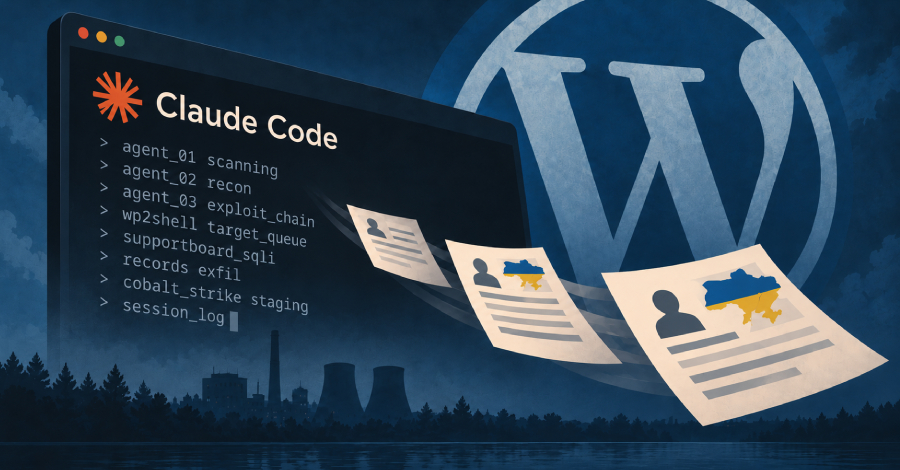
The activity, which brings together commodity offensive tools like Cobalt Strike with an AI orchestration layer powered by Anthropic's Claude Code, has been attributed to a Russian-speaking, financially motivated initial access broker codenamed CyberXero. The threat actor is assessed to be active since at least July 2026.
"The operation runs two pipelines at once: a global, automated campaign against WordPress and e-commerce platforms, and a curated, manual campaign against Ukrainian energy and critical infrastructure," SOCRadar said in a report published last week.
The global campaign specifically focuses on known security flaws like wp2shell (CVE-2026-63030 and CVE-2026-60137) and CVE-2026-4815, an SQL injection vulnerability impacting the Support Board WordPress plugin, to seize control of WordPress sites.
The campaign is estimated to have resulted in confirmed exfiltration from four Ukrainian organizations, leading to the harvesting of more than 628,000 records tied to Ukrainian individuals. Other confirmed compromises have occurred in Poland, China, and the Netherlands.
SOCRadar said it discovered the operation after it identified an exposed open directory hosted at "46.21.250[.]135" that leaked the threat actor's live working directory associated with a Linux workstation, including AI session logs, scripts with plaintext tokens, exploitation toolkits, reconnaissance output, AI agent configurations, and exfiltrated victim data. The campaign remains ongoing.
The opportunistic campaign aimed at WordPress and e-commerce platforms is designed for access and payment data, while the second campaign is a lot more targeted and geared towards deep reconnaissance and manual exploitation against Ukrainian energy and utilities, including a heating provider in Kharkiv.
Source link