This article has been reviewed according to Science X's editorial process and policies. Editors have highlighted the following attributes while ensuring the content's credibility:
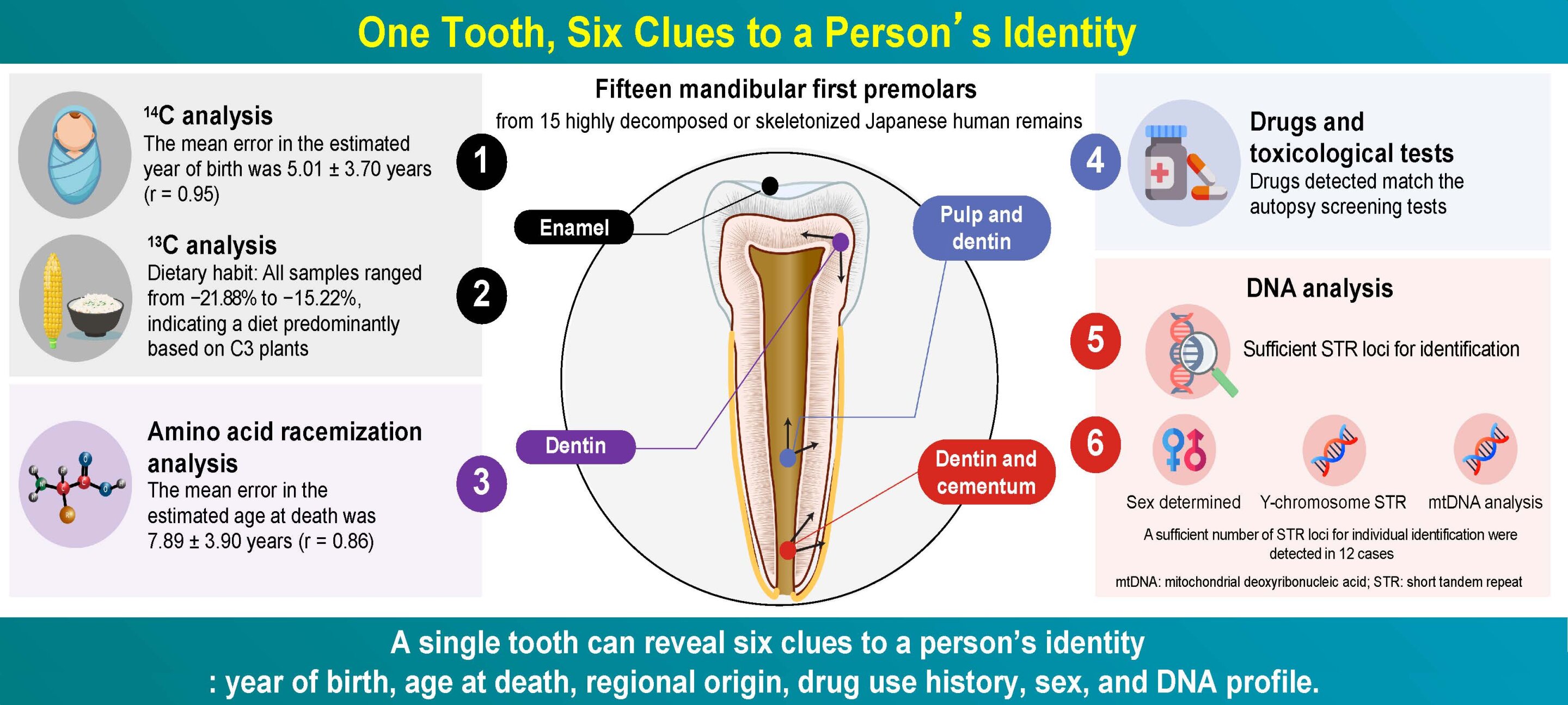
A single tooth can contain valuable clues to a person's identity, even when remains are severely decomposed or reduced to bones, according to a study by researchers at the Institute of Science Tokyo. By applying multiple forensic methods to different tissues within a single tooth, the researchers obtained six types of information about the deceased. This integrated approach could provide complementary evidence to help identify unknown human remains when conventional methods are difficult to apply.
Identifying human remains can be challenging when a body is severely decomposed or reduced to just a skeleton, as evidence used in conventional identification may no longer be available. In such cases, bones and teeth have been the samples of choice for identification of the deceased. Although bones can provide valuable forensic information, certain analyses may be affected by environmental exposure and postmortem changes. In contrast, teeth contain enamel, the hardest tissue in the human body, which is highly resistant to decomposition and can preserve biological and chemical information over long periods.
Previous research by a Dutch forensic research group demonstrated that multiple types of forensic information could be obtained through a multidisciplinary analysis of teeth and toenails. Building on this approach, the present study investigated whether six types of forensic information could be obtained from a single tooth, even in cases involving severely decomposed or skeletonized human remains.
Extending previous research to challenging forensic cases involving advanced postmortem changes, a study led by associate professor Hisako Saitoh and doctoral student Sayaka Yamada of the Department of Forensic Dentistry at the Graduate School of Medical and Dental Sciences, Institute of Science Tokyo (Science Tokyo), Japan, along with professor Fuyuki Tokanai of the Center for Accelerator Mass Spectrometry at Yamagata University, explored the range of information that a single tooth could provide.
Source link