This article has been reviewed according to Science X's editorial process and policies. Editors have highlighted the following attributes while ensuring the content's credibility:
A research team from the Faculty of Dentistry at The University of Hong Kong (HKU), working in collaboration with Su Ryon Shin's group at Brigham and Women's Hospital, Harvard Medical School, has advanced and preclinically validated a shape-adaptive hydrogel designed for challenging clinical trauma scenarios involving severe bleeding, irregular bone defects and comminuted fractures.
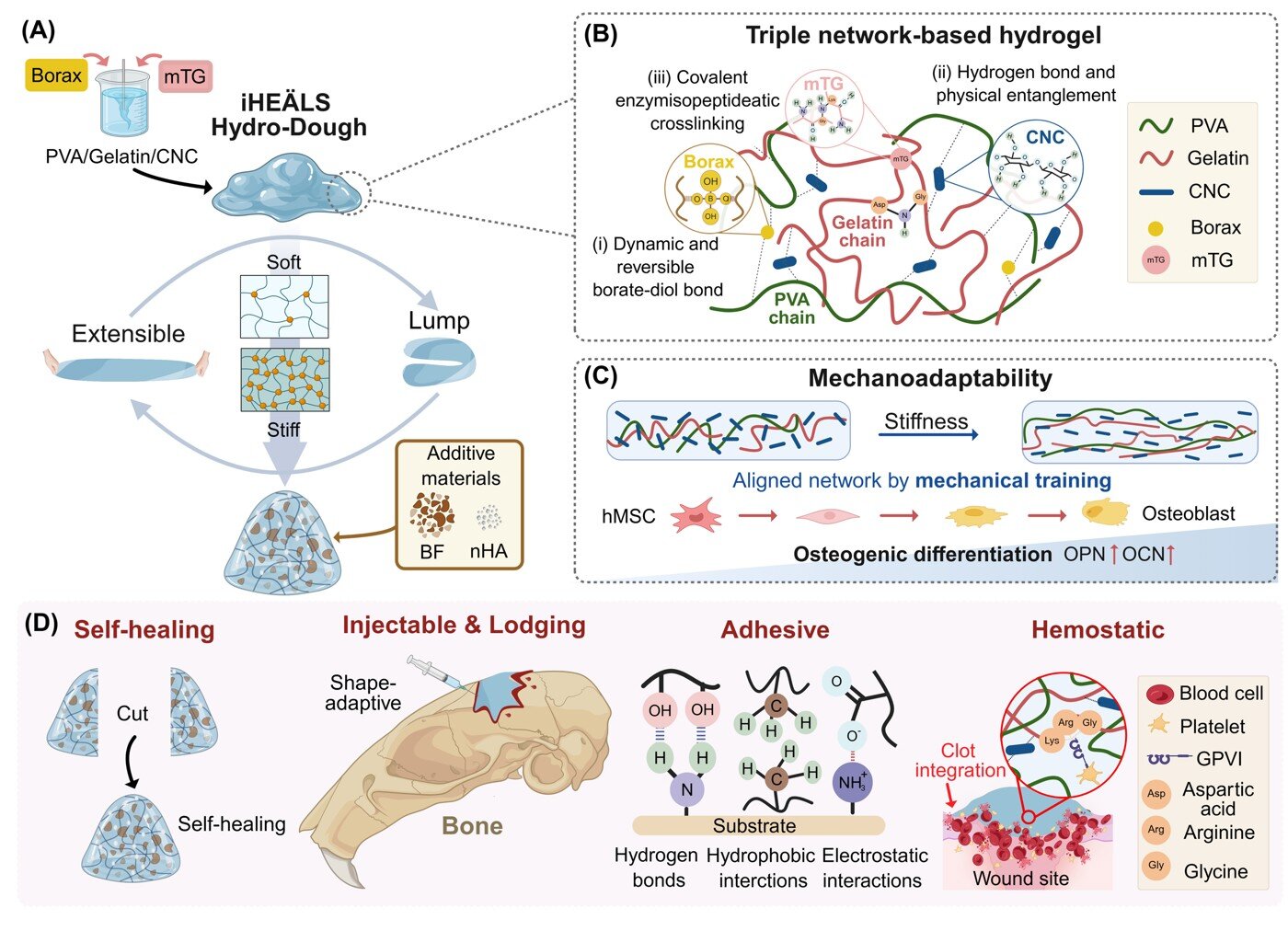
The findings, published in Advanced Materials, demonstrate the potential of the novel biomaterial, named iHEÄLS, as a versatile platform for complex craniomaxillofacial reconstruction.
Inspired by the familiar malleability of Play-Doh, the hydrogel can be shaped and adapted to irregular anatomical defects while combining rapid hemostasis, strong tissue adhesion, self-healing capability and mechanical resilience—properties that are particularly relevant to emergency trauma care.
The HKU research team was led by Sang Jin Lee, an assistant professor of biofunctional materials in the Division of Applied Oral Sciences and Community Dental Care at the HKU Faculty of Dentistry. The iHEÄLS platform was developed through a collaborative effort between the HKU and Harvard teams.
Shin's team at Harvard led the invention and material engineering of the hydrogel platform, while the HKU Dentistry team further developed and established its potential clinical applications, particularly for complex craniomaxillofacial trauma, and led the corresponding preclinical functional validation.
The collaboration was driven by a clinically oriented question: how can a biomaterial be applied in situations where conventional reconstructive materials are difficult to use because of active bleeding, wet and damaged tissue surfaces, highly irregular defects and fragmented bone?
Source link