This article has been reviewed according to Science X's editorial process and policies. Editors have highlighted the following attributes while ensuring the content's credibility:
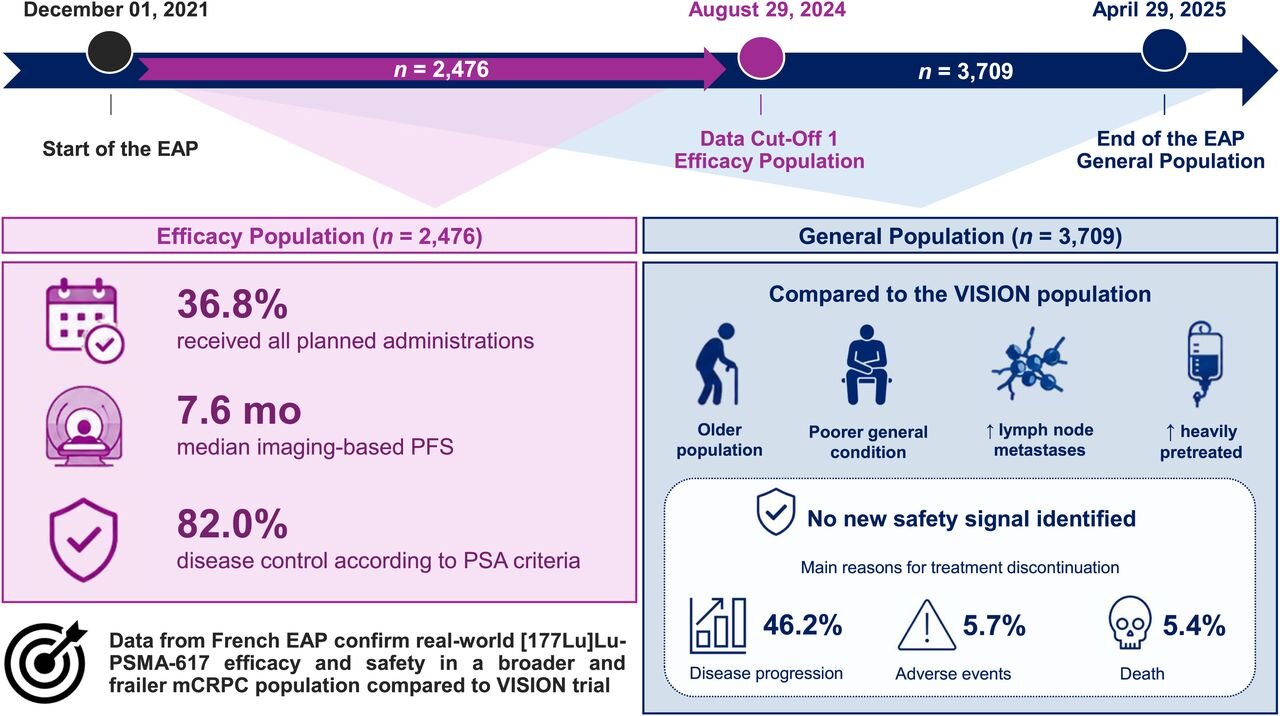
Prostate-specific membrane antigen (PSMA)-targeted radiopharmaceutical therapy is safe and effective for patients with metastatic castration-resistant prostate cancer (mCRPC) in routine clinical practice, consistent with outcomes from the VISION trial. An analysis of outcomes from a French early-access program, the largest real-world cohort of patients studied to date, confirms the benefit-risk profile of the therapy, while also shedding light on patient selection and use trends. This research was published in The Journal of Nuclear Medicine.
PSMA-targeted radiopharmaceutical therapy has emerged as a treatment modality for mCRPC patients whose disease has progressed after receiving standard therapies. It was studied extensively in the VISION clinical trial, and in 2022, ¹⁷⁷Lu-PSMA-617 became the first radiopharmaceutical therapy approved to treat prostate cancer.
"Although the VISION clinical trial demonstrated the safety and efficacy of ¹⁷⁷Lu-PSMA-617 in a selected population, there is a need for complementary real-world data to understand its use and outcomes in routine clinical practice among broader and more diverse patient populations," said Clément Bailly, M.D., Ph.D., a nuclear medicine physician at Nantes University Hospital in France. "France's early-access program provided a valuable opportunity to evaluate the safety and efficacy of ¹⁷⁷Lu-PSMA-617 in a real-world setting."
From December 2021 to April 2025, the early-access program enrolled 3,709 patients with mCRPC across 46 centers in France. All patients had progressive disease after receiving at least one standard treatment. Through the early-access program, the patients received up to six cycles of ¹⁷⁷Lu-PSMA-617.
Source link