This article has been reviewed according to Science X's editorial process and policies. Editors have highlighted the following attributes while ensuring the content's credibility:
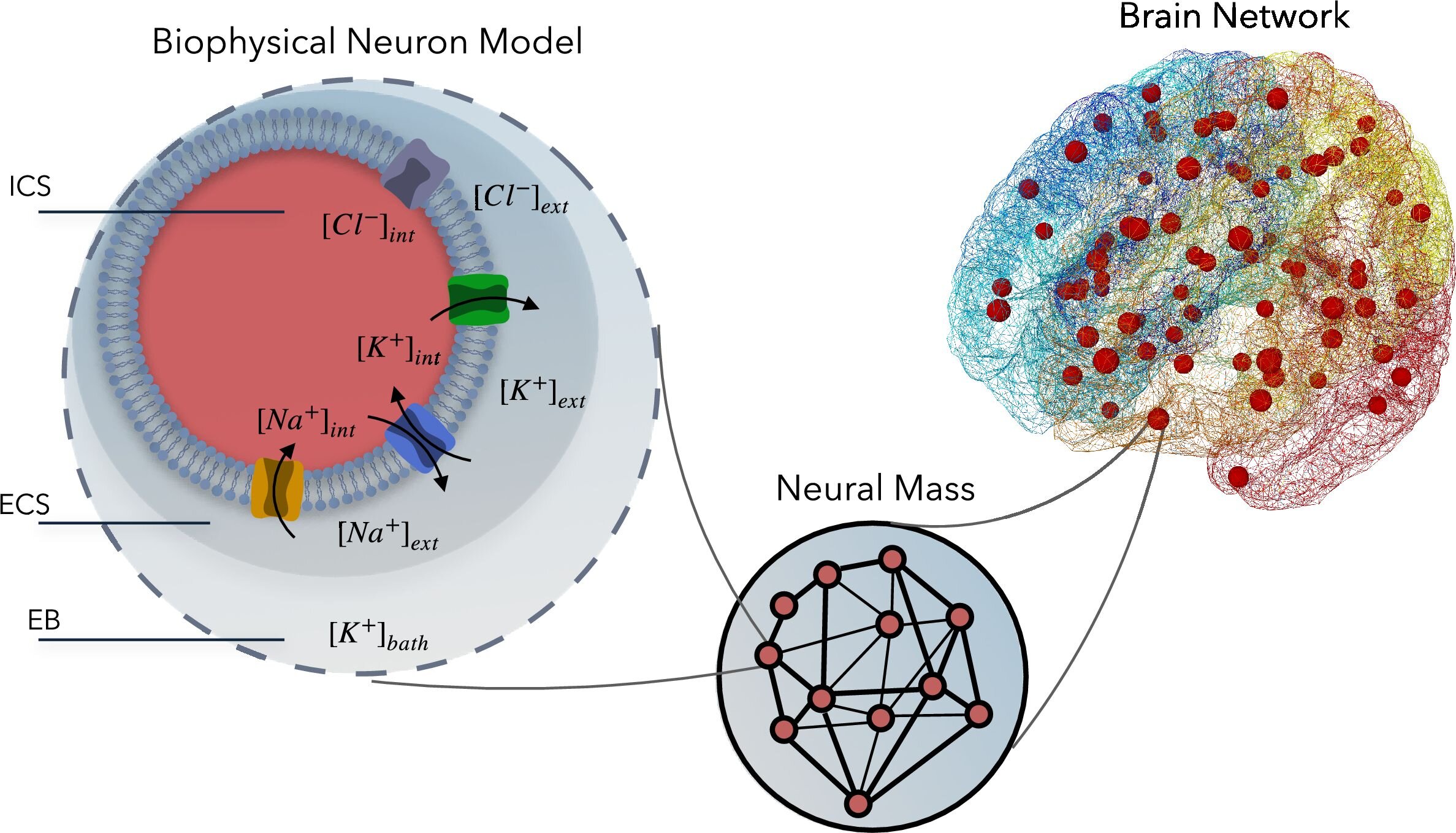
Mean-field models are a powerful tool for understanding collective brain activity. A new model extends this approach by incorporating the exchange of ions between neurons and their surroundings, bringing important biological mechanisms into simulations of neuronal populations.
How can researchers simulate the activity of the whole brain without modeling every neuron in full detail? A new study, published in eLife, explores one part of the answer: retaining key biological mechanisms while simplifying the mathematics needed to model large neuronal populations.
The brain's electrical activity depends on the movement of charged particles, called ions, across cell membranes and through the fluid surrounding neurons. These processes also influence one another: changes in ion concentration can affect how neurons fire and, in some circumstances, contribute to abnormal brain activity, including epileptic seizures.
Capturing these interactions in large-scale computer simulations is challenging. Simulating many individual neurons in detail can be computationally demanding. Researchers therefore often use "mean-field models," which approximate the collective behavior of a neuronal population using a smaller set of mathematical equations.
In this study, researchers from France, Spain and Finland present a new mean-field model derived from a network of Hodgkin–Huxley-type point neurons. These are mathematical models that describe how electrical signals arise from the movement of ions across neuronal membranes. The new model uses a simplified description of neuronal populations while retaining equations for ion exchange between the inside of cells and the surrounding extracellular space.
Source link