This article has been reviewed according to Science X's editorial process and policies. Editors have highlighted the following attributes while ensuring the content's credibility:
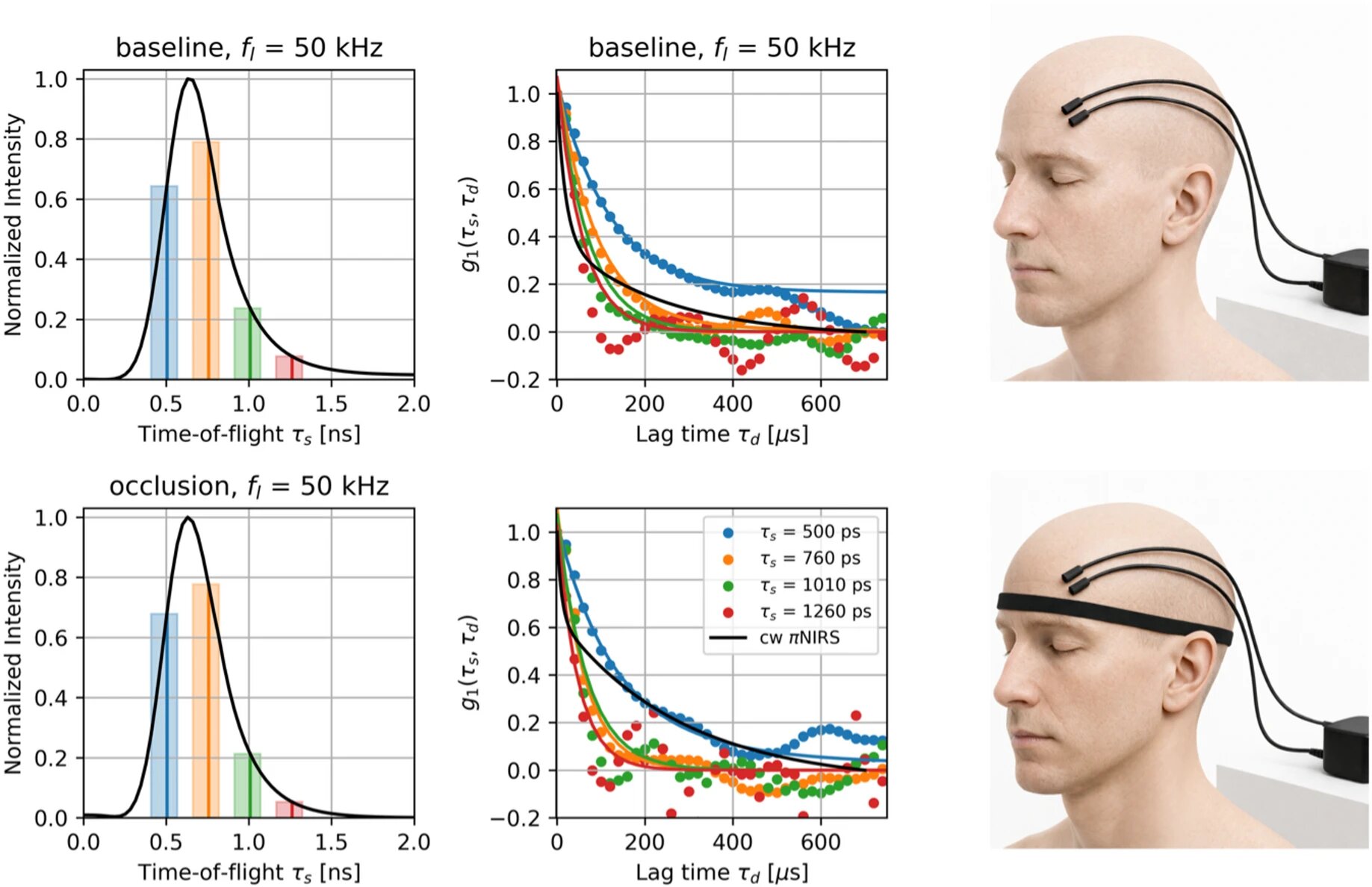
How can we efficiently collect light returning from tissues while also identifying what it tells us about blood flow in the deeper tissues? Conventional interferometric near-infrared spectroscopy (iNIRS) can distinguish signals according to the amount of time that light takes to travel through tissue, but it collects only a few photons. Camera-based systems capture many more photons, but this distinction is not realized when living tissue changes rapidly. Researchers associated with ICTER combined both approaches in a hybrid system. They showed that an appropriately analyzed camera signal can reproduce the blood-flow response observed with iNIRS for late-arriving photons, which are more sensitive to deeper tissues.
When blood flow is measured optically at the forehead, the detector receives mixed information. Some comes from circulation in the scalp, while some comes from deeper tissues. This makes it difficult to determine what an observed change really tells us about the brain's blood supply.
The problem was investigated by Marcin Marzejon, Ph.D., Eng., who previously worked at the International Centre for Translational Eye Research (ICTER) at the Institute of Physical Chemistry of the Polish Academy of Sciences, and Dawid Borycki, Ph.D., DSc, leader of the PICO group. Their paper "Hybrid interferometric near infrared spectroscopy (hybrid iNIRS) enables time-of-flight–resolved non-invasive blood flow monitoring in humans in vivo" is published in Scientific Reports.
The authors built a hybrid system that enables information about blood-cell motion to be considered during the time it takes for light to travel through tissue.
Source link