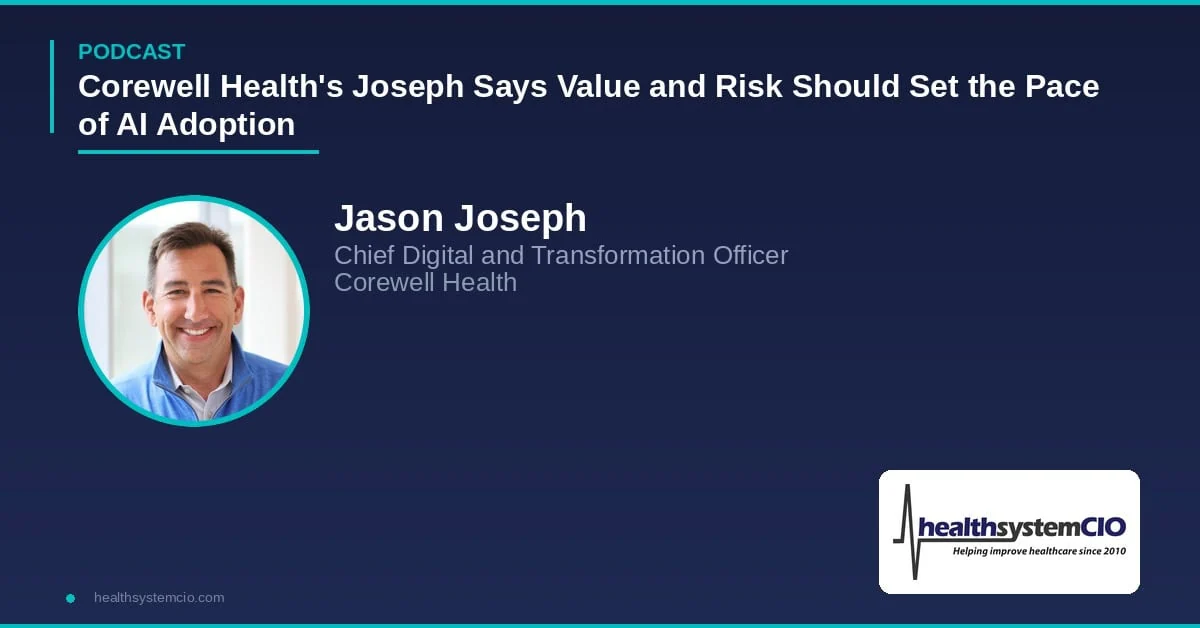
Corewell Health’s Jason Joseph explains how he weighs an AI use case’s value against its risk, and why human attention fades as AI improves. Watch below or on YouTube.
Health systems control how fast AI spreads through their organizations, and the test for that pace should be the value a use case produces weighed against its risk, according to Jason Joseph, chief digital and transformation officer at Corewell Health. Speaking on a recent episode of the healthsystemCIO Show, Joseph said the catch is that most high-value use cases require high automation, which carries high risk. He will take up the question at the CHIME26 Fall Forum in a Nov. 12 session titled “Who Decides the Pace of AI—and Who Is Accountable When It’s Wrong?” Michigan-based Corewell Health operates 22 hospitals and a health plan with about 1.4 million members. Joseph’s role now also includes the system’s transformation and acceleration office.
A health system sets the pace of AI through its processes and policies, Joseph said. Leaders choose how much to ease the path for new tools and which guardrails to install. As a result, they can throttle activity up or down and screen out the most dubious ideas. About two years ago, for example, someone pitched a chatbot that could talk to patients, and Corewell’s health plan was interested in using it for triage. Joseph asked whether anyone had evaluated its risk. Some proposals, he said, have to be stopped because of risk.
“The risk is the brakes, and the value is the gas,” Joseph said.
Source link