This article has been reviewed according to Science X's editorial process and policies. Editors have highlighted the following attributes while ensuring the content's credibility:
As they age, many individuals can struggle to remember recent events or what they meant to say next during a conversation, while also frequently losing or misplacing objects. In some cases, cognitive tests detect these memory impairments. In others, people notice and report a decline even though their test scores remain within the normal range.
The term mild cognitive impairment (MCI) refers to measurable difficulties with memory or other thinking skills in people who remain largely independent in daily life. Subjective cognitive decline (SCD), on the other hand, is a perceived decline despite normal performance on standard cognitive tests. Understanding the neural underpinnings of both could potentially help researchers develop and test interventions for cognitive decline.
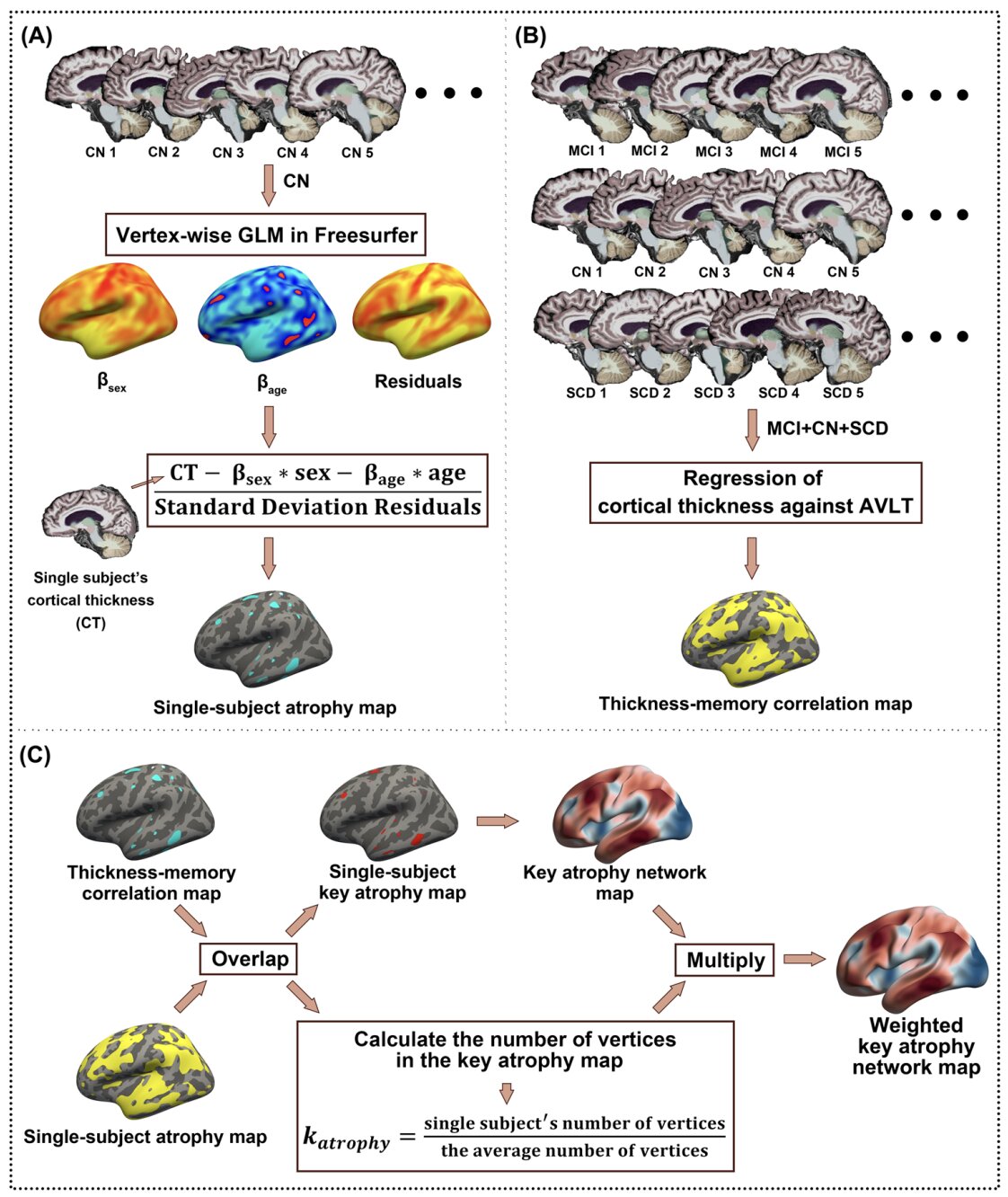
Researchers at the Affiliated Brain Hospital of Nanjing Medical University, Nanjing University and other institutions recently compared brain scans and memory test scores using data collected from more than 1,000 people. Their paper, published in Translational Psychiatry, suggests that different areas of cortical thinning in people with MCI could map to a shared memory network, while the same pattern was not statistically significant in people with SCD.
The researchers analyzed data from 1,312 people across three independent cohorts, including brain scans and scores on tests assessing episodic memory, the ability to recall specific events or experiences. They used structural magnetic resonance imaging (MRI) to measure cortical thickness and a reference map based on resting-state functional MRI (fMRI) to estimate how activity in different brain regions typically varies together.
Source link