This article has been reviewed according to Science X's editorial process and policies. Editors have highlighted the following attributes while ensuring the content's credibility:
The brain uses motion signals to predict the current position of an object, enabling us to respond promptly and accurately. But how does the brain use motion information to predict an object's position and generate visual awareness? The causal relationship between neural activity in the primary visual cortex (V1) and visual awareness has long been controversial.
A new study by professor Zhang Peng's team from the Institute of Biophysics of the Chinese Academy of Sciences (CAS), together with collaborators, provides evidence that feedback signals expressed in V1 are necessary for visual awareness of an object's "predicted" current position. The researchers identified a critical role for these feedback signals in visual awareness by combining a visual position illusion with experiments involving patients with different types of visual pathway damage.
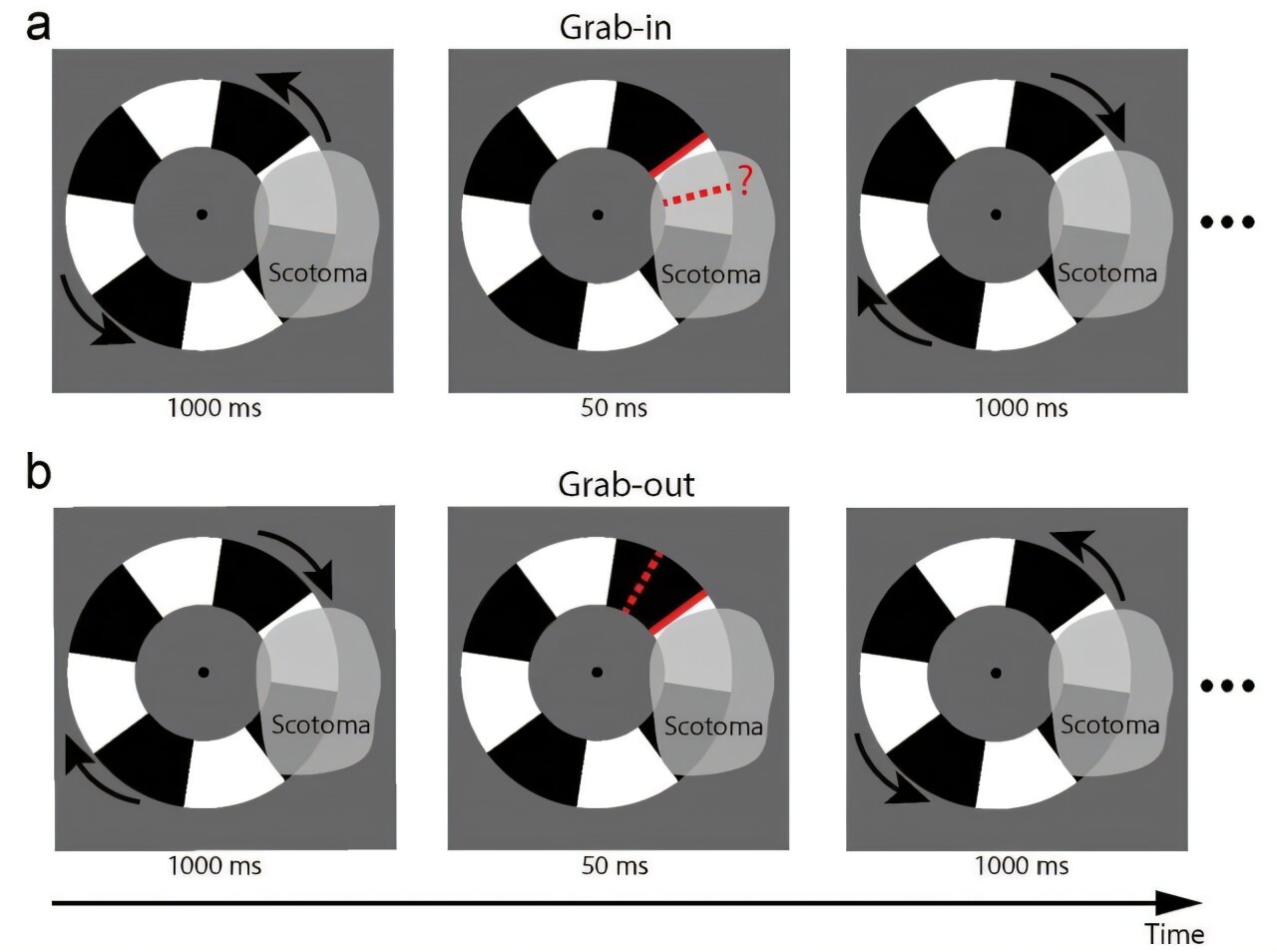
The researchers used the flash-grab effect (FGE) to dissociate an object's physical position from its perceived position. They conducted experiments in hemianopic patients with V1 lesions, hemianopic patients with damage to the optic radiation (the white matter tract from the visual thalamic LGN to V1), and healthy participants.
In the Grab-in condition, patients with V1 lesions could not see the red bar when the illusion displaced it into their blind visual field, or scotoma. They could only see it when it was moved farther outward, beyond the scotoma boundary. However, in the Grab-out condition, they could see the bar when it appeared in their intact visual field.
Source link