This article has been reviewed according to Science X's editorial process and policies. Editors have highlighted the following attributes while ensuring the content's credibility:
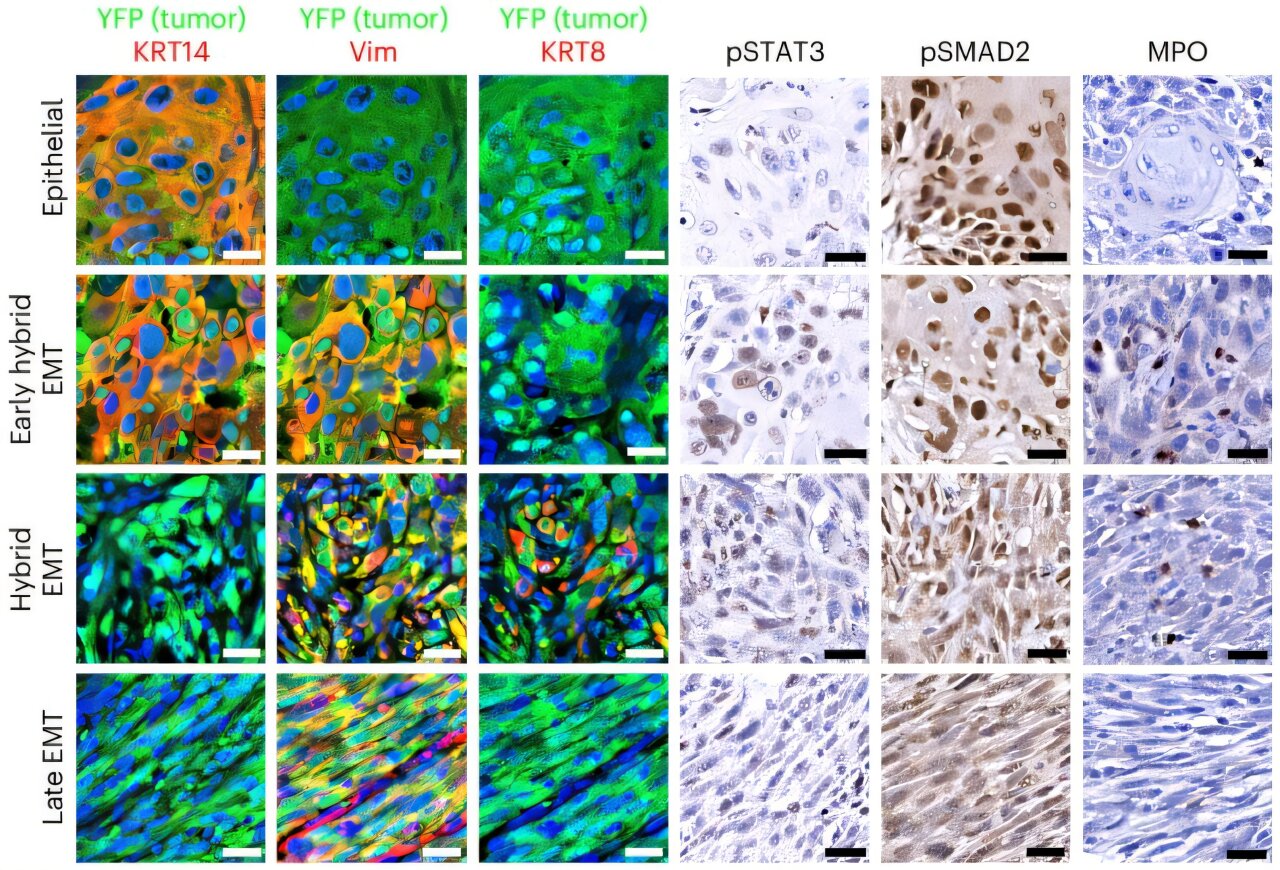
Most cancer deaths are not caused by the original tumor, but by metastases, which form when cancer cells leave the original tumor and spread to other organs. To do so, cancer cells must loosen their attachment to other cancer cells and become more mobile so they can move away from the tumor, a process called epithelial-to-mesenchymal transition, or EMT. EMT is a progressive phenomenon, and cancer cells go through an intermediate "hybrid" stage that is the best at forming metastases.
Researchers at the Université libre de Bruxelles (ULB) have discovered that immune cells build distinct "neighborhoods" around cancer cells. In one of these neighborhoods, immune cells communicate with cancer cells to promote their ability to spread to distant organs and mediate metastasis formation.
The research, which could eventually help develop new therapies to target metastasis, is published in the journal Nature Cancer. It was led by Cédric Blanpain, M.D., Ph.D., an investigator at the WEL Research Institute, director of the Laboratory of Stem Cells and Cancer and professor at the Université libre de Bruxelles.
Tumors contain cancer cells as well as normal cells and blood vessels, which usually help cancer cells grow. The researchers wanted to know which normal neighboring cells surround cancer cells during EMT and how these normal cells communicate with cancer cells to give rise to metastasis.
Like a city divided into districts, each with its own residents, the tumor is organized into distinct neighborhoods.
Source link