
Mercedes is developing new technology to constantly provide a voltage of 800 volts in electric vehicles. With current technology, the system voltage is directly dependent on the state of the battery cells. In the future, Mercedes wants to use a so-called Power Converter that bypasses this dependency through individual micro-converters per cell unit.
Mercedes has announced a new architecture for electric vehicles that uses advanced power electronics to decouple the high-voltage supply from the battery’s state of charge.
In conventional electric vehicles, the system voltage is determined by the number of battery cells connected in series. As the state of charge decreases, this voltage drops during operation. Ageing or weakened cells also impair the performance of the entire battery pack.
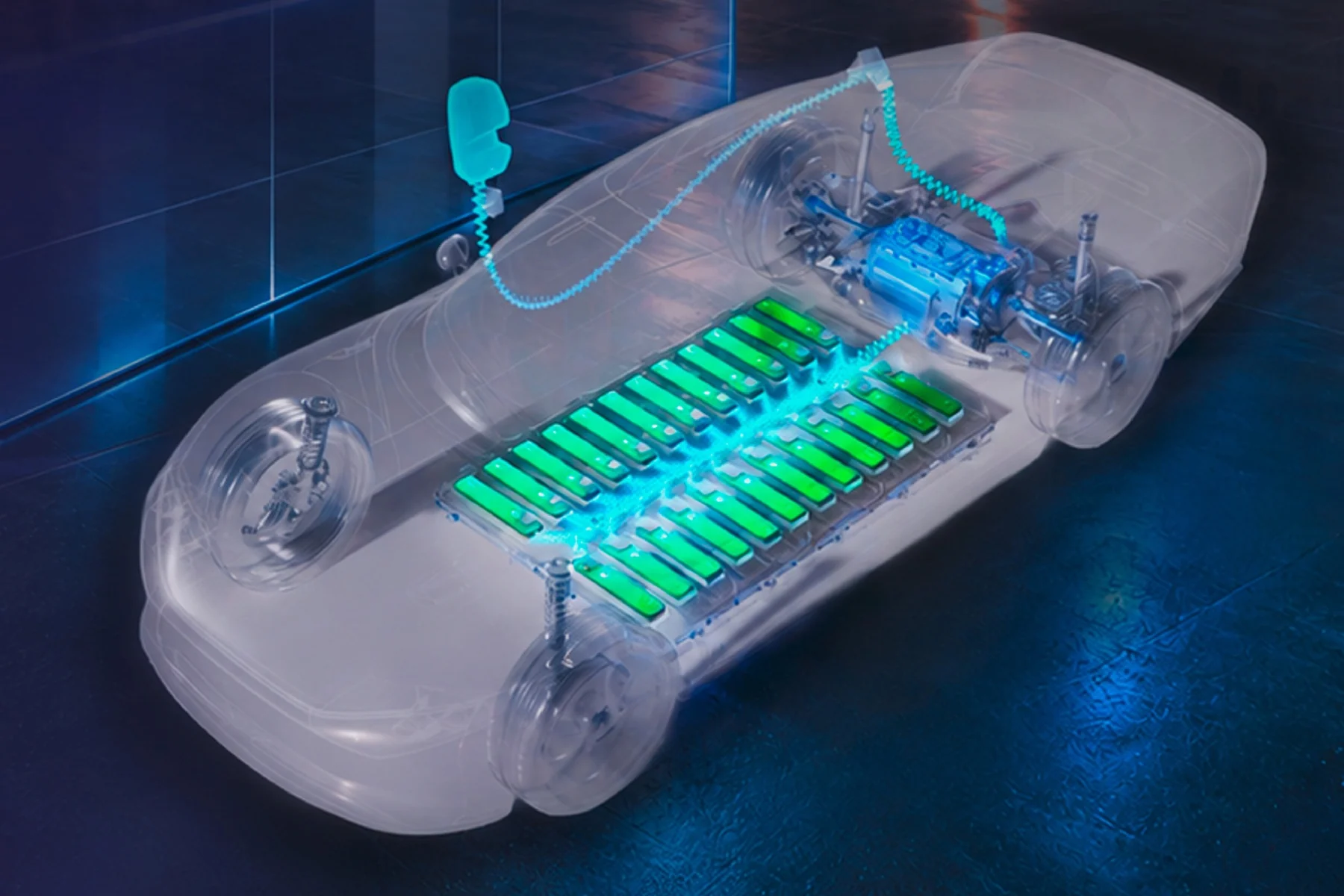
Mercedes’ Power Converters function as individual decentralised microconverters, controlling individual battery cells or cell clusters. Multiple parallel-connected Power Converters coordinate energy flows and prevent voltage fluctuations by maintaining a stable DC high-voltage supply.
The control system selectively relieves weaker cells, increasing overall efficiency. Functions such as AC and DC charging, as well as bidirectional charging, can be integrated into the electronic devices. The converter has a power output of up to three kilowatts.
The main advantage of this design lies in the consolidation of previously separate components. Since the new microconverters can handle the conversion of AC and DC voltage directly, the conventional, separate on-board charger (OBC) can be omitted from the vehicle. This saves weight, space and production costs.
At the same time, the traction inverter always receives a constant input of 800 volts and no longer needs to be designed for fluctuating input voltages.
Source link