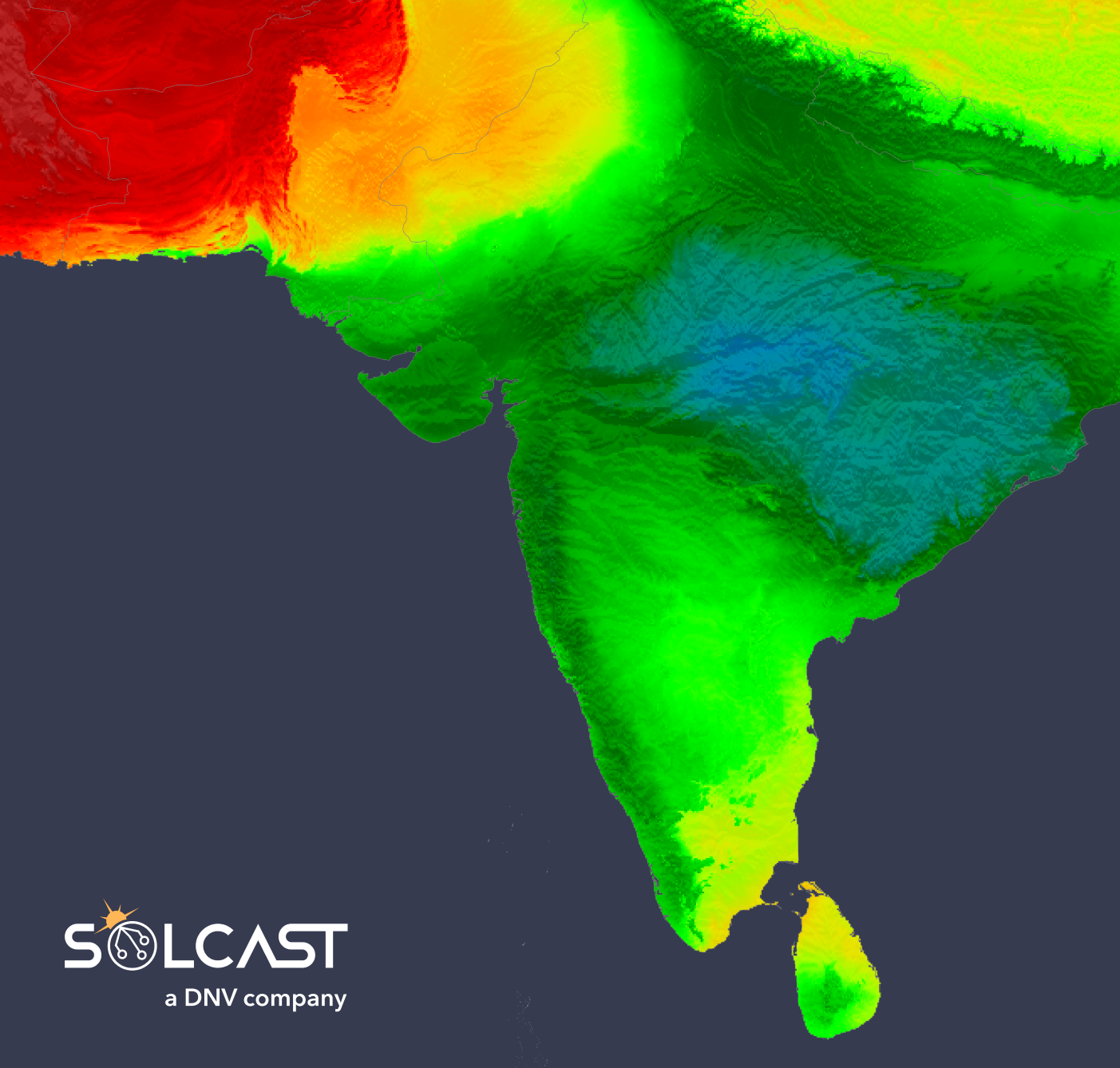
Northwestern and southern India and Pakistan saw above-average solar irradiance during the 2026 summer monsoon, while August tropical depressions reduced irradiance in eastern and central India, according to analysis using the Solcast API. Fortunately, the majority of India’s utility-scale PV capacity is in the regions with favourable conditions. After late-August flood damage in Nepal, India began exporting electricity there, supported in part by Indian PV generation.
The monsoon arrived slowly in June and rainfall has been below average in the sunnier regions. Early June–September analysis, using forecasts out to the end of September, puts irradiance around 5% above the long-term average in those areas, whilst August saw up to 10% above average. The weaker monsoon is consistent with the strong El Niño that has developed throughout 2027. These effects are also influenced by a marginal positive Indian Ocean Dipole, an Indian Ocean temperature pattern that can counteract El Niño’s influence.
Accumulated irradiance at Jodhpur, near Rajasthan’s PV-producing areas, is provisionally tracking as the second-highest year since 2007. Bahawalpur, near solar installations in Pakistan’s Punjab province, is tracking at the top of its comparison years since 2007.
Eastern and central India followed a different course. Several tropical depressions, or low-pressure systems formed over the Bay of Bengal in August and moved northwest across land, carrying cloud and heavy rain. August irradiance in the affected areas was 20–30% below the monthly average. The provisional June–September estimate is around 10% below average across Chhattisgarh, Jharkhand, Odisha, eastern Madhya Pradesh and
Maharashtra.
Spot analysis of time-series data in impacted locations demonstrates the impact this has for local solar production, revealing the impacts of the onset of the monsoon.
Source link