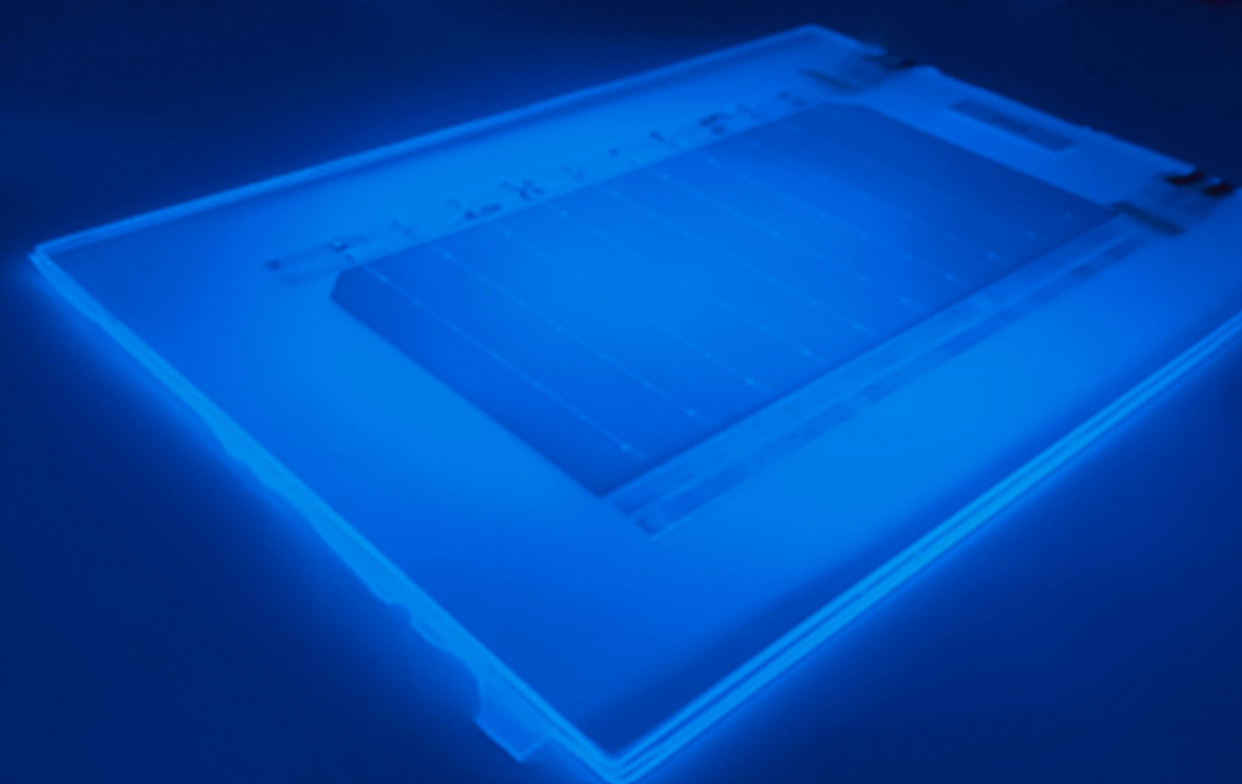
Researchers at the University of Ljubljana in Slovenia have investigated whether luminescent ultraviolet down-shifting (UVDS) layers could replace conventional UV absorbers to reduce UV-induced degradation in solar cells based on tunnel oxide passivating contact (TOPCon) technology and have found that the small initial performance penalty associated with UVDS layers could be offset by higher long-term energy yields if UV-induced degradation is effectively suppressed.
Both UVDS layers and conventional UV absorbers are designed to protect solar cells from harmful UV radiation. However, while conventional UV absorbers primarily dissipate the absorbed energy as heat, UVDS layers convert UV radiation into visible light by absorbing high-energy UV photons and re-emitting them at longer wavelengths. The main advantage of UVDS layers is their ability to make part of the absorbed UV radiation available for electricity generation while protecting solar cells from UV-induced degradation, potentially improving long-term energy yields.
“UVDS integration shifts part of the incident photon flux from the ultraviolet region into a spectral range where the external quantum efficiency of silicon solar cells is typically higher,” the scientists explained. “While UVDS concepts have been studied for several decades and across various photovoltaic technologies, their practical implementation remains challenging due to the complex interplay between absorption, photoluminescence, reabsorption, optical trapping, device geometry, and outdoor operating conditions.”
Against this backdrop, the research team developed an optical modeling framework for UVDS layers integrated into realistic photovoltaic devices. “Throughout this work, the investigated UVDS materials are treated as experimentally characterized optical systems defined by their measured absorption, emission, and photoluminescence properties, which constitute the relevant inputs for the proposed modelling approach,” they stressed.
Source link