Lithium grabs the spotlight, but cheap and abundant sodium has long held the key to large-scale energy storage. There is just one catch. Sodium–sulfur batteries degrade fast.
Now, researchers at the Chinese Academy of Sciences (CAS) have cracked a major hurdle that plagued the technology for years, using a metal found in ordinary soda cans.
Led by Profs. Wang Hui and Zheng Fangcai at the High Magnetic Field Laboratory in Hefei, the team successfully re-engineered single-atom aluminum to outperform far pricier rare-earth elements.
Researchers have developed an efficient aluminum single-atom catalyst to overcome the performance limitations of main-group metal catalysts in sodium-sulfur (Na–S) batteries.
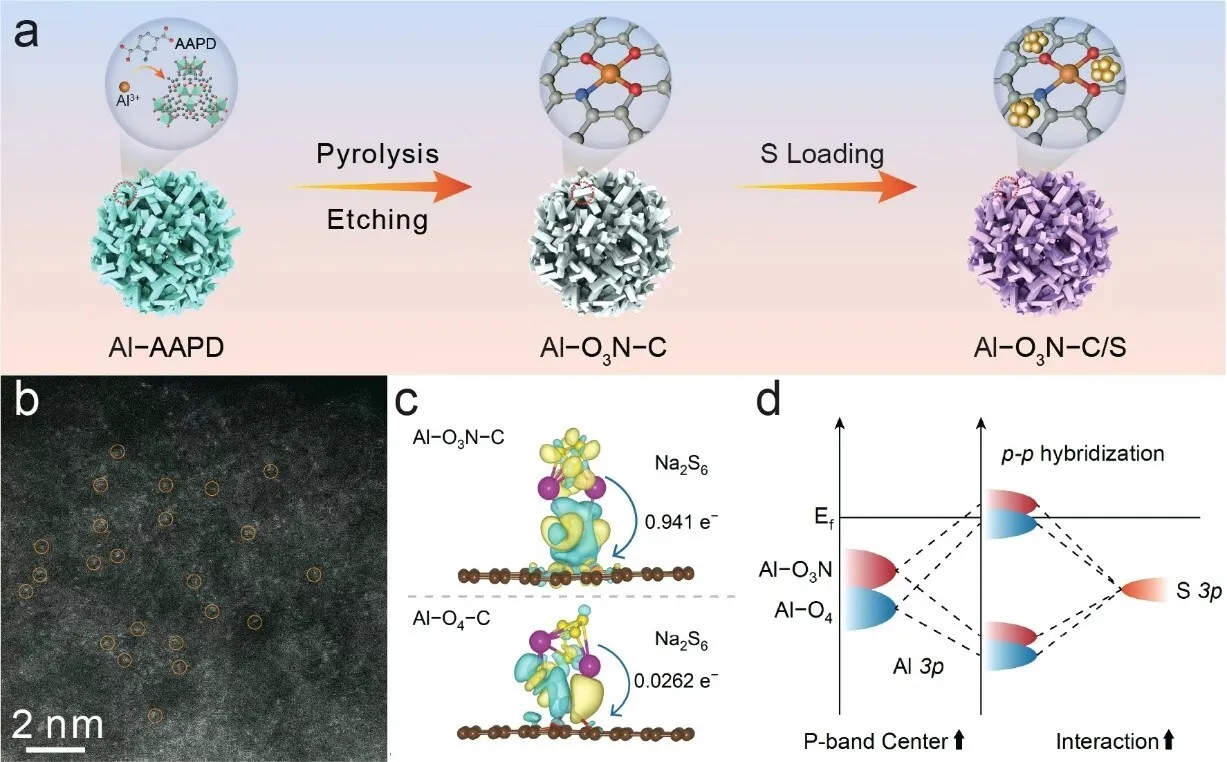
“This created an asymmetric structure with three oxygen atoms and one nitrogen atom around each Al atom,” the team wrote in the press release.
“The batteries also maintained stable performance over thousands of charge-discharge cycles, showing good potential for long-lasting sodium–sulfur batteries,” it added.
For a long time, the search for long-lasting batteries focused on precious heavy metals like platinum, cobalt, or nickel. Main-group metals like aluminum were cheaper and non-toxic, but fundamentally lazy catalysts. And simply lacked the catalytic punch to manage sodium polysulfides. These volatile compound intermediates shuttle and dissolve from the cathode, draining battery life.
The team found the solution in breaking atomic symmetry. Typically, isolated aluminum single atoms sit comfortably surrounded by four oxygen atoms (Al–O4). The Hefei team plucked out a single oxygen atom and swapped it for a nitrogen atom. That single change created an asymmetric Al–O3N coordination structure.
Altering the local electron distribution around the central aluminum atom through a single nitrogen substitution created a strong localized electric charge.
Source link