This article has been reviewed according to Science X's editorial process and policies. Editors have highlighted the following attributes while ensuring the content's credibility:
All-solid-state batteries (ASSBs) are emerging as promising candidates for next-generation energy storage technologies because they use solid electrolytes instead of liquid electrolytes, offering potential advantages in safety and energy density. However, lithium (Li)-based ASSBs can suffer from instabilities caused by nonuniform plating and stripping of Li metal during operation.
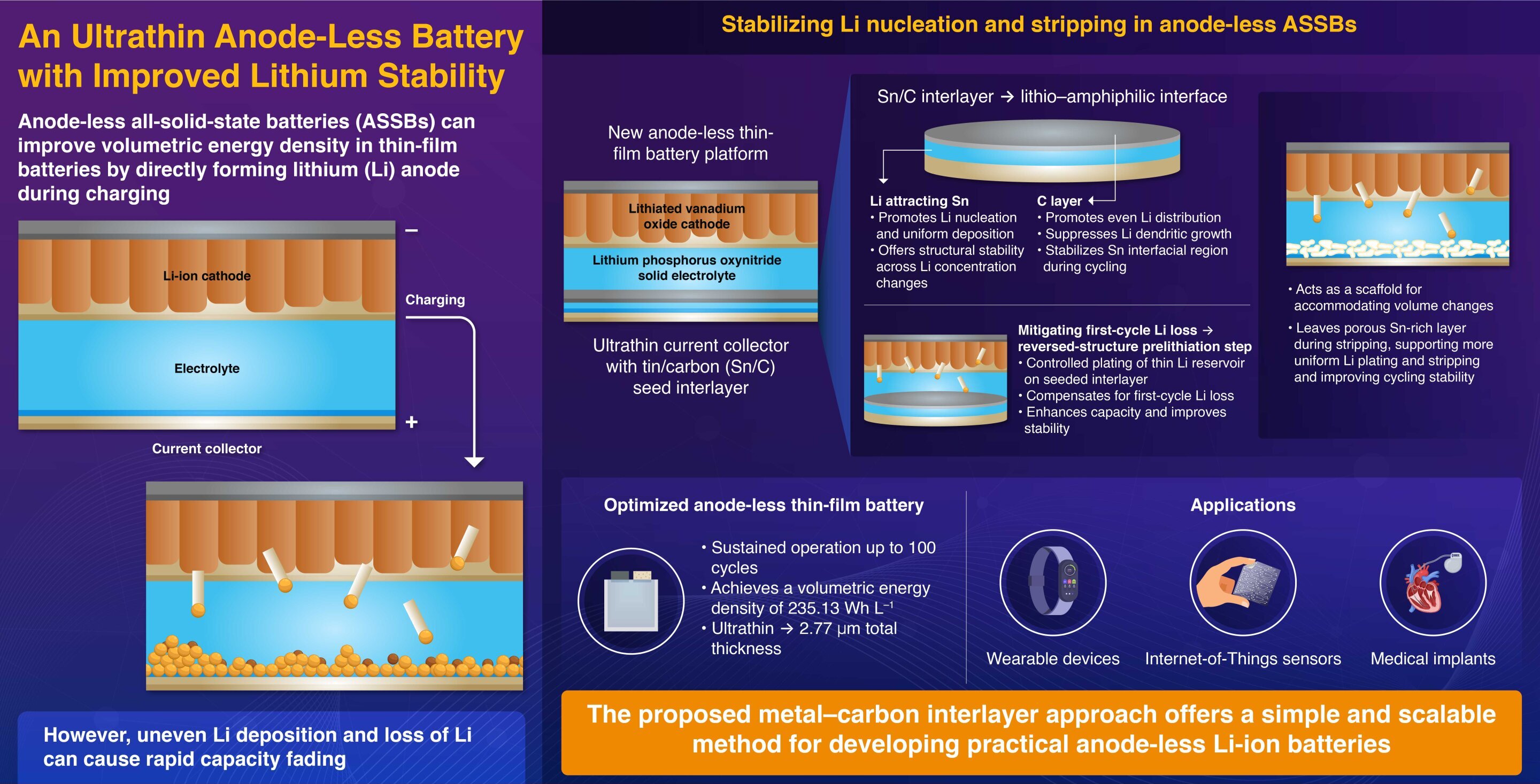
A promising solution is the anode-less ASSB, in which lithium from the cathode deposits directly onto a bare current collector during the first charge, forming the anode in situ. This architecture enhances volumetric energy density and simplifies fabrication, particularly for thin-film batteries. However, it is vulnerable to lithium loss caused by uneven deposition, electrically isolated "dead" lithium or loss of contact with the solid electrolyte during stripping, compromising battery stability and capacity.
To address these issues, a research team led by professor Hyun-Suk Kim from the Department of Energy and Materials Engineering at Dongguk University in South Korea has developed an anode-less thin-film battery platform using an ultrathin tin/carbon (Sn/C) interlayer on the current collector to guide Li deposition. "Our interlayer acts as a seed for Li nucleation, promoting uniform Li plating and reducing Li loss and improving the reversibility of repeated charging and discharging," explains Kim.
Their study was published in Advanced Energy Materials on Aug. 19, 2026.
The researchers first systematically screened carbon-only, metal-only and metal/carbon coatings on current collectors. Through this analysis, they found that introducing a seed/interlayer helps promote more uniform Li nucleation and plating in anode-less conditions.
Source link