This article has been reviewed according to Science X's editorial process and policies. Editors have highlighted the following attributes while ensuring the content's credibility:
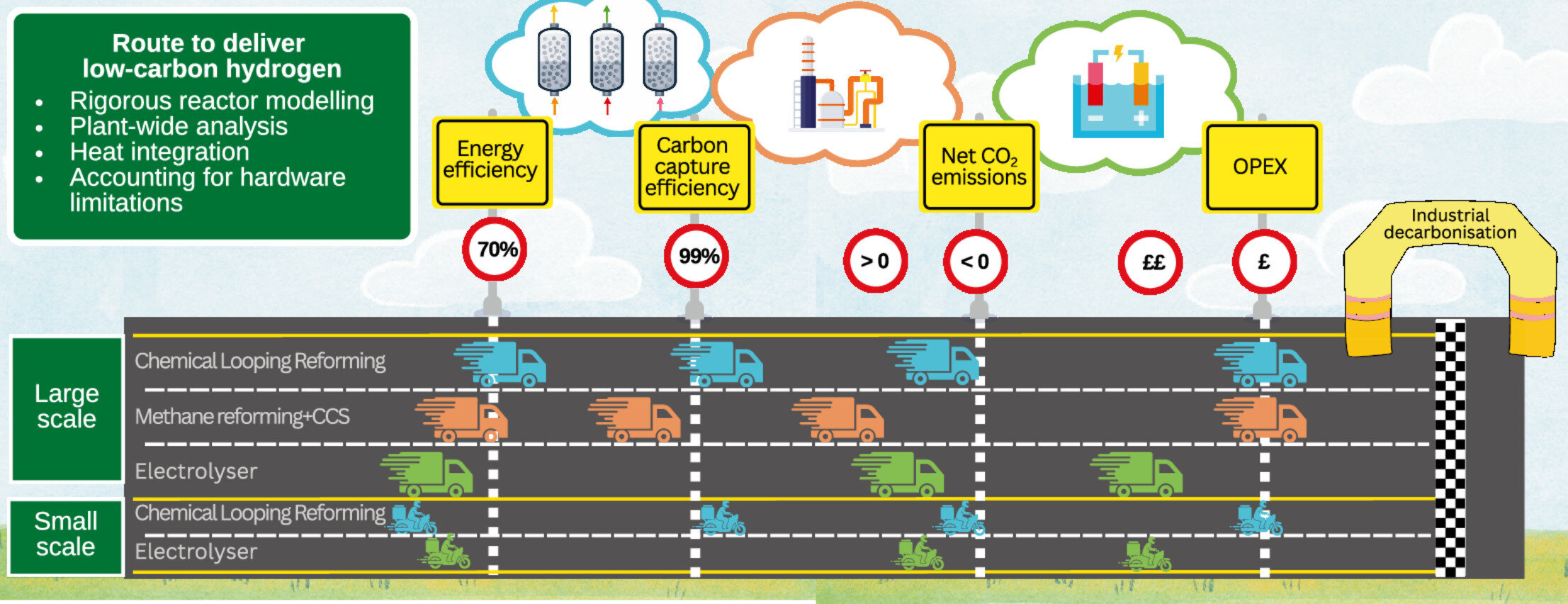
A new study led by researchers at The University of Manchester has provided the first plant-wide assessment of chemical looping reforming, an emerging hydrogen production technology that combines hydrogen generation with built-in carbon capture.
Published in Carbon Capture Science & Technology, the research, conducted in collaboration with industrial partners, evaluates how chemical looping reforming could operate in real-world industrial settings, from small, decentralized facilities serving industrial boilers to large-scale plants supplying refineries and industrial clusters.
Unlike conventional hydrogen production methods, chemical looping reforming is a process that inherently concentrates and separates CO₂ by means of solid oxygen-carrier materials that circulate oxygen through a sequence of reactions while producing heat. Then, this heat drives the transformation of methane and steam into a hydrogen-containing mixture, syngas.
Hydrogen is expected to play a crucial role in reducing emissions from sectors that are challenging to electrify, including heavy industry, chemicals and refining. However, producing low-carbon hydrogen efficiently and affordably remains a significant challenge. Blue hydrogen, produced from natural gas with carbon dioxide captured and not released, can bridge the energy-transition gap by leveraging existing supply infrastructure while offering a more environmentally friendly alternative to reach decarbonization targets.
The researchers used detailed reactor, process and plant-level modeling to assess chemical looping reforming across two representative scales: a 2 MW plant suitable for decentralized industrial applications and a 600 MW facility aligned with large industrial hydrogen demand.
Source link