
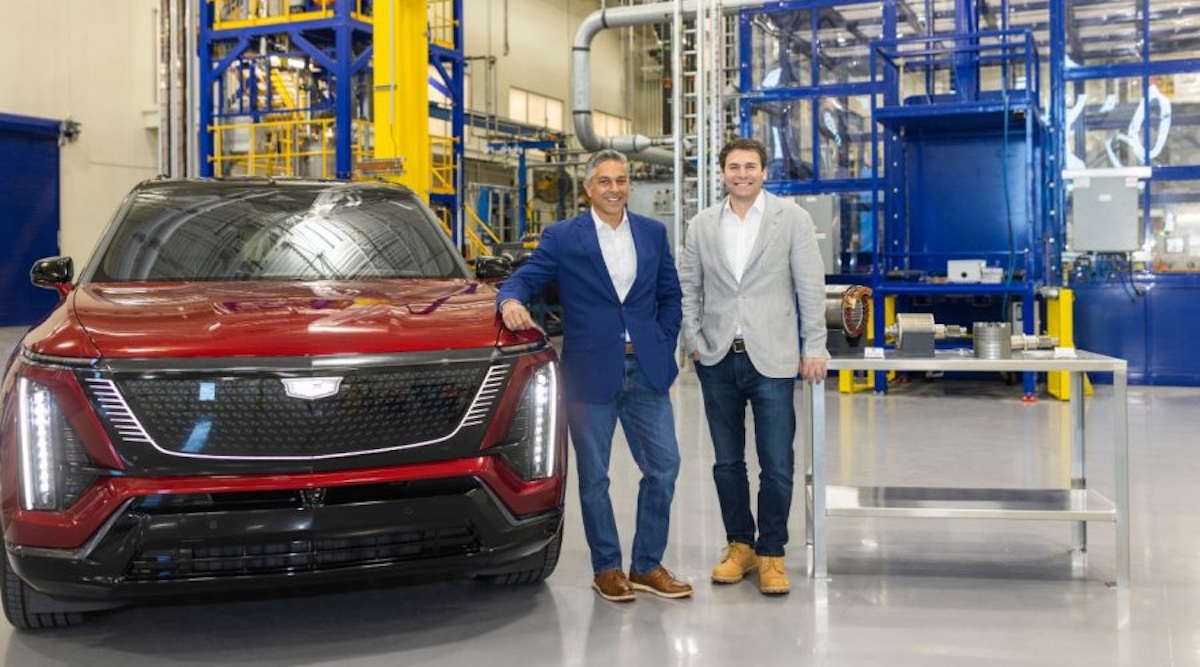
Long before electric vehicles became a familiar sight on American roads, General Motors engineers were developing technologies that help make today’s EVs possible.
One example sits at the heart of a modern electric motor: the permanent magnet. In the early 1980s, GM researchers helped pioneer a process for producing powerful neodymium-based permanent magnets. That work was an early demonstration of something GM has done throughout its history: bringing materials science, engineering and manufacturing together to solve difficult problems at scale in ways few other companies can.
GM’s experience does not stop with magnets. Our history with electric motors also runs deep.
The first-generation Chevrolet Volt advanced permanent-magnet motor performance in a hybrid-vehicle application. Its successor introduced a dual-V magnet arrangement designed to increase torque and reduce noise and vibration. Later, the first-generation Chevrolet Bolt EV helped bring permanent-magnet motor technology to a long-range, mass-market EV.
Each generation taught us something new. Today, those lessons are reflected in a family of electric motors engineered for a broad portfolio of vehicles and customer needs.
An EV motor has a straightforward job: turn electrical energy into motion. But delivering the performance and durability customers expect is anything but simple.
Most GM EV motors today use interior permanent magnets. The motor’s stator creates a rotating magnetic field, which interacts with magnets inside the rotor to produce torque. Permanent-magnet motors generally provide excellent efficiency and power density—valuable characteristics when engineers are working to maximize range, performance and space. To earn the label “automotive grade,” the magnets in these motors must withstand extreme heat, vibration and mechanical stress while continuing to deliver consistent performance.
Source link