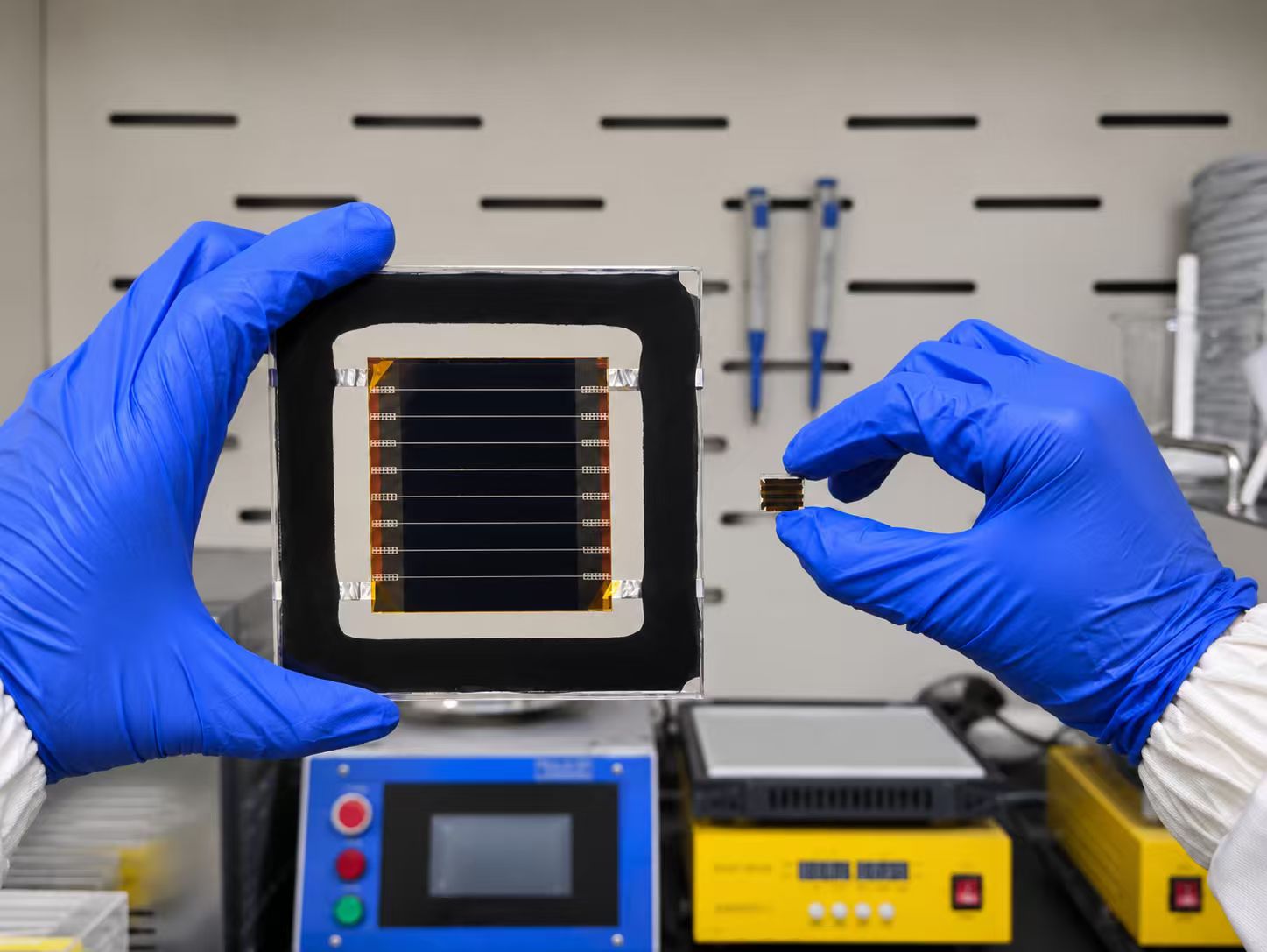
A research team led by scientists from Chinese perovskite solar cell manufacturer MicroQuanta Semiconductor has achieved a certified steady-state efficiency of 23.9% for a 19.48 cm² perovskite mini-module, setting a new world record.
The researchers said the result was enabled by cooling the wet perovskite precursor film before vacuum treatment to slow crystallization and reduce the fill factor losses associated with scaling up from cells to modules.
“What makes our result special is that the world record is achieved at the module level, rather than in a small laboratory cell,” corresponding author Dongchen Lan told pv magazine. “Solar cells often lose efficiency when scaled up into modules.”
The result was certified by the National PV Industry Measurement and Testing Center (NPVM) of China’s Fujian Metrology Institute.
Lan said the team identified a major cause of these losses and demonstrated a way to mitigate them while helping modules maintain their performance over time. “This addresses a key challenge in bringing next-generation solar technologies closer to practical use,” he said.
The researchers first compared laboratory-scale perovskite solar cells with mini-modules fabricated under matched processing conditions in previous studies. They used Shapley value analysis, which averages the contribution of each parameter across all possible orders of substitution, to quantify the contributions of open-circuit voltage, short-circuit current density, and fill factor to the measured efficiency loss.
After accounting for current losses in inactive areas created by laser scribing, they found that fill factor was the largest contributor to the efficiency drop from cells to modules.
Source link