
Europe’s industrial hydrogen plans have a buyer problem. A factory cannot make its products competitive by paying whatever a new hydrogen plant needs to recover its investment. Its maximum hydrogen price is set by the cost of making the same product, or delivering the same useful heat, another way.
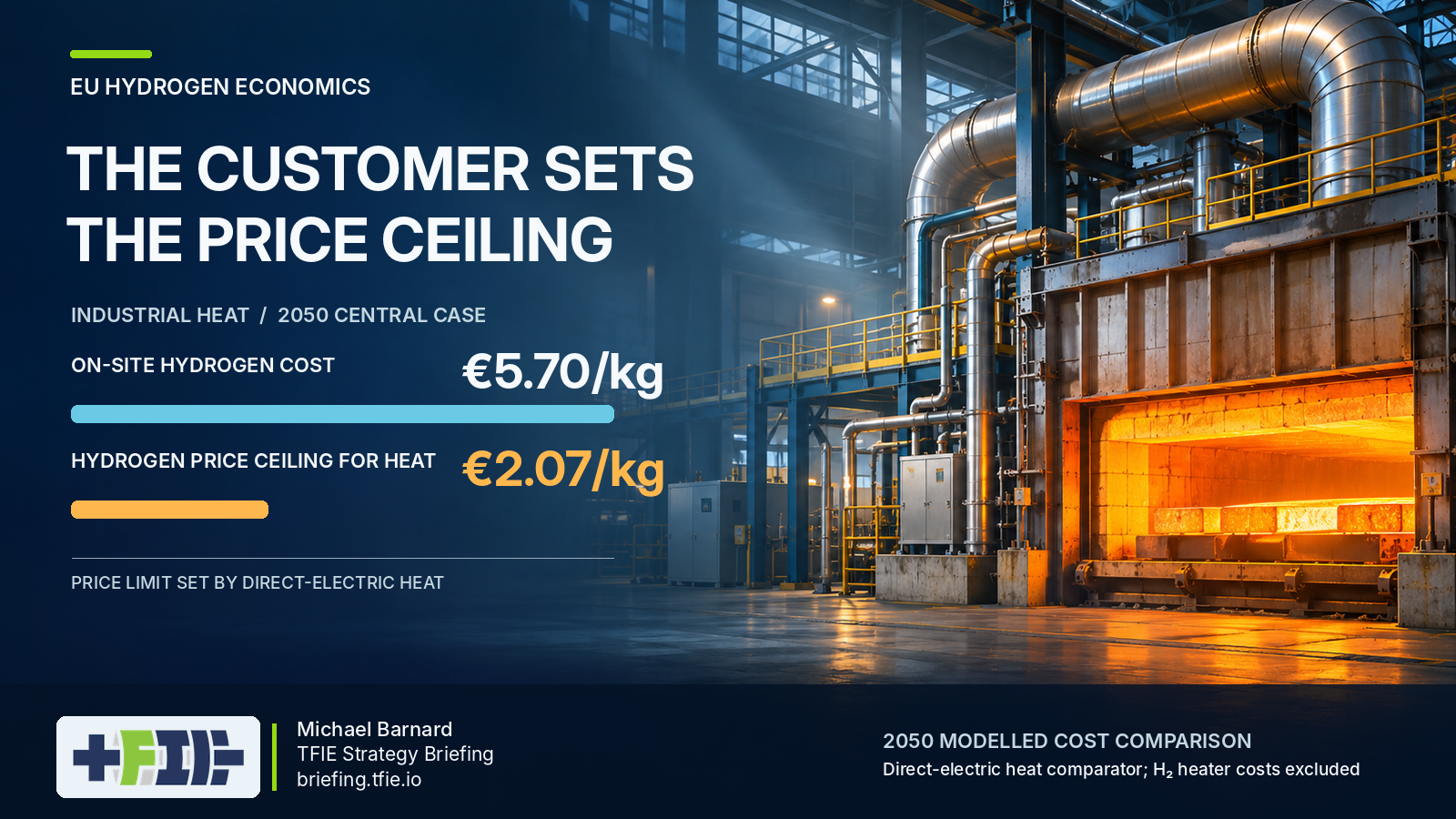
The central 2050 scenario in my European hydrogen assessment puts on-site production at €5.70/kg. That starts with electricity at €60/MWh and 53 kWh of electricity per kilogram of hydrogen, so the electricity alone costs €3.18/kg. Electrolysers, capital recovery, maintenance, stack replacements, water and other plant costs bring the total to €5.70. Getting hydrogen to a customer can cost more.
At a factory using hydrogen for process heat, €5.70/kg is an expensive fuel. With 94% heating efficiency, delivering one MWh of useful heat requires roughly 31.9 kg of hydrogen. The fuel bill reaches €182/MWh before the burner, maintenance and other equipment costs. In the model’s central 2050 comparison, suitable direct-electric heating sets a hydrogen price ceiling of €2.07/kg. At that ceiling the same hydrogen heat costs about €66/MWh. The hydrogen production case overshoots the customer’s competitive input price by €3.63/kg.
The mismatch is not a prediction that hydrogen makers will never lower costs. It is the actual commercial test investors should apply before financing supply. Reducing the cost of production from €7 to €5 a kilogram achieves little if the relevant industrial customer can pay €2. Production-cost targets are meaningless without a corresponding market price ceiling.
The International Energy Agency’s Global Hydrogen Review 2026 has made customer cost acceptability part of its assessment.
Source link