This article has been reviewed according to Science X's editorial process and policies. Editors have highlighted the following attributes while ensuring the content's credibility:
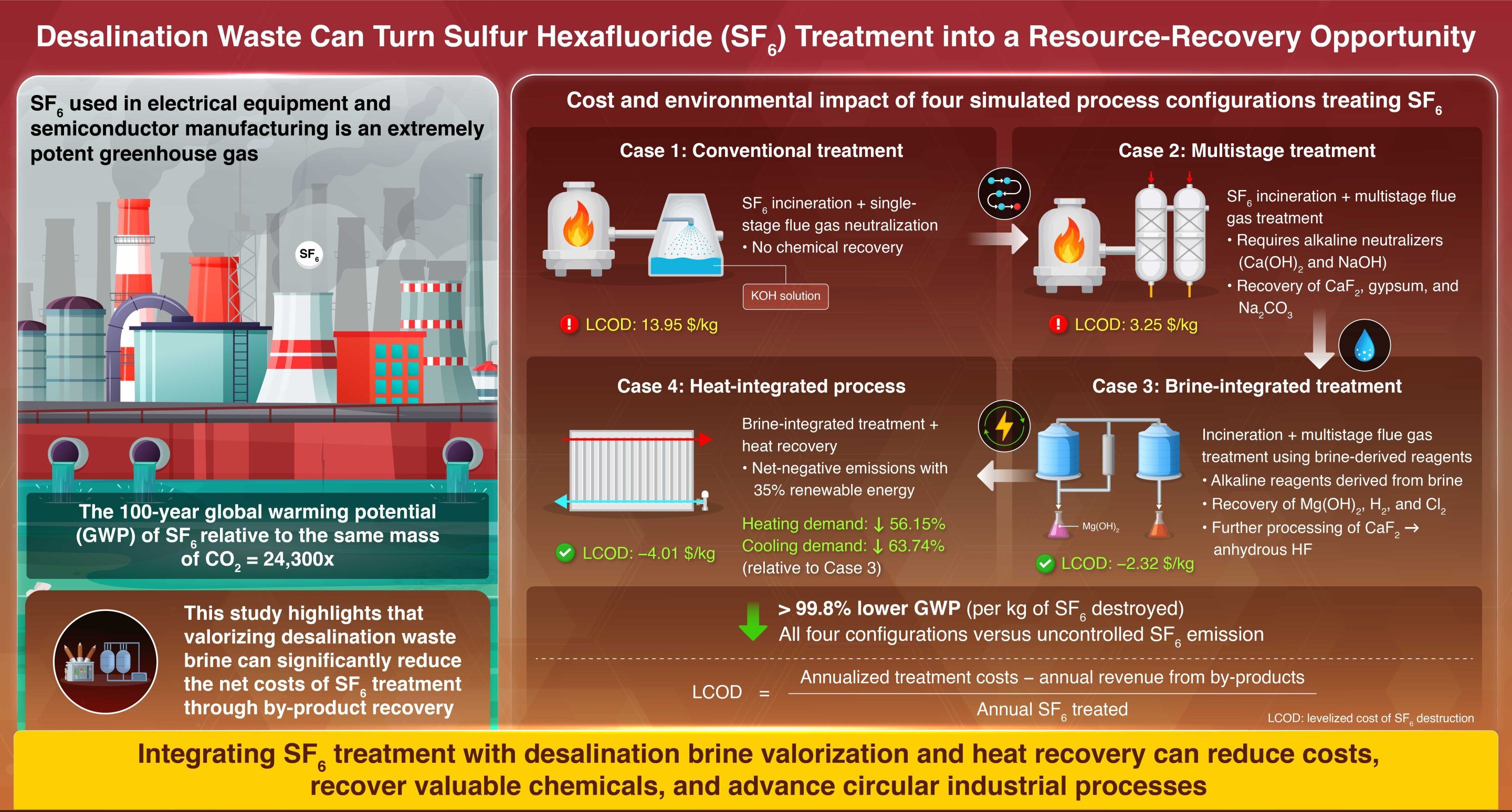
Behind the electric grid upgrades driven by the artificial intelligence boom and the electrification of transportation lies an environmental concern: sulfur hexafluoride (SF₆), an extremely potent greenhouse gas. SF₆ is used in high-voltage electrical equipment for its insulating properties and in semiconductor manufacturing as an etching gas. It can trap about 24,300 times more heat than the same amount of CO₂ over 100 years.
SF₆ is an extremely stable gas that can remain in the atmosphere for nearly 3,000 years. Capturing and properly treating it before release is therefore important to prevent long-term environmental damage.
SF₆ is mainly treated through high-temperature incineration, followed by chemical treatment of the resulting gases. Now, researchers led by assistant professor Sunghyun Cho at the School of Chemical Engineering at Jeonbuk National University in South Korea have demonstrated how integrating SF₆ treatment with desalination brine processing could enable the recovery of valuable chemicals and improve the economics of the treatment process.
The researchers designed and simulated four process configurations for treating 250 kg of SF₆ per hour and evaluated their economic and environmental performance. "The results show that an integrated process can simultaneously address two environmental challenges: sulfur hexafluoride emissions and waste brine generated from seawater desalination," says Cho.
The paper was published in the Journal of Cleaner Production on Aug. 2, 2026.
The first configuration used conventional incineration followed by a single chemical scrubbing stage, while the second introduced multiple treatment stages to capture and recover useful salts, including calcium fluoride, gypsum and sodium carbonate.
Source link