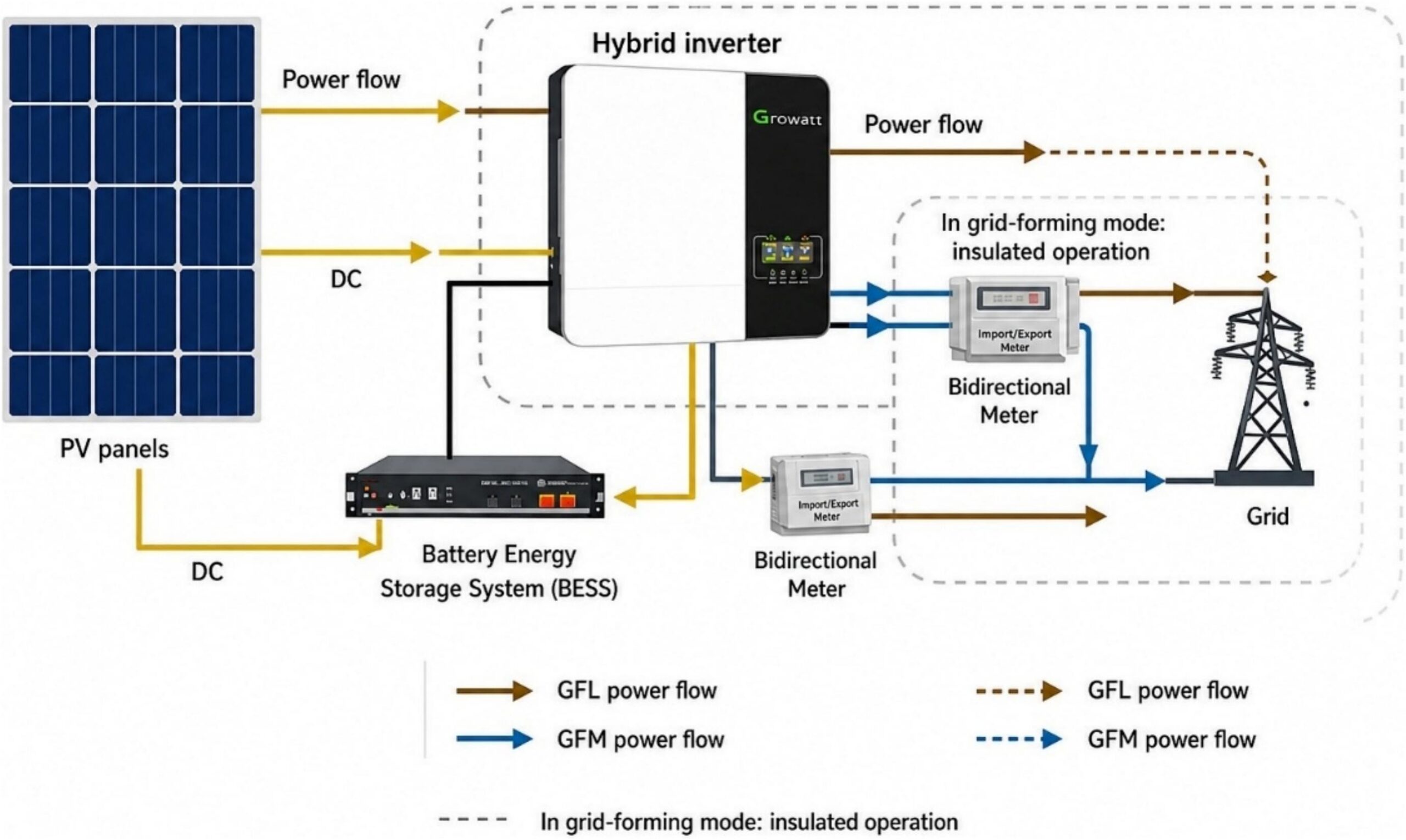
Scientists at the Bucharest University of Economic Studies in Romania have compared the performance of grid-following (GFL) and grid-forming (GFM) inverters in residential solar-plus-storage systems under low-inertia grid conditions and have found that GFM technology offers significant advantages in terms of grid stability, frequency and voltage recovery, islanding capability, and economic returns, with a relatively short payback period for the additional investment.
The researchers explained that most existing studies focus on control design, dynamic stability, and large-scale integration, with limited attention paid to country-specific economic assessments, particularly for prosumers in emerging electricity markets such as Romania. Their study addressed this gap by combining an analysis of GFM dynamic performance, including frequency stability, voltage regulation, rate of change of frequency (RoCoF), and islanding capability, with a techno-economic assessment based on net present value (NPV), internal rate of return (IRR), adjusted levelized cost of energy (LCOE), and payback period. It also identified an indicative transition point toward inverter-dominated operation based on installed-capacity trends and long-term Romanian grid scenarios.
For the technical comparison, the researchers used MATLAB/Simulink to model a 5 kW residential PV system coupled with a 10 kWh lithium iron phosphate battery. Both inverter configurations were evaluated under identical operating conditions using detailed electromagnetic transient simulations. Two disturbances were considered: a 1.2 kW load increase and a 20% voltage sag lasting 200 milliseconds. The performance indicators included frequency deviation, voltage deviation, stabilization time, and RoCoF.
The economic assessment compared capital expenditure, operating costs, self-consumption savings, grid export revenues, and energy arbitrage.
Source link