This article has been reviewed according to Science X's editorial process and policies. Editors have highlighted the following attributes while ensuring the content's credibility:
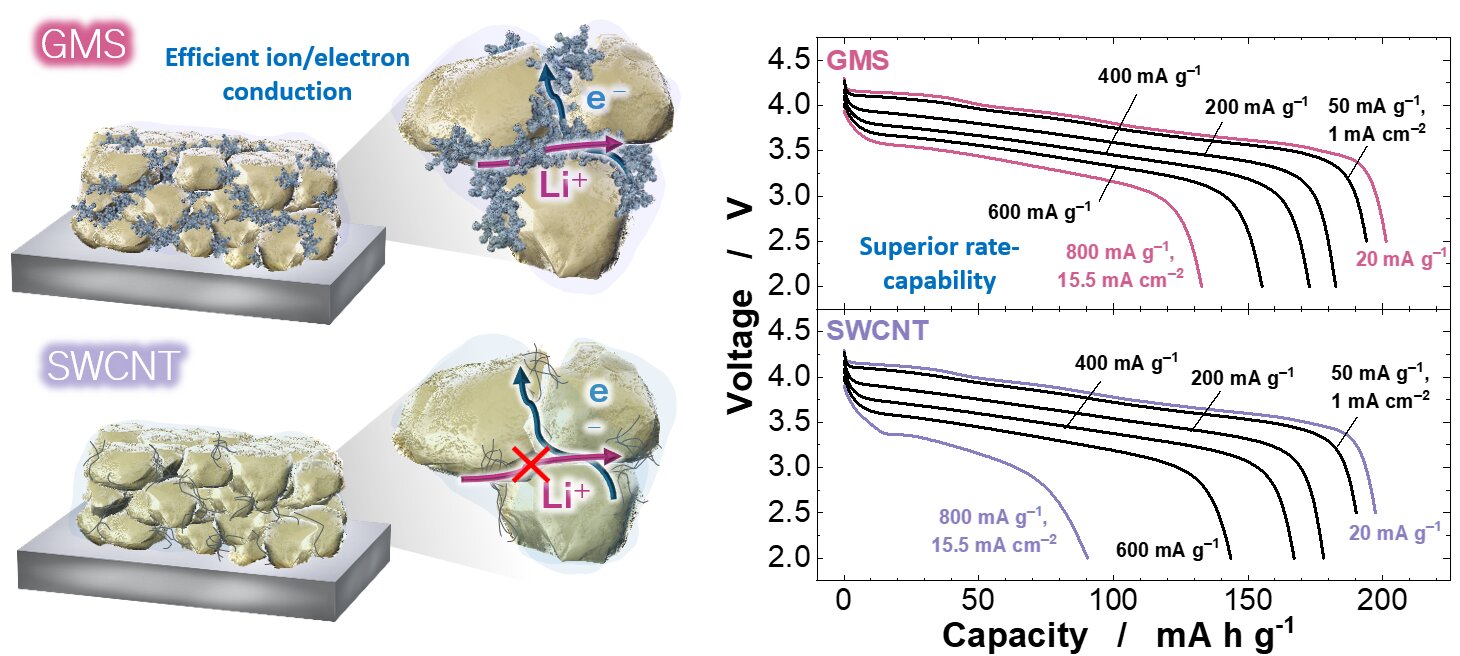
Making more efficient, longer-lasting lithium-ion batteries has been a challenge for researchers because adding more mass to the batteries restricts how fast electricity and lithium ions can move. To overcome this challenge, a research team has added graphene mesosponge to batteries to improve their performance during fast discharge. Their results show that graphene mesosponge is highly effective at improving the energy and power densities of commercial lithium-ion batteries.
Their research was published in the journal Advanced Energy Materials on Oct. 8, 2026.
With a goal of building a cleaner, more sustainable society, scientists are working to develop more powerful lithium-ion batteries. These batteries are used to power items ranging from smartphones and laptops to electric vehicles. In current commercial lithium-ion batteries, the positive electrode restricts the batteries' energy density. Scientists are focused on creating high-performance positive electrode active materials that can achieve higher battery energy density.
Scientists have explored the use of pure nickel oxide as an electrode candidate for high-energy lithium-ion batteries. However, the battery degrades because high voltage stresses the nickel-containing materials, making it harder for the battery to charge and discharge.
To achieve higher battery energy density, scientists are studying ways to increase the active materials in the battery while reducing the parts of the composite electrode, such as conductive additives and polymer binders, that do not store electricity. But adding too much active material to the battery electrode while minimizing the conductive additives and polymer binders results in inefficient batteries in which electricity cannot flow freely through the material.
Source link