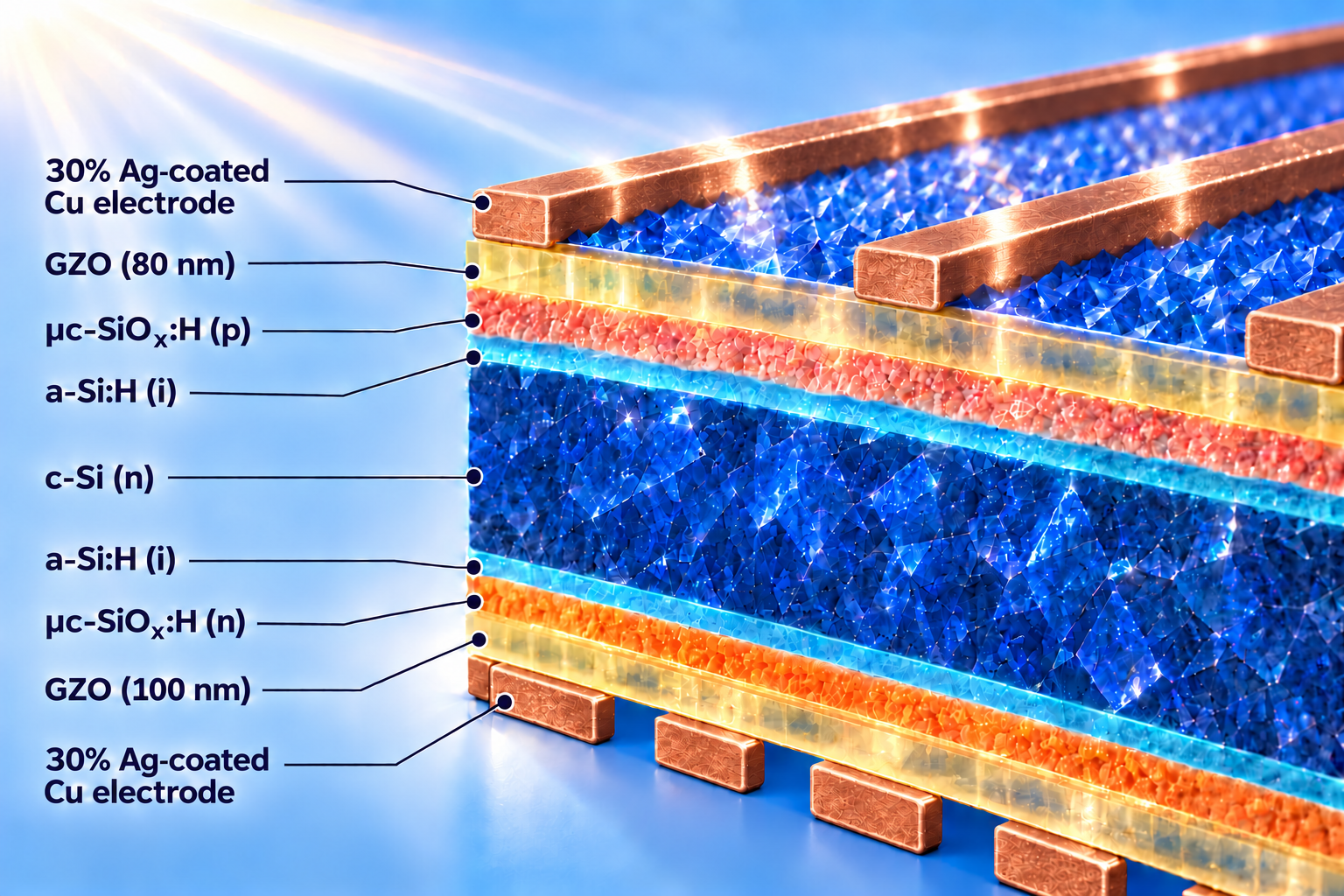
Researchers in China have investigated gallium-doped zinc oxide (GZO) as an indium-free transparent conductive oxide (TCO) for silicon heterojunction (HJT) solar cells. The approach aims to reduce manufacturing costs and reliance on scarce indium used in conventional transparent electrodes.
“The high cost of indium has driven the development of indium-free alternatives to conventional TCOs for HJT solar cells,” the group explained. “In this study, the structural, morphological, electrical, optical, and chemical properties of GZO films were investigated by combining in situ optical emission spectroscopy (OES) with ex situ characterization.”
The researchers fabricated HJT solar cells using n-type crystalline silicon wafers measuring 210 × 105 mm and approximately 130 μm thick. They chemically cleaned and textured the wafers, then deposited intrinsic amorphous silicon passivation layers and doped microcrystalline silicon oxide layers on both sides by plasma-enhanced chemical vapor deposition.
They then deposited GZO transparent electrodes at room temperature using reactive plasma deposition, with thicknesses of 80 nm on the front and 100 nm on the rear. The team varied the oxygen fraction in the oxygen-argon deposition gas from 5% to 25%, while keeping the total gas flow constant, and screen-printed contacts using 30 wt% Ag-coated Cu paste.
They monitored the plasma using optical emission spectroscopy and characterized the films’ crystal structure, surface morphology, oxygen chemical states, electrical properties, and optical transmission. Finally, they measured the cells’ current-voltage characteristics under simulated sunlight at 1,000 W/m² and 25 C, comparing their performance with a reference HJT cell featuring indium-based transparent electrodes on both sides.
Source link