This article has been reviewed according to Science X's editorial process and policies. Editors have highlighted the following attributes while ensuring the content's credibility:
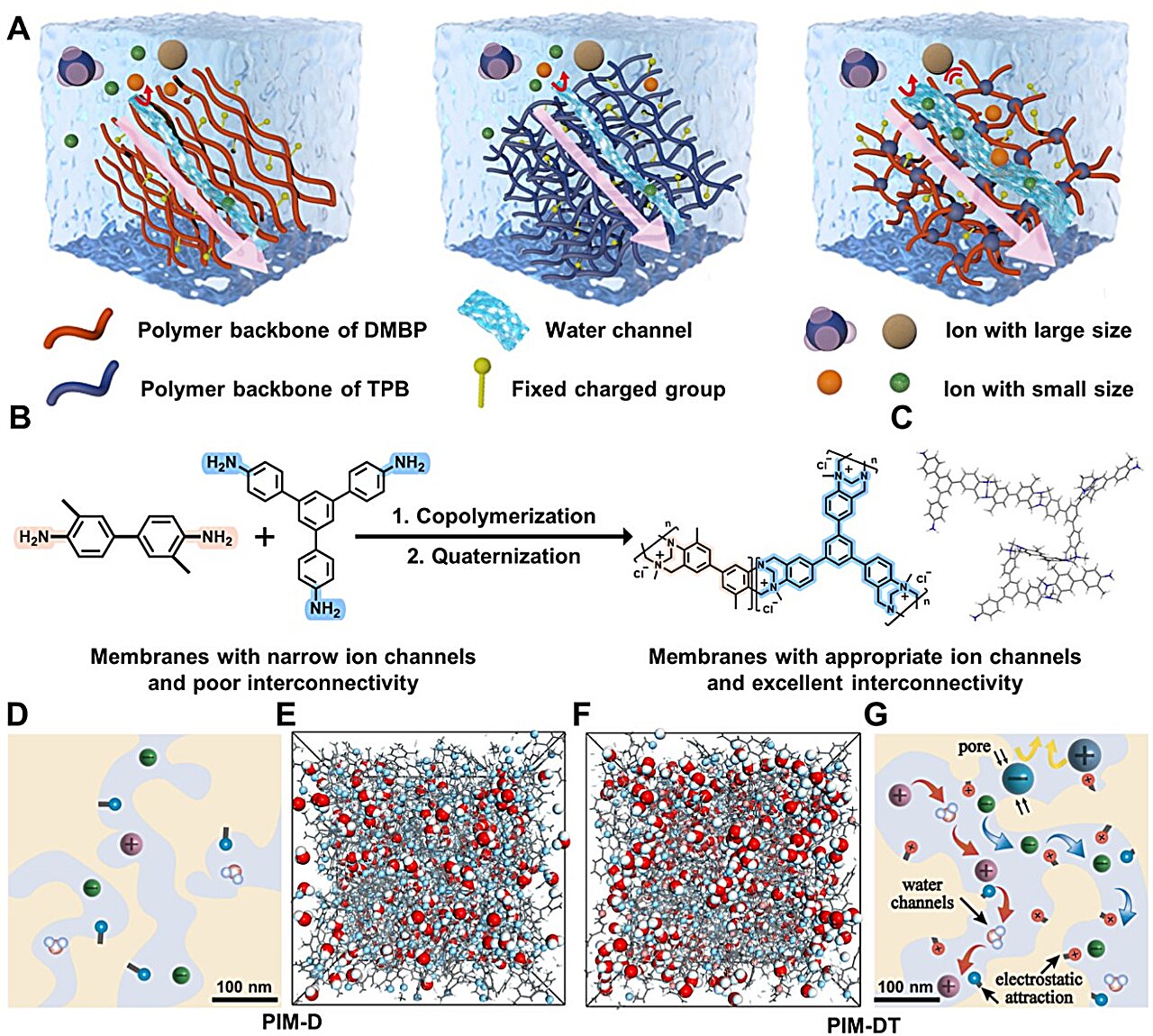
Researchers at Kobe University and their collaborators have developed a polymer membrane that allows singly charged ions to pass through rapidly while effectively blocking multiply charged ions, whether positively or negatively charged. The work is published in the journal Science Advances.
By engineering interconnected water-filled channels at the Angstrom scale, the researchers demonstrate efficient lithium enrichment from magnesium-rich brines and high-purity salt recovery from simulated seawater, opening new possibilities for sustainable resource recovery.
Lithium is essential for rechargeable batteries used in electric vehicles and renewable energy storage systems. However, recovering lithium from natural salt-lake brines remains challenging because these solutions often contain large amounts of magnesium and other dissolved salts. Similar difficulties arise in seawater treatment, where valuable salts must be separated from complex mixtures of dissolved ions.
Membrane-based separation offers a promising alternative to conventional chemical treatment, but existing membranes often face a fundamental trade-off between ion transport efficiency and selectivity. Enlarging membrane channels facilitates ion movement but allows unwanted ions to pass through, while narrowing these channels improves separation at the expense of transport efficiency.
Moreover, conventional ion-exchange membranes generally favor either positively or negatively charged ions. Developing a membrane capable of efficiently distinguishing singly and multiply charged ions across both cationic and anionic systems remains a major challenge.
To address these limitations, Kobe University membrane engineering researchers Lin Yuqing, Matsuyama Hideto and their colleagues developed a new class of ion-exchange membranes based on Tröger's base-derived porous organic polymers.
Source link