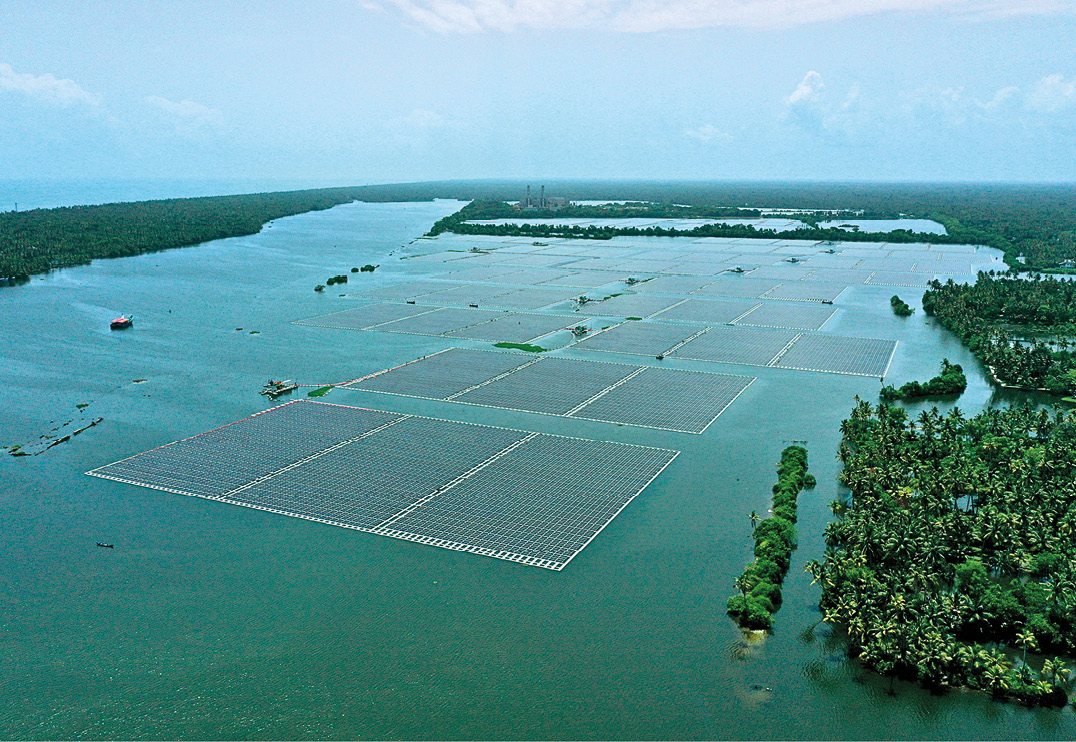
India’s federal government has decided it wants more floating solar and is backing its ambition with investment and incentives.
Deployed floating solar capacity in India stands at roughly 700 MW in 2026, but a new support mechanism approved by India’s cabinet in July aims to see that expanded by 5 GW in a five-year period. The Pradhan Mantri Surya Sarovar Yojana (PM-SSY) scheme is a program for floating solar projects co-located with two-hour energy storage. India’s federal government has budgeted INR 50.7 billion ($530 million) to support projects sanctioned between 2026-27 and 2030-31 fiscal years, with financial support continuing up to 2032-33.
Under the scheme, central financial assistance of INR 10 million per megawatt is promised for eligible floating solar projects, but only after successful commissioning. An additional INR 5 million is being made available for feasibility studies, including hydrography assessments and environmental studies. The central government has committed to supporting all states and union territories in India through the program, which it expects to generate 16,000 to 17,000 jobs, while also promoting domestic manufacturing of components such as floating systems – and of course the country’s growing domestic supply chain for PV cells, modules and energy storage systems.
So if everything goes to plan, the program should result in a fivefold increase in floating solar capacity. It’s a big percentage change but compared to the rate of deployment for ground-mounted capacity, floating solar would remain a drop in the ocean.
“The addressable market size is smaller,” explained Uttamarani Pati, analyst for new energies at Rystad Energy.
Source link