This article has been reviewed according to Science X's editorial process and policies. Editors have highlighted the following attributes while ensuring the content's credibility:
A key goal in solar cell research is to improve efficiency toward the Shockley–Queisser limit, the theoretical maximum efficiency for converting sunlight into electricity under specified conditions. Organic solar cells use carbon-based semiconducting materials and offer advantages such as being lightweight, potentially low-cost and suitable for flexible applications. Their power conversion efficiencies have approached 20%, but voltage losses remain a major obstacle to further improvements.
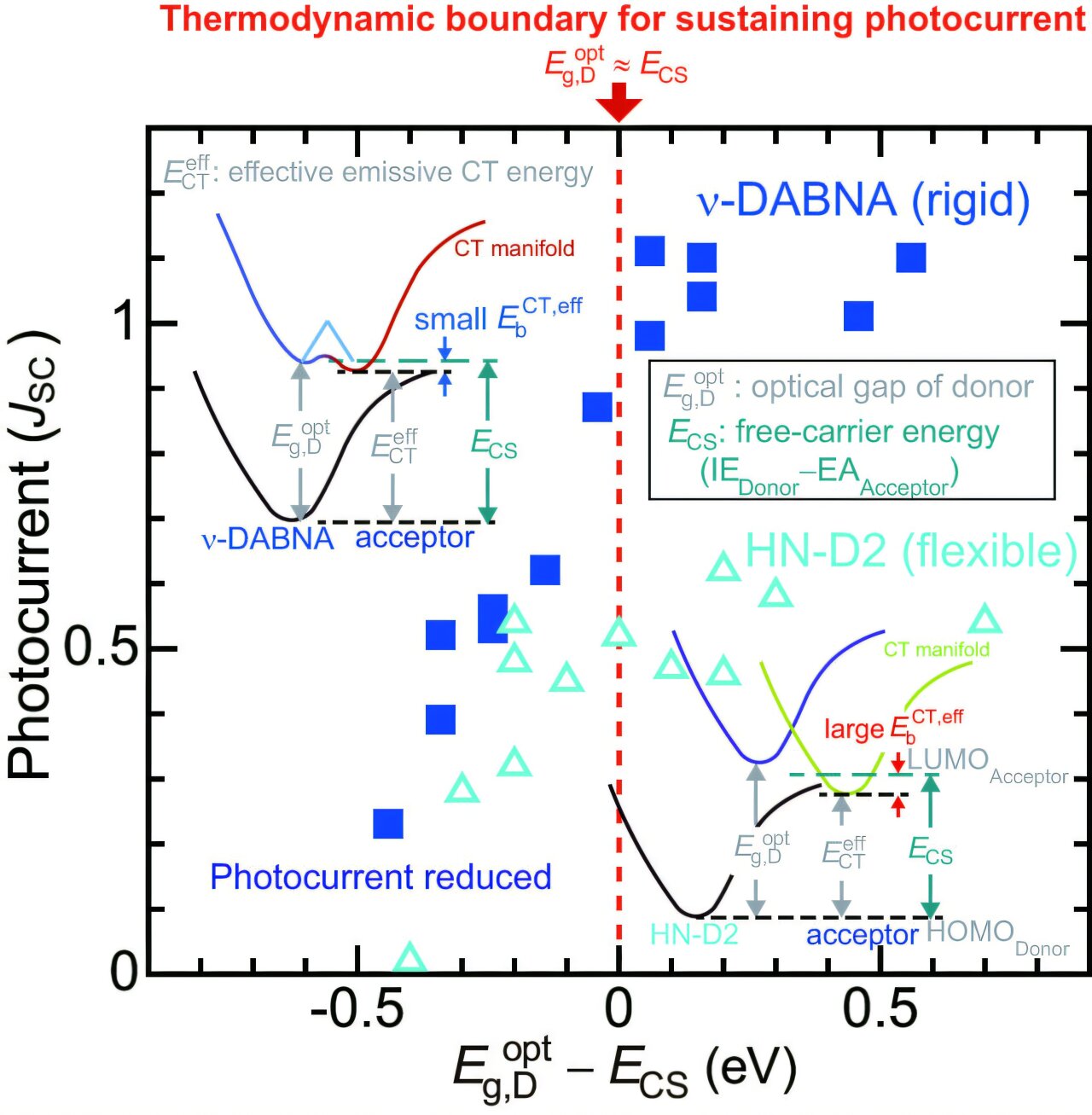
In organic solar cells, the donor material absorbs light and creates excited states. An electron can then transfer to the acceptor material, forming a charge-transfer (CT) state in which the electron and hole remain bound to each other. For the cell to generate electricity, these charges must separate into free charges. The energy of the CT state also influences the voltage the cell can deliver, and radiative recombination involving these states contributes to voltage losses.
One challenge is to identify the energy-level relationships that allow efficient charge generation while minimizing voltage losses. In particular, researchers need to understand the conditions under which a solar cell can continue generating photocurrent as the donor's optical energy gap approaches the energy of separated charges.
To investigate this, researchers led by professor Hirohiko Fukagawa from the Center for Frontier Science, Chiba University, Japan, measured the energy levels of different donor–acceptor combinations to develop a framework for understanding how they influence charge generation and voltage losses.
Source link