This article has been reviewed according to Science X's editorial process and policies. Editors have highlighted the following attributes while ensuring the content's credibility:
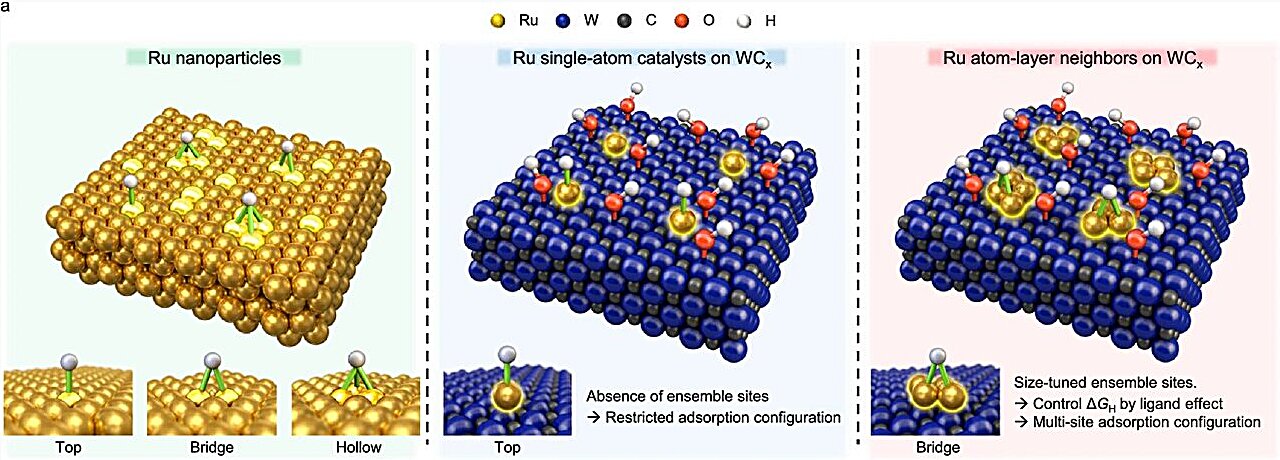
Lowering the cost of green hydrogen production requires catalysts that produce hydrogen efficiently while using smaller amounts of expensive precious metals. A Korean research team has developed a catalyst that brings three or four ruthenium (Ru) atoms together so they can work cooperatively.
The catalyst achieved hydrogen production performance comparable to that of a commercial platinum catalyst while using only one-quarter as much precious metal, potentially helping to lower the cost of green hydrogen production.
The research team, led by Professor Jinwoo Lee from the Department of Chemical and Biomolecular Engineering, KAIST, has developed a high-performance water electrolysis catalyst based on an "atom-layer neighbor" structure.
The work, published in the journal Nature Communications, was carried out in collaboration with Professor Hyungjun Kim from the Department of Chemistry, Professor Jang Yong Lee from Konkuk University, Dr. Joonhee Moon from the Korea Basic Science Institute (KBSI) and Dr. Sungjun Kim from the Korea Research Institute of Chemical Technology (KRICT).
Water electrolysis uses electricity to split water into hydrogen and oxygen. When powered by renewable energy sources such as solar and wind, the process produces "green hydrogen" with low carbon emissions. However, catalysts for the hydrogen-producing reaction rely on expensive precious metals, creating a need for technologies that maintain performance while reducing precious metal use.
In conventional precious metal nanoparticle catalysts, many atoms are clustered together, leaving those buried inside the particles largely unable to participate in the reaction.
Source link