

Serhii Kupriienko sits in an unadorned room in an unadorned house on a quiet residential street in Kyiv, sketching out for me what the future of war looks like.
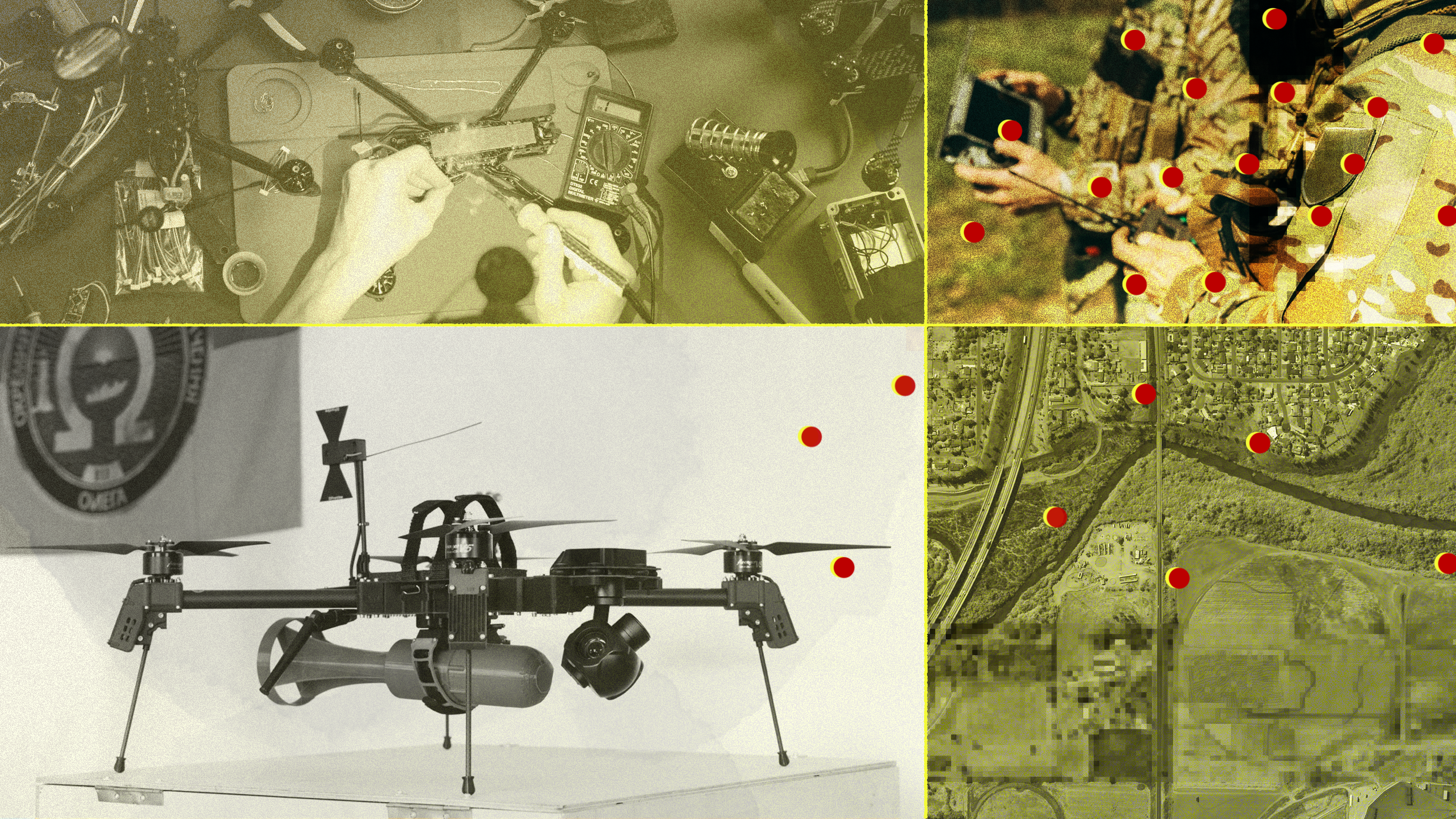
“I’m not very good at drawing,” he says, dragging a blue marker across the lid of his laptop (he assures me it washes off), creating a series of rough formations meant to represent groups of drones. The point of the art is to show how his company is making it so the machines might better coordinate with one another in order to eliminate Russian forces.
Before Russia’s full-scale invasion of Ukraine in February 2022, Kupriienko, who sports a black T-shirt and thick glasses, led artificial intelligence teams for Amazon’s Ring division in Ukraine. At the time we meet, he is the CEO and cofounder of Swarmer, a Ukrainian defense tech company that builds AI software to help groups of drones and other unmanned systems coordinate with less human direction. (He would step down as CEO later that month, remaining on the company’s board.)
The idea for Swarmer came to Kupriienko in early 2023. Ukraine’s drone warfare program was still taking shape. Small first-person view (FPV) drones had begun spreading across the front but had not yet become the ubiquitous specter they would soon be. Drones caused less than 10% of battlefield casualties in 2022; by 2025, that figure had risen to as much as 80%.
Kupriienko saw both a scarcity and an opportunity: Ukraine was using more drones but still relied heavily on humans to fly and coordinate them.
Source link