The Cova de la Font Major in Catalonia has long been a popular attraction for tourists, scientists, and looters. The cave is known for its marvelous views and scientific value, though the general consensus was that the walls were too soft for prehistoric artists to sketch their creations. It turns out we just weren’t looking hard enough.
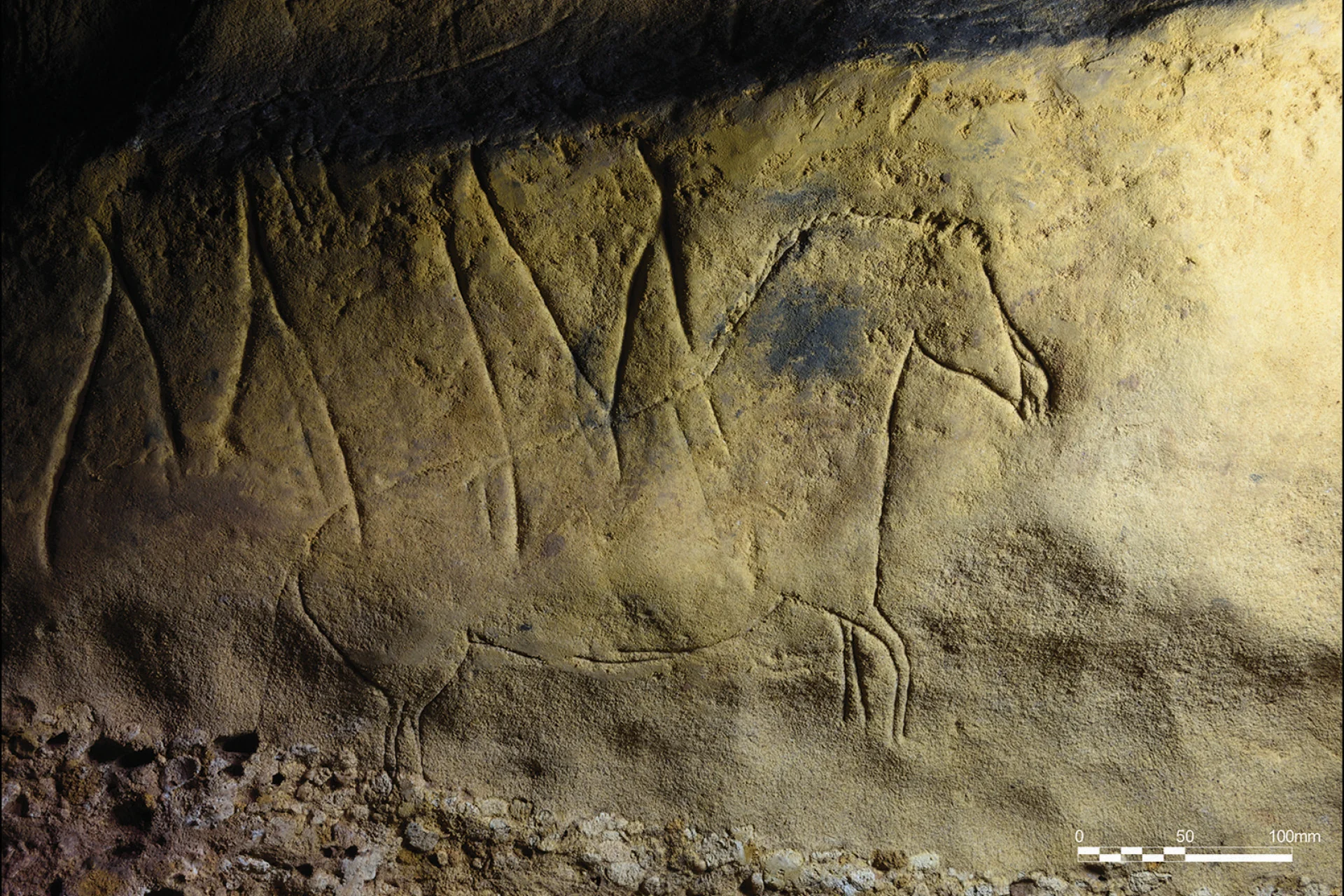
In 2019, Josep Maria Vergès discovered a series of vertical lines on the cave walls of the Cova de la Font Major, which turned out to be part of a large art assemblage from prehistoric times. When Vergès and his colleague Míriam Salas-Altès formally investigated the engravings, they identified 280 motifs on the cave’s walls and ceilings, including 55 animal figures representing horses, deer, or bovids, 40 parallel lines, and other geometric shapes. Dating the engravings has been trickier, but the team has narrowed the age of the engravings to at least 19,000 years old; they date to the Upper Paleolithic, during the last glacial period.
Vergès and Salas-Altès, both archaeologists at the Catalan Institute of Human Palaeoecology and Social Evolution, shared their findings in a paper published today in Antiquity.
“At the moment of discovery, I [Vergès] experienced a mixture of excitement at encountering something both unexpected and extraordinary and profound disbelief,” the team recalled in a joint comment to Gizmodo. “It seemed inconceivable that none of the many visitors who had traversed the gallery […] had ever noticed the presence of these prehistoric engravings.”
To be fair, the team wasn’t necessarily looking for the drawings, either.
Source link