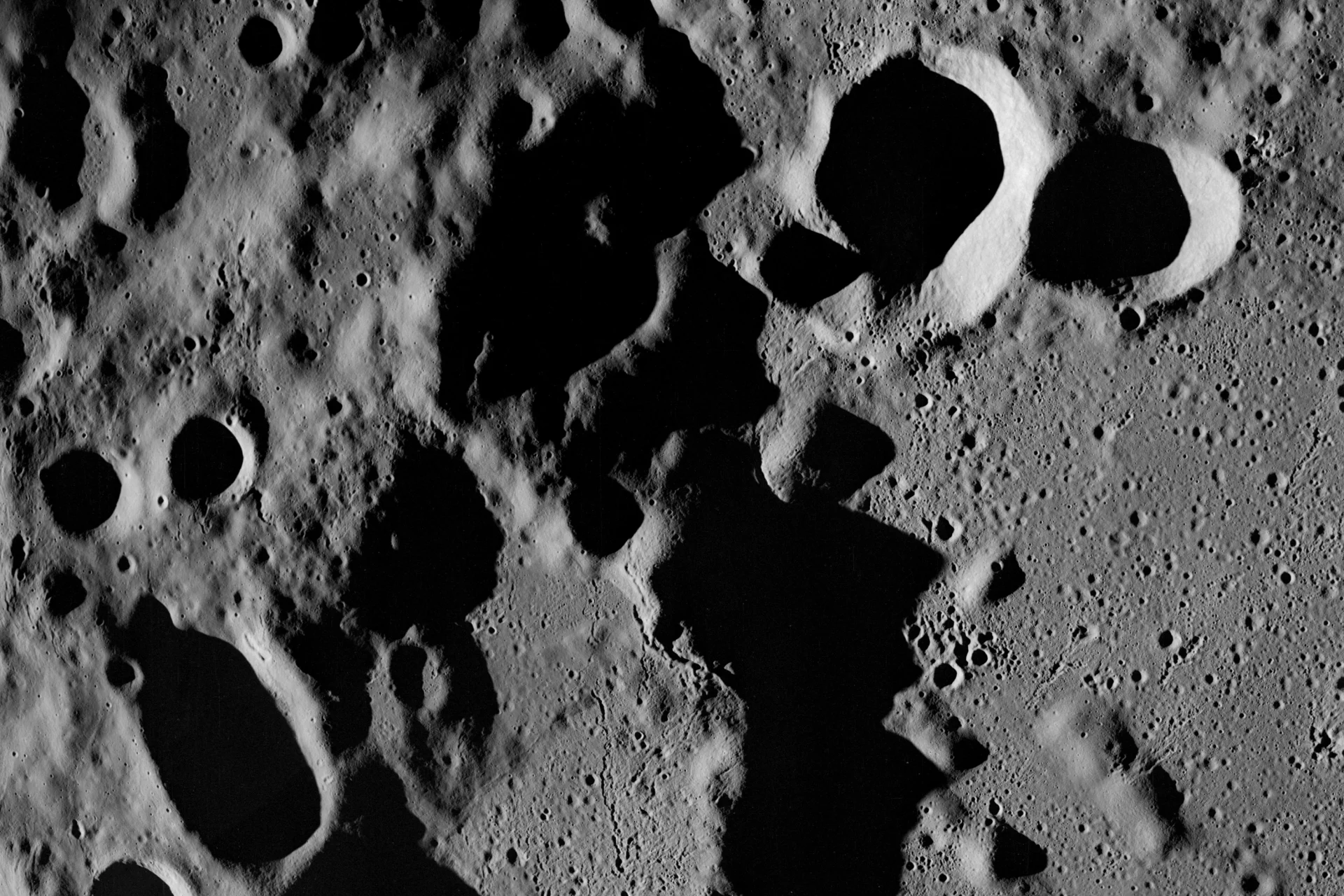
Today, the Moon has a very weak magnetic field—but did it always? This is something scientists have long debated. Some have theorized that the Moon did have its own magnetic field—a dynamo—some billions of years ago. Others disagree, saying the evidence doesn’t hold up. New observations from the Moon’s far side may finally settle the debate.
A review of archived lunar observations discovered a large, strongly magnetized rock in the Dewar region on the far side of the Moon. According to a study published today in Science Advances, this rock, about 37 miles (60 kilometers) wide, is likely solidified magma that emerged from deep inside the Moon roughly 4.2 billion years ago. The Dewar crater also hosts a lunar swirl—bright, sinuous patterns—that often coincides with magnetic anomalies on the lunar surface. Coupled with gravitational, orbital, and magnetic measurements, the findings strongly support the presence of an internally generated magnetic field in the Moon’s earliest days.
If true, the lunar magnetic field would have been around 11 microteslas, study co-authors Xi Yang and Anna Mittelholz told Gizmodo. (For context, Earth’s magnetic field today is around 50 microteslas.) “Dewar was a rare case where a magnetic anomaly, a gravity anomaly, and a surface swirl all coincide,” added Yang and Mittelholz, a PhD student and planetary scientist at ETH Zurich in Switzerland, respectively.
In astrophysics, the dynamo generates the magnetic field of a planetary body (and adjacent things) by driving the rotation and convection of hot, electrically conductive fluids deep within the core.
Source link