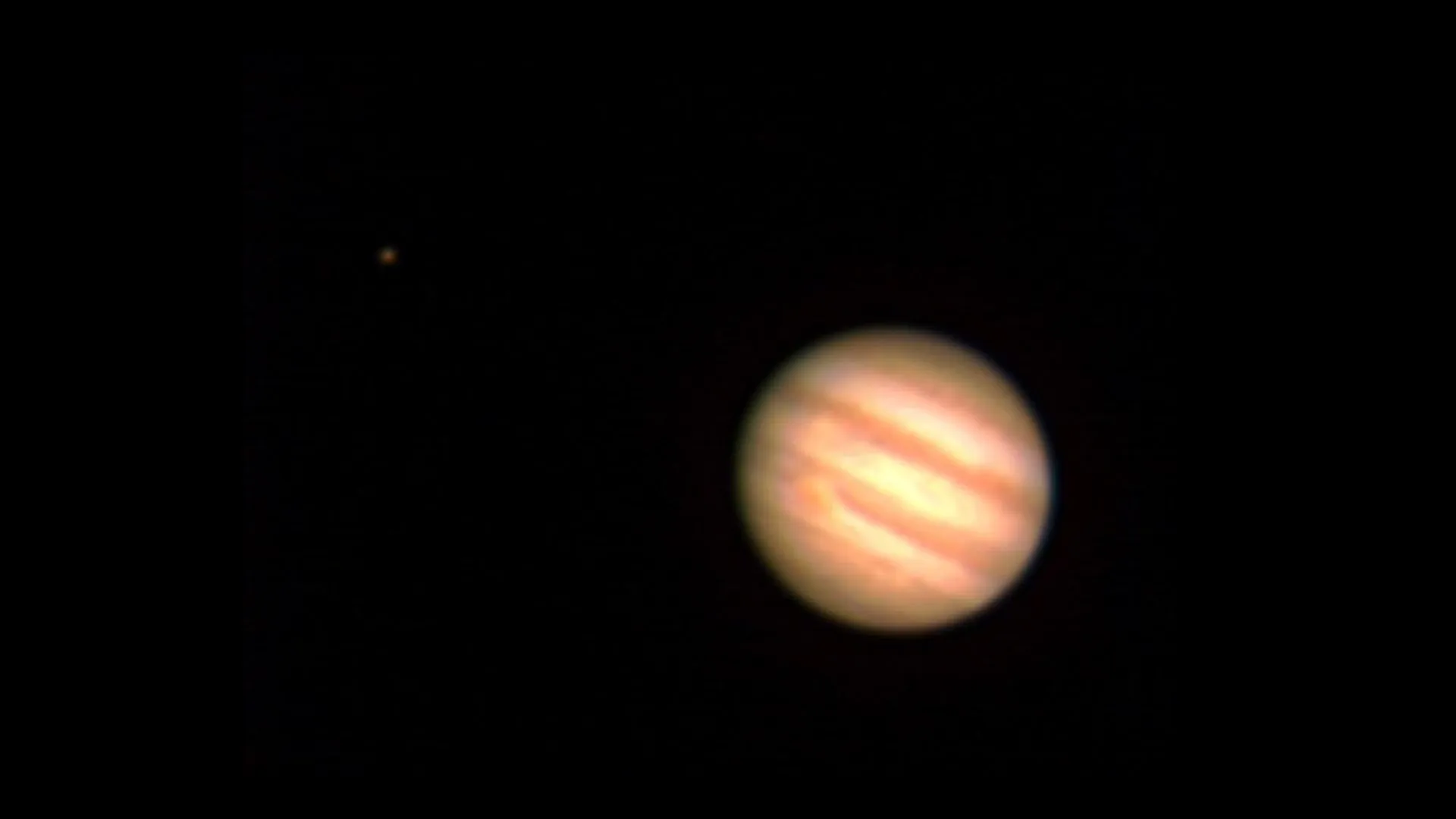
Water clouds are growing thicker and thinner on a frigid world just 7.5 light-years from Earth, giving astronomers a direct view of changing weather beyond the solar system.
A team led by Brittany Miles at the University of Arizona’s Steward Observatory used the James Webb Space Telescope to observe WISE 0855, the coldest known brown dwarf, for 11 hours.
Collecting a spectrum every 15 minutes, the researchers distinguished shifting cloud cover from gases rising out of deeper atmospheric layers.
WISE 0855 sits near the boundary between brown dwarfs and giant planets. Brown dwarfs lack sufficient mass to ignite as stars and instead emit faint light from heat left over after their formation.
At about twice Jupiter’s mass and nearly the same size, WISE 0855 resembles a free-floating giant planet. Its temperature is roughly 265 kelvins, or 17°F, placing it at the coldest end of the known brown dwarf population.
“This is the first time we’ve been able to confirm that water clouds are becoming thinner and thicker on a nearby world,” University of Arizona researcher Brittany Miles said.
“Before JWST, we only had photometry, which mixed up the effects of clouds, chemistry, and temperature all together. Now we can actually distinguish them,” she added.
As the object rotates, regions with different cloud cover and temperatures come into view.
Webb’s medium-resolution spectrograph tracked these variations across individual molecular features, allowing the team to separate atmospheric signals that earlier observations mixed together.
The observations revealed at least two processes operating simultaneously. Water clouds at high altitudes changed thickness, while convection carried chemical gases upward from deeper layers.
Source link