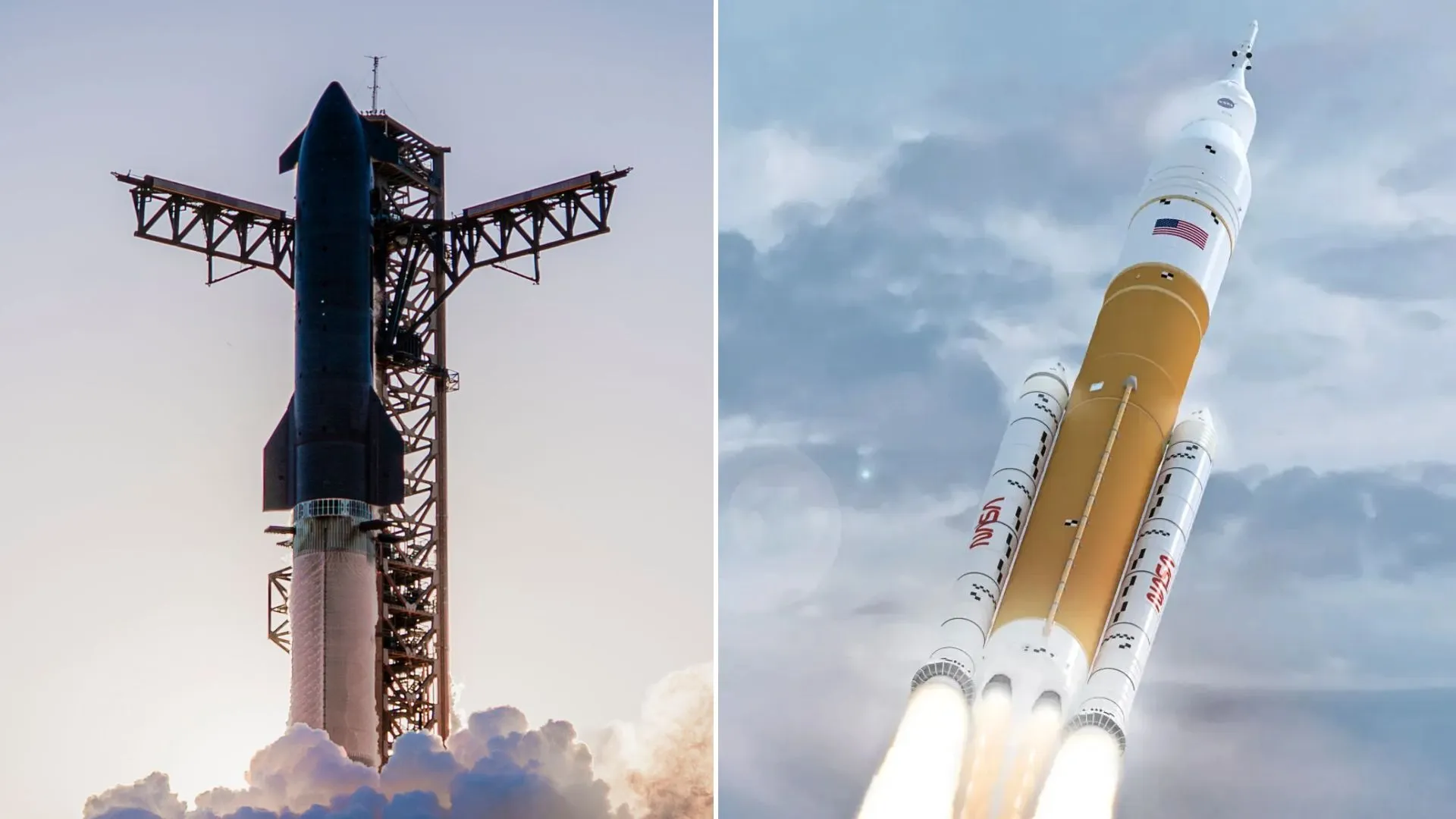
America’s return to the Moon relies on two radically different super heavy-lift launch vehicles: NASA’s Space Launch System (SLS) and SpaceX’s Starship. Though often framed as rivals, the two rockets are built on opposite engineering principles and play complementary roles in NASA’s Artemis program.
SLS will carry astronauts aboard the Orion capsule toward lunar space, and a modified Starship will serve as a commercial Human Landing System (HLS) to ferry crews down to the lunar surface.
In its Block 1 configuration, NASA’s Space Launch System stands 322 feet (98 meters) tall and produces 8.8 million pounds (39.1 meganewtons) of maximum thrust at liftoff. This is roughly 15 percent more thrust than the Apollo-era Saturn V. Its orange core stage burns super-cold liquid hydrogen and liquid oxygen through four Aerojet Rocketdyne RS-25 engines, which are upgraded variants of the Space Shuttle Main Engine.
Two flanking five-segment solid rocket boosters built by Northrop Grumman provide more than 75 percent of initial liftoff thrust during the first two minutes of flight before separating.
SpaceX’s Starship, by contrast, is a 407-foot-tall (124-meter) stainless-steel stack measuring 29.5 feet (9 meters) in diameter. It is wider than the 27.6-foot (8.4-meter) SLS core. Powered by 33 Raptor engines burning sub-cooled liquid methane and liquid oxygen, the Super Heavy first stage generates up to 18.1 million pounds (8,240 metric tons-force) of thrust, more than double the liftoff power of SLS.
Those propellant choices emphasize distinct engineering trade-offs. Liquid hydrogen offers high specific impulse, which means exceptional fuel efficiency per pound of propellant, making SLS well suited for injecting payloads directly onto a trans-lunar trajectory in a single launch.
Source link