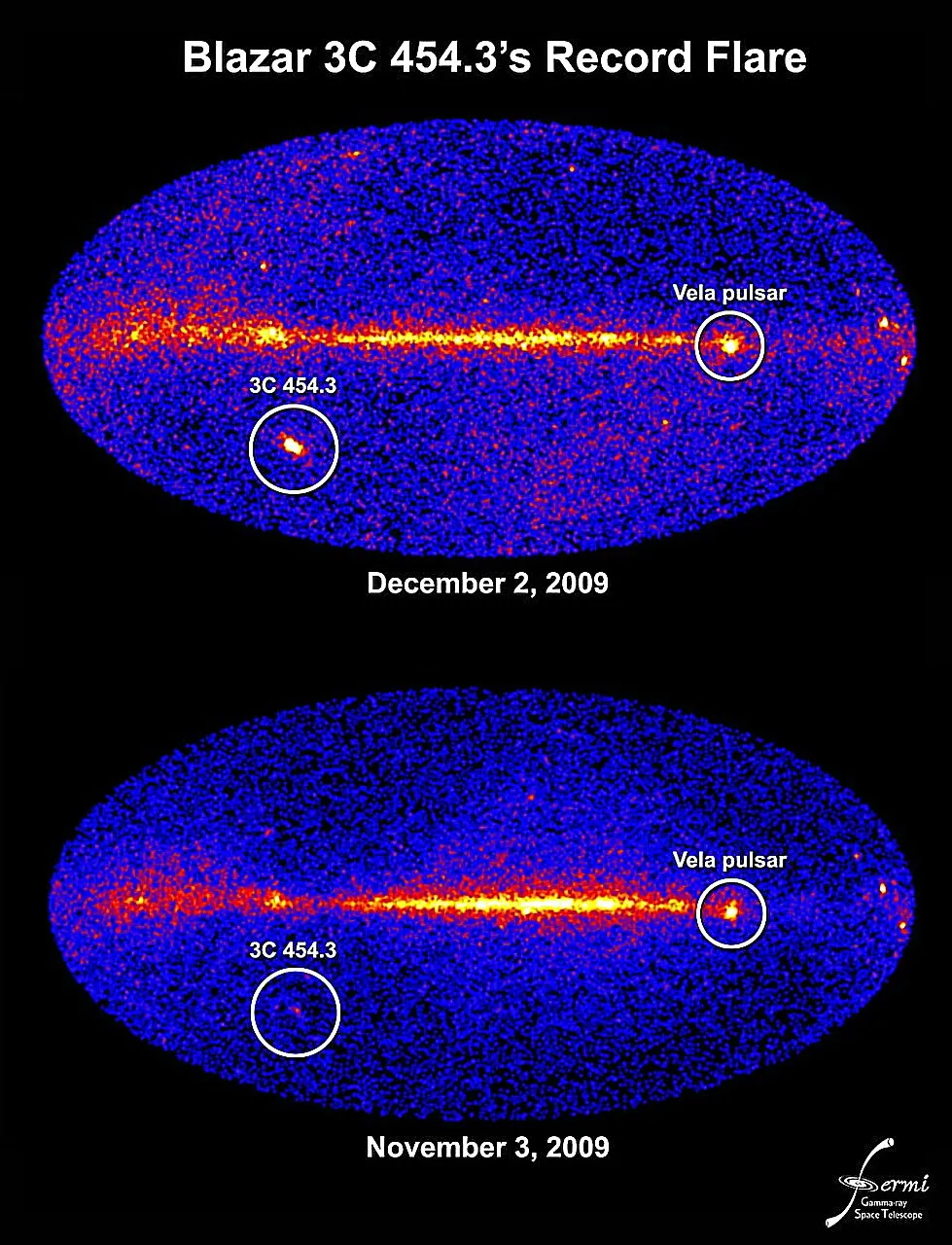
Gamma rays can reveal some of the most violent events in the universe, from matter falling into supermassive black holes to particles accelerated to extraordinary energies. Yet astronomers have struggled to explore one particular part of this radiation: the 20–200 megaelectronvolt (MeV) range.
This poorly charted region, known as the MeV gap, could hold important clues about how cosmic objects accelerate particles and release energy.
Now, an international team working with NASA’s Fermi Large Area Telescope (Fermi-LAT) has mapped 450 sources in this elusive energy range, including 60 newly detected gamma-ray sources with no established counterparts at other wavelengths.
The findings offer astronomers their most detailed catalog of this largely unexplored part of the gamma-ray sky.
The problem is not that gamma rays are too faint to detect. It is that they are exceptionally difficult to locate precisely. Unlike visible light, gamma rays cannot be focused using ordinary mirrors. Instead, instruments such as Fermi-LAT detect them through their interactions with matter inside the telescope, unlike specialized X-ray observatories.
When a gamma-ray photon enters Fermi-LAT, it interacts with tungsten layers, which convert it into a pair of charged particles: an electron and a positron. Silicon detectors then track these particles, helping astronomers work out where the original photon came from.
However, at lower energies, reconstructing its path becomes much harder because the particles scatter more as they travel through the instrument.
At around 20 MeV, Fermi-LAT can only narrow down a photon’s arrival direction to a region roughly 20 degrees across.
Source link