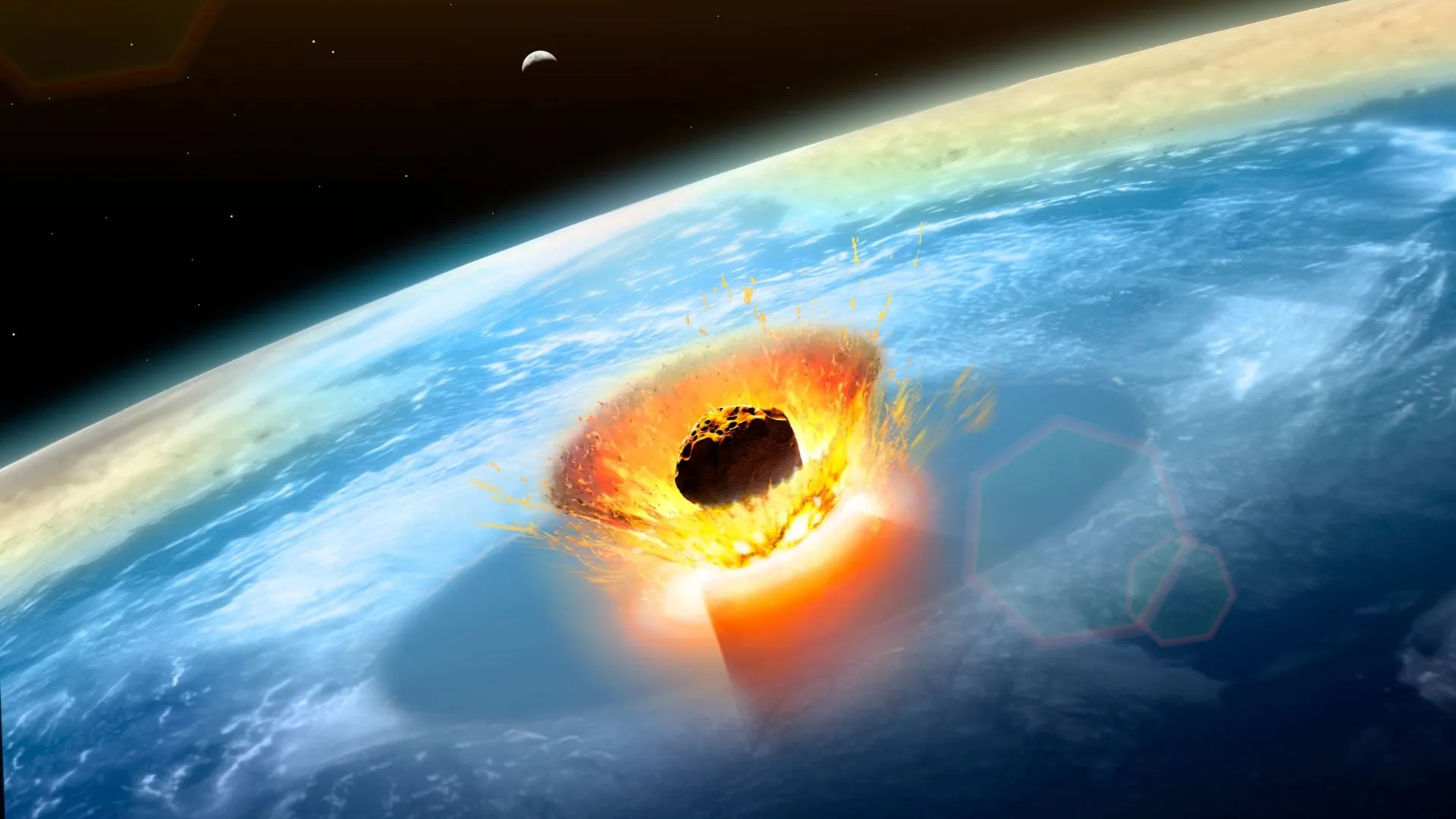
Researchers in the United States are developing three-dimensional simulations to examine how a nuclear device could be used to deflect or potentially disrupt an asteroid threatening Earth.
The team from Lawrence Livermore National Laboratory (LLNL) uses Spheral simulation code to more accurately model how an asteroid might respond when X-rays from a nuclear device detonated near its surface rapidly heat and vaporize material. After validating the approach against established asteroid-deflection models, researchers used Spheral to study three complex disruption scenarios.
The team revealed that unlike many natural disasters, a hazardous asteroid impact could potentially be prevented if the object is detected early enough. One approach is deflection — imparting a small change in velocity that causes the asteroid to miss Earth while largely remaining intact. Another approach is disruption, in which an asteroid is intentionally fragmented and dispersed so that no remaining piece poses a significant threat to the planet. NASA’s Double Asteroid Redirection Test, or DART, demonstrated a kinetic-impact approach to deflection in 2022 by deliberately striking the asteroid moon Dimorphos. Nuclear mitigation represents an alternative emergency option, particularly for larger objects or scenarios with shorter warning times, because much more energy can be delivered to an asteroid than the kinetic energy of a spacecraft impactor, according to a press release. Two of the simulations showed strong signs of disruption, highlighting how high-fidelity 3D modeling can help researchers better understand how an asteroid could respond to a nuclear mitigation attempt, as per the release. “These simulations give us a much more detailed picture of how an asteroid may respond to a nuclear mitigation attempt,” said Isaiah Santistevan, who led the study.
Source link