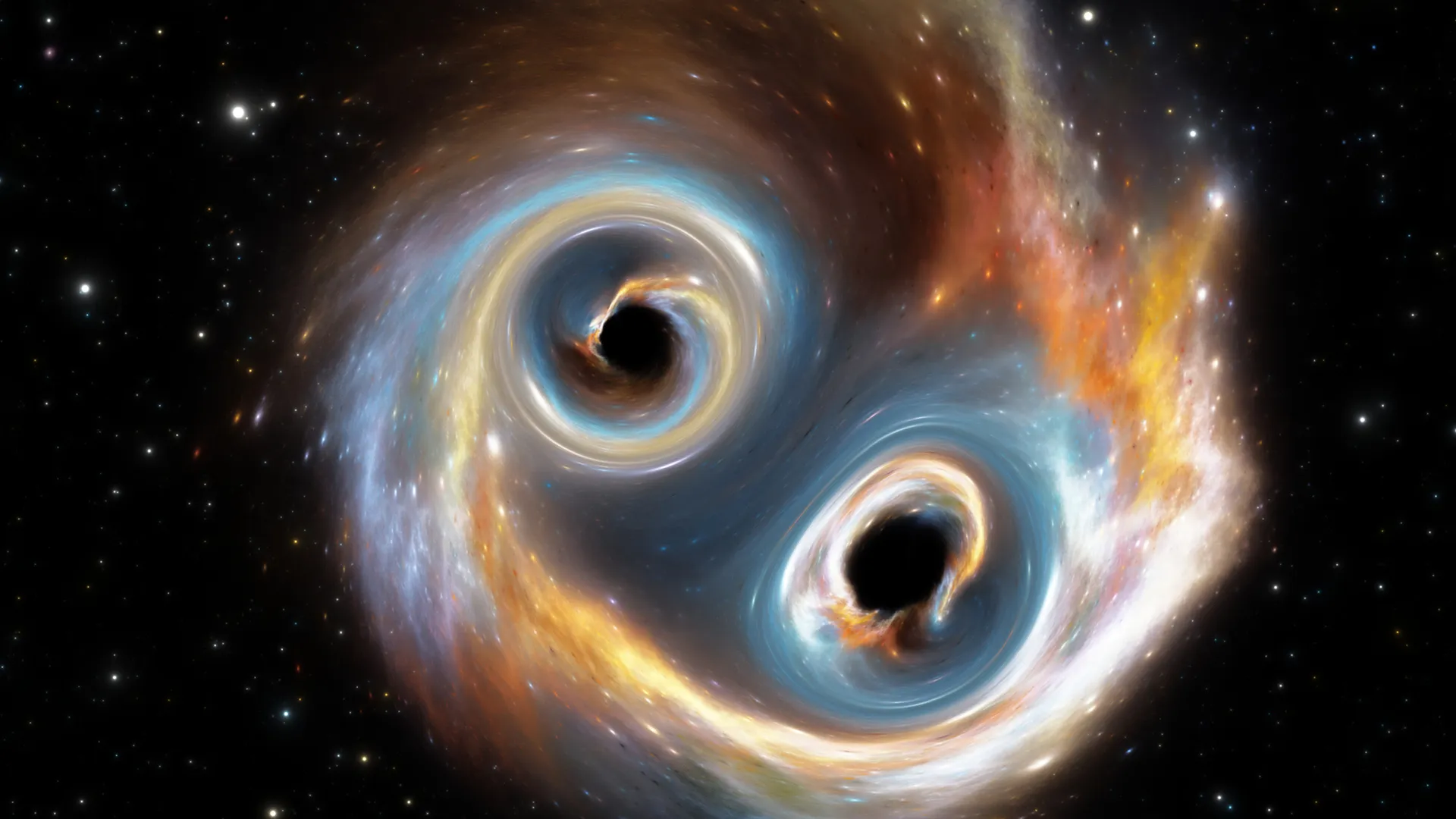
Black holes are famous for colliding and merging into larger ones. However, could a black hole tear itself apart and become two black holes?
A new theoretical study exploring the answer to this question suggests that a black hole spinning almost as fast as physics allows might be able to split, although the laws governing black holes make such a breakup extremely difficult.
The findings could help scientists understand the limits of Einstein’s theory of general relativity and investigate whether black holes can behave in ways that challenge our current understanding of the universe.
“Our analysis clarifies the theoretical landscape where black holes may fragment, which is particularly relevant for primordial black holes and catastrophic events such as black hole mergers,” the study authors note.
One major obstacle is entropy, a measure of how many microscopic arrangements a system can have while appearing the same from the outside.
For a non-rotating black hole, entropy increases with the square of its mass. Splitting one black hole into two smaller ones with the same combined mass would therefore reduce their total entropy, making the process thermodynamically unfavorable.
“In our study, we investigate which physical laws normally prevent a black hole from splitting into two. We also investigate if certain circumstances may allow a split to happen,” Francesco Sannino, study co-author and a professor of physics at the University of Naples Federico II, said.
The researchers found that rapidly rotating black holes could provide a possible way around the entropy barrier.
Source link