This article has been reviewed according to Science X's editorial process and policies. Editors have highlighted the following attributes while ensuring the content's credibility:
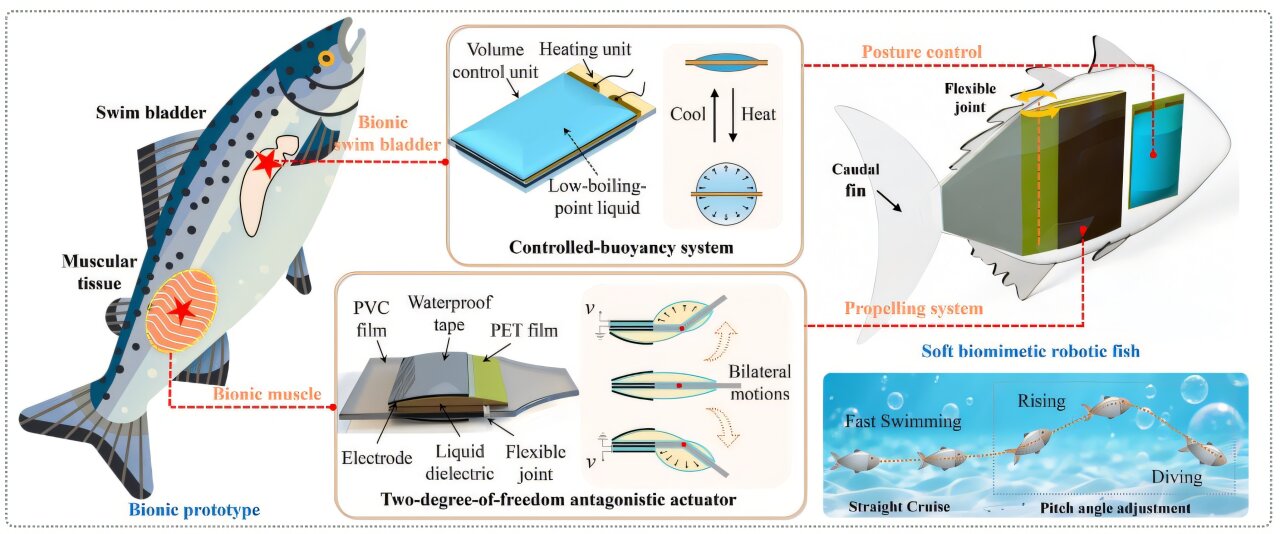
Researchers from the Shenyang Institute of Automation (SIA) of the Chinese Academy of Sciences have developed an electrohydraulically actuated soft robotic fish that can swim at high speeds and perform agile three-dimensional (3D) maneuvers. The soft robotic fish addresses a longstanding design challenge by combining a rigid–flexible coupled propulsion system with dynamic buoyancy regulation. This allows for fast propulsion without sacrificing maneuverability.
The study was published in IEEE/ASME Transactions on Mechatronics on Oct. 5.
Soft robotic fish show potential for underwater environmental monitoring and resource exploration. However, conventional designs often sacrifice swimming speed for maneuverability, especially when performing complex 3D movements.
Inspired by the coordinated action of fish muscles and skeletons, as well as the buoyancy regulation provided by the swim bladder, the researchers incorporated these biological mechanisms into the robotic design. The system combines electrohydraulic propulsion with active buoyancy control to enable rapid propulsion and flexible 3D movement.
The researchers designed a rigid–flexible electrohydraulic actuator with two degrees of freedom. Local rigid constraints reduce undesired deformation during actuation. Alternating movements of the two driving units mimic antagonistic muscle contractions, generating high-frequency tail oscillations.
4 J/(kg·m). This sets a new speed record for soft robotic fish using body-caudal-fin (BCF) propulsion.
Source link