This article has been reviewed according to Science X's editorial process and policies. Editors have highlighted the following attributes while ensuring the content's credibility:
Smartphones combine cameras, motion sensors and powerful processors in devices that fit inside a pocket. These features could also make them useful components for robots, reducing the need to buy and connect separate sensors, processors or other electronics.
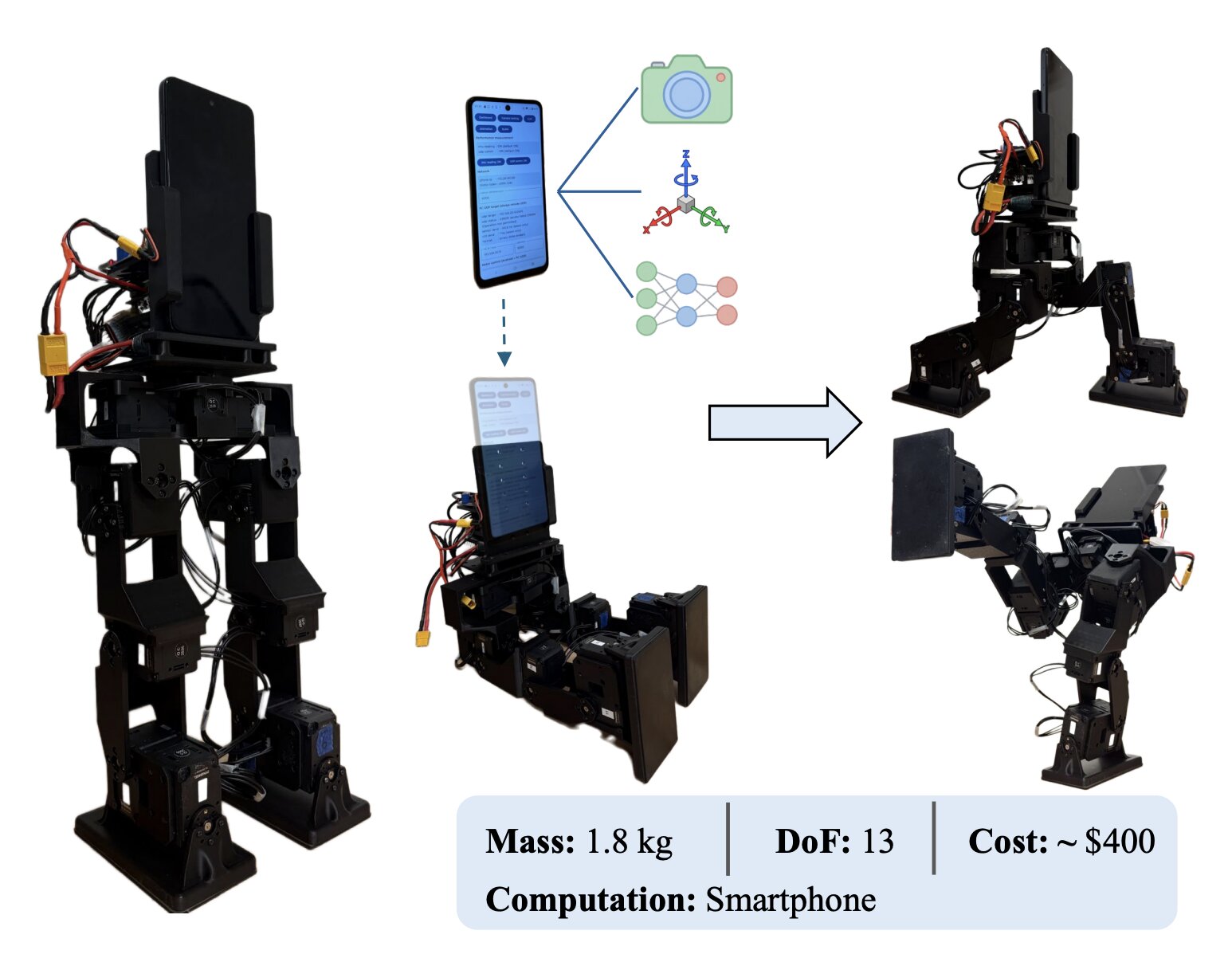
Researchers at the University of California, Los Angeles, recently developed PhoneBot, a small humanoid robot that relies on an Android smartphone to sense its surroundings and control its movements. Their proposed system, introduced in a preprint posted to arXiv, could make robotics experiments more accessible for students and researchers worldwide.
PhoneBot stands approximately 19 inches (48 centimeters) tall and weighs about 4 pounds (1.8 kilograms), including the smartphone it relies on. The researchers estimate its hardware cost at around $400, excluding the smartphone. In initial demonstrations, the team showed that the robot can walk, track a person and stand up from a face-down position.
The smartphone is mounted above PhoneBot's hips, essentially forming its torso. The phone's camera allows the robot to detect and track people, while its motion sensors can gather information about the body's movement and orientation.
The phone also runs the software controlling the robot's movements. It sends commands over Wi-Fi to a small onboard computer, which forwards them to the motors.
PhoneBot has 13 motors: six in each leg and one that rotates its torso. This additional joint allows the camera to turn sideways while the robot's feet remain planted.
Source link