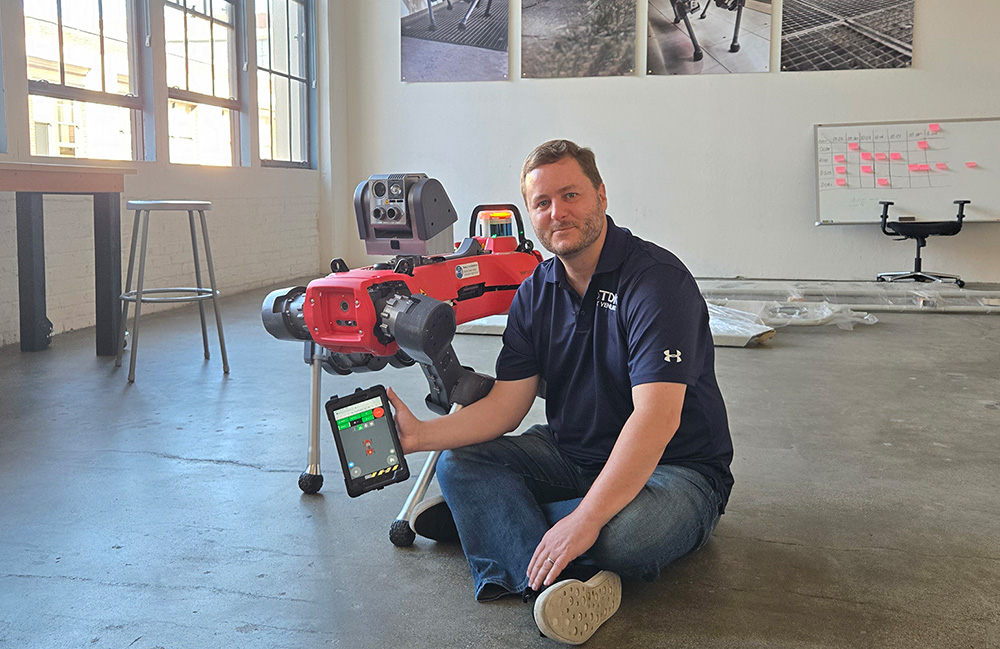
Nicolas Sauvage, founder and president of TDK Ventures, with ANYbotics’ quadruped robot. | Source: TDK Ventures
A robot picks up an object, moves it, and puts it down successfully. Is it dexterous? Perhaps. But now ask it to do that successfully hundreds of times, while objects move slightly, its grip changes, components wear, and unexpected failures occur. That is a much harder test of dexterity, and a much better measure of whether a robot is dexterous enough for the real world.
We are making rapid progress in what robots can manipulate. However, useful dexterity isn’t simply the ability to complete an individual action once. It is the ability to sense, grasp, move, adjust and recover reliably enough to complete an entire workflow without constant human assistance.
A robot that succeeds 99% of the time sounds ready for work, but a job rarely consists of a single action. Consider a workflow that requires 100 physical actions in a sequence. At a 99% success rate for each action, the probability that all 100 succeed on the first attempt is just 36.6%. Increase the success rate to 99.9%, and the probability of completing the workflow rises to 90.5%. At 99.99%, it reaches 99.0%.
This is, of course, a simplified example that assumes equal and independent success rates, but it illustrates an important point. A robot with a 99% success rate is not necessarily 99% automated.
Small reliability gaps become much bigger when repeated across an entire workflow. This means that a robot that looks almost flawless in a demonstration can still be far from ready for autonomous deployment.
Source link