This article has been reviewed according to Science X's editorial process and policies. Editors have highlighted the following attributes while ensuring the content's credibility:
Humanoid robots, robotic systems with a human-like body structure, could assist people in homes, offices, health care facilities, public spaces and various other environments. Before they can be reliably deployed in these settings, however, robots should be able to safely navigate cluttered and dynamic environments.
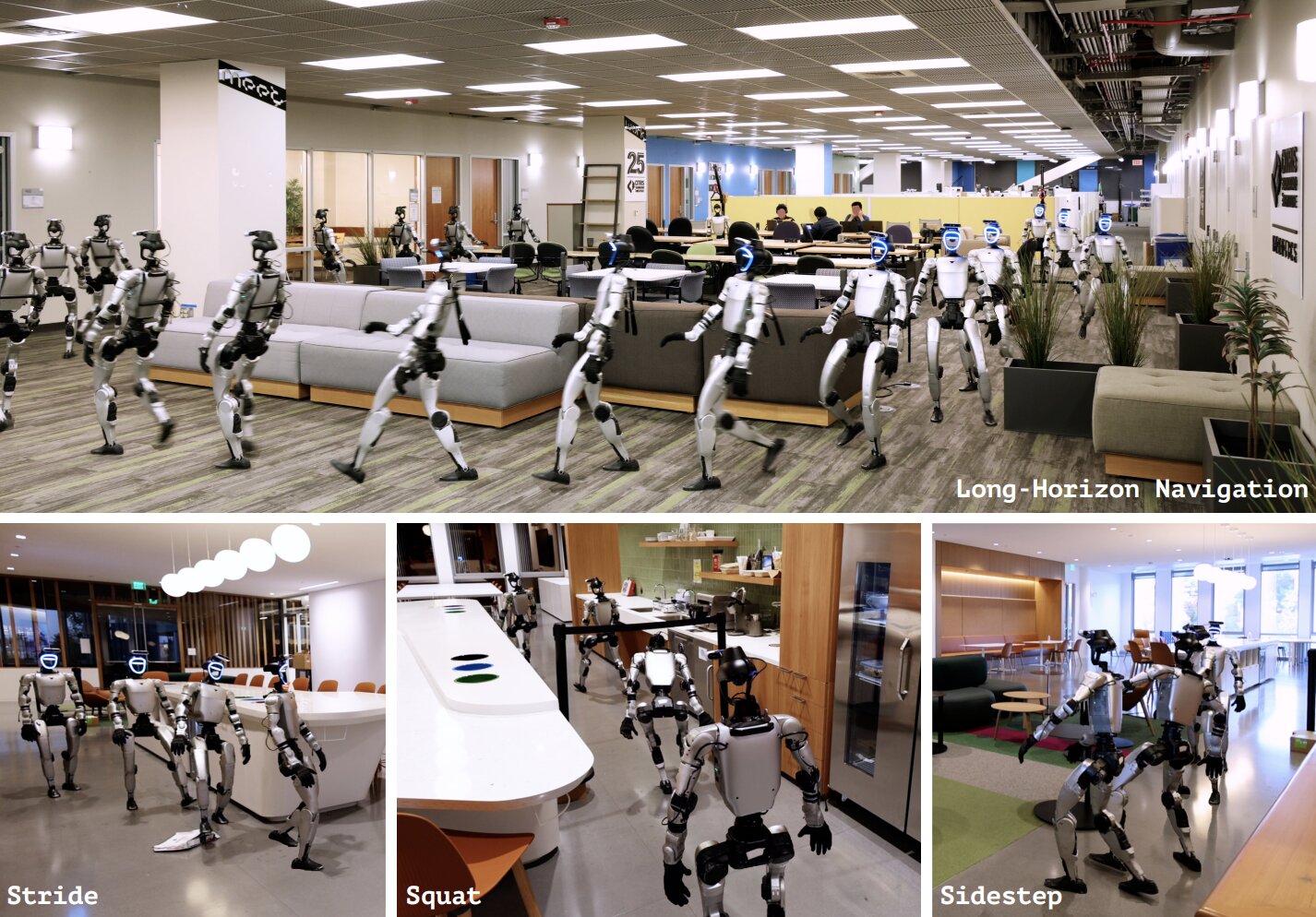
In a recent paper posted to the arXiv preprint server, researchers at the University of California, Berkeley (UC Berkeley) and Princeton University introduced TANGO, an artificial intelligence vision-language robot navigation framework that could improve robot navigation in unpredictable real-world settings. The project was led by Anqi Li, with Yuxin Chen, Zhaobo Li, Zhuo Cao, Junli Ren and Masayoshi Tomizuka from UC Berkeley, in collaboration with Dhruv Shah at Princeton University.
"I have been working on end-to-end navigation foundation models for many years now, and almost all navigation research—including a lot of my own—treats the problem as drawing a line on the floor: a 2D route from A to B," Dhruv Shah, co-senior author of the paper, told Tech Xplore. "That is a reasonable abstraction for a wheeled robot, but a humanoid is a tall, wide, articulated body whose shape changes continuously as it moves. Whether a route is actually passable depends on what the arms, torso and legs are doing at that moment."
When conducting earlier studies, Shah and his colleagues were running into similar system failures. Specifically, they found that a navigation policy would confidently commit to a path through a gap in which the robot could not realistically fit.
Source link