This article has been reviewed according to Science X's editorial process and policies. Editors have highlighted the following attributes while ensuring the content's credibility:
In a potential advance for wearable technology, researchers from Virginia Commonwealth University and Florida International University have developed a cold-spray technique that can reliably deposit sensors directly onto human skin and other flexible surfaces.
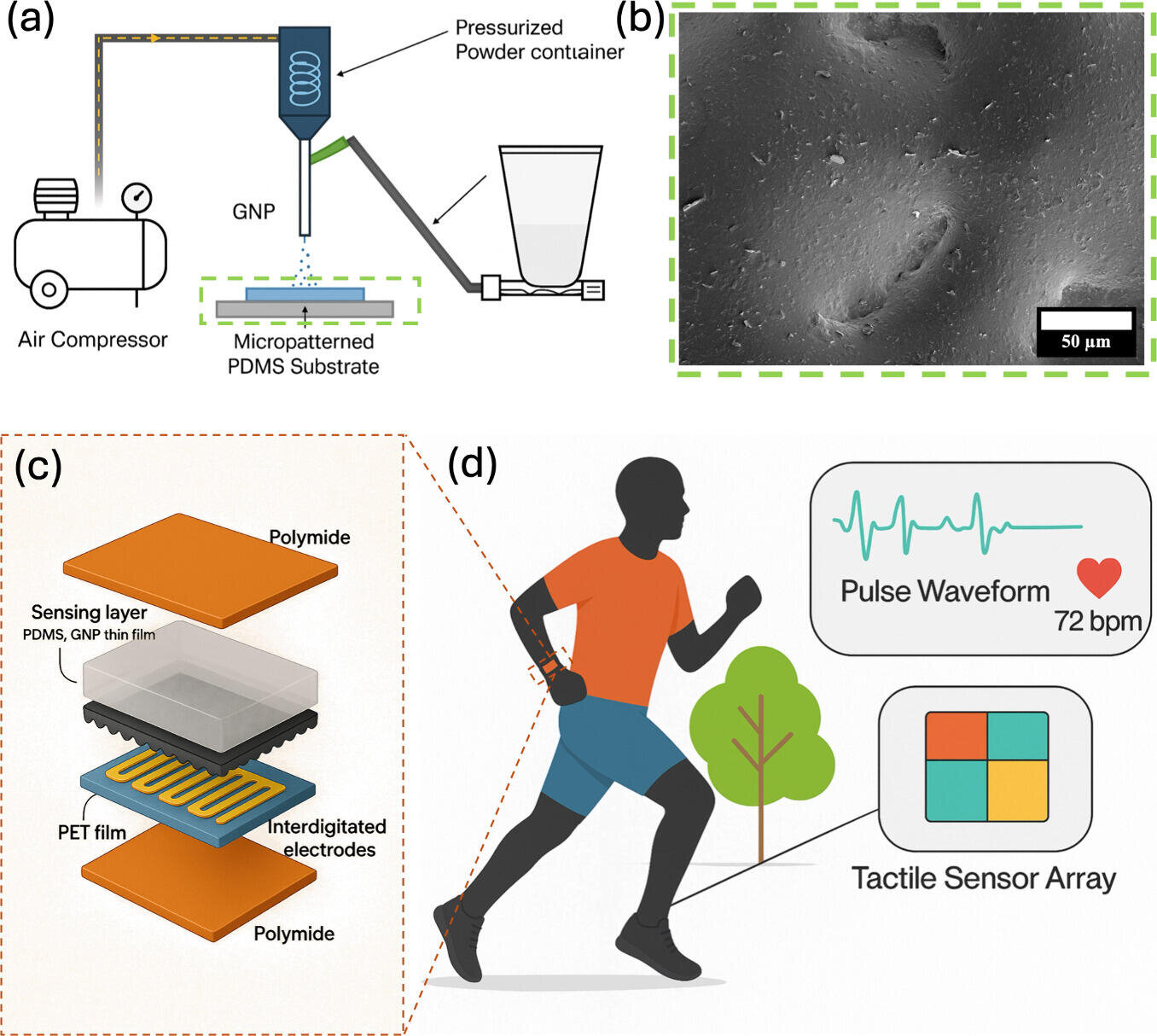
Wearable sensors offer substantial benefits for health monitoring, human-machine interaction and flexible electronics, yet fabrication often relies on costly, multistep processes with limited scalability. The researchers report that their technique provides strong adhesion of sensors to flexible surfaces while maintaining mechanical robustness and the potential for scalable manufacturing.
The expansion of wearable technology has led to a growing need for low-cost, expandable and high-performing sensors, said Arvind Agarwal, Ph.D., chair and professor in the Department of Mechanical and Nuclear Engineering in VCU's College of Engineering. These sensors allow for continuous health monitoring and customized health care for the individual wearing them.
Agarwal and the research team created an improved wearable pressure sensor and a first-ever cold-spray method to adhere it to the human body. The sensor is made of polydimethylsiloxane polymer, a soft, stretchy rubber material that molds to where it is applied. The cold spray directly applies graphene nanoplatelets to the PDMS material for durable adhesion onto human skin.
"The sensor can be made by spraying the sensing material [graphene] directly onto a flexible surface, without glue or several complicated steps," Agarwal said.
Source link