This article has been reviewed according to Science X's editorial process and policies. Editors have highlighted the following attributes while ensuring the content's credibility:
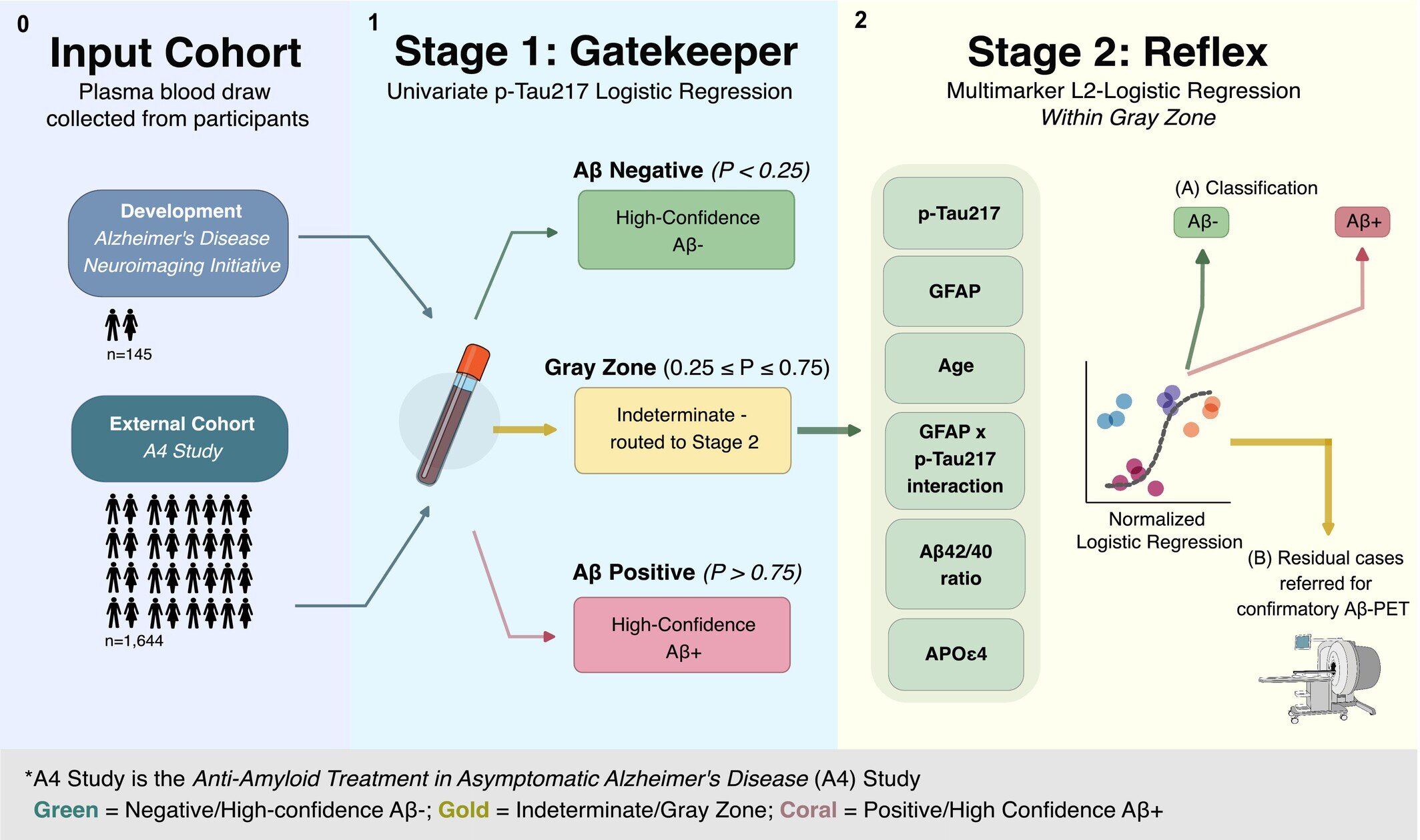
Blood-based biomarkers (BBMs) are blood tests that can detect Alzheimer's disease (AD) brain changes earlier, more cheaply and more easily than traditional methods such as Aβ-PET scans, which are expensive and have limited accessibility. However, blood tests do not always give a clear yes-or-no answer. One of the most promising blood markers, called p-Tau217, can leave a substantial number of people with an uncertain diagnosis. Patients within this "gray zone" may need an expensive brain scan or other testing to determine whether amyloid, a key feature of Alzheimer's disease, is present.
To address this problem, researchers at Boston University Chobanian & Avedisian School of Medicine and the University of Connecticut have developed and tested a two-step approach called the Gatekeeper‐Reflex model for AD (GRAD)—a step-by-step blood-testing strategy that could resolve many of these uncertain results. While promising, the researchers caution that GRAD is not ready to replace confirmatory imaging and still needs to be tested prospectively before use in routine clinical care.
The paper is published in the journal Annals of Clinical and Translational Neurology.
"GRAD does not try to replace a good Alzheimer's blood test. Instead, it focuses additional testing specifically on the people for whom the first blood test does not give a clear answer. This creates a practical 'test first, investigate further only when needed' approach that more closely resembles how clinicians make decisions in the real world," explains first author Harthik Parankusham, a student in the department of physiology and neurobiology at the University of Connecticut.
Source link