This article has been reviewed according to Science X's editorial process and policies. Editors have highlighted the following attributes while ensuring the content's credibility:
A tiny sensor could one day measure blood pressure continuously, comfortably and accurately without an inflatable cuff. The device was developed by professors Amir Rosenthal and Daniel Lange of the Technion's Andrew and Erna Viterbi Faculty of Electrical and Computer Engineering, together with doctoral student Gil Gelbert. They published their findings in Nature Communications.
Blood pressure is one of the most important indicators of cardiovascular health, yet in most cases it is still measured using an inflatable cuff that provides a reading at a single point in time. The researchers' device is a tiny wearable sensor that measures blood pressure continuously, without a cuff or any action required from the user.
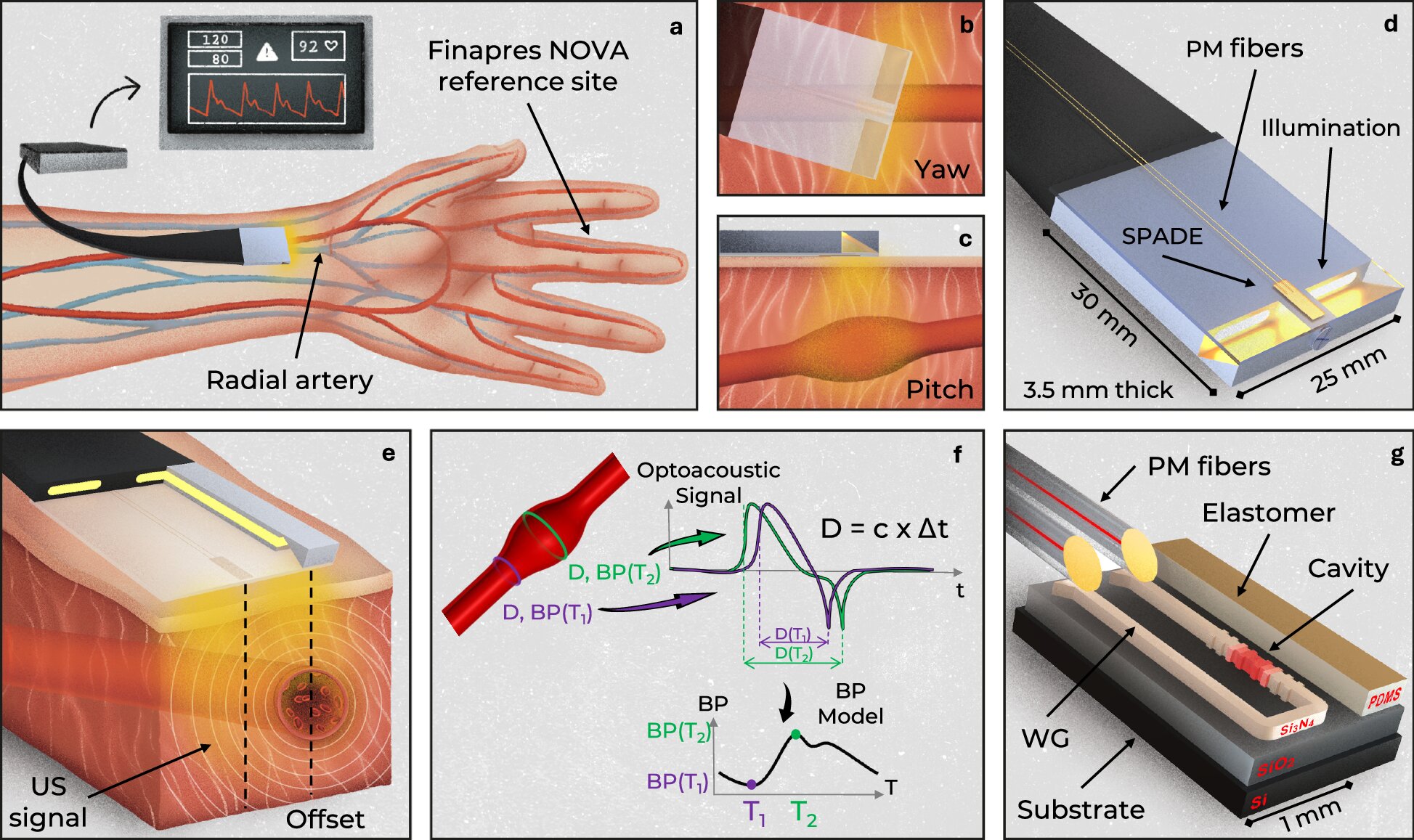
The device is based on silicon photonics and optoacoustic technology. Short pulses of light generate ultrasound waves inside an artery, while a tiny sensor called SPADE measures both the artery's absolute diameter and its minute changes with each heartbeat. These measurements can be used to reconstruct the full blood pressure waveform and estimate blood pressure in real time and over extended periods.
By measuring the artery's absolute diameter for the first time using this miniature sensing approach, SPADE overcomes a major limitation of earlier technologies. Combined with sophisticated AI-based modeling of arterial behavior, this capability provides a more complete basis for accurate, continuous blood pressure estimation.
Source link