This article has been reviewed according to Science X's editorial process and policies. Editors have highlighted the following attributes while ensuring the content's credibility:
The human brain is constantly taking in information about the world through sight, touch, hearing and the other senses. Influential theories in neuroscience and psychology suggest that it also anticipates incoming sensory information, preparing to process what we are likely to see or feel in specific scenarios.
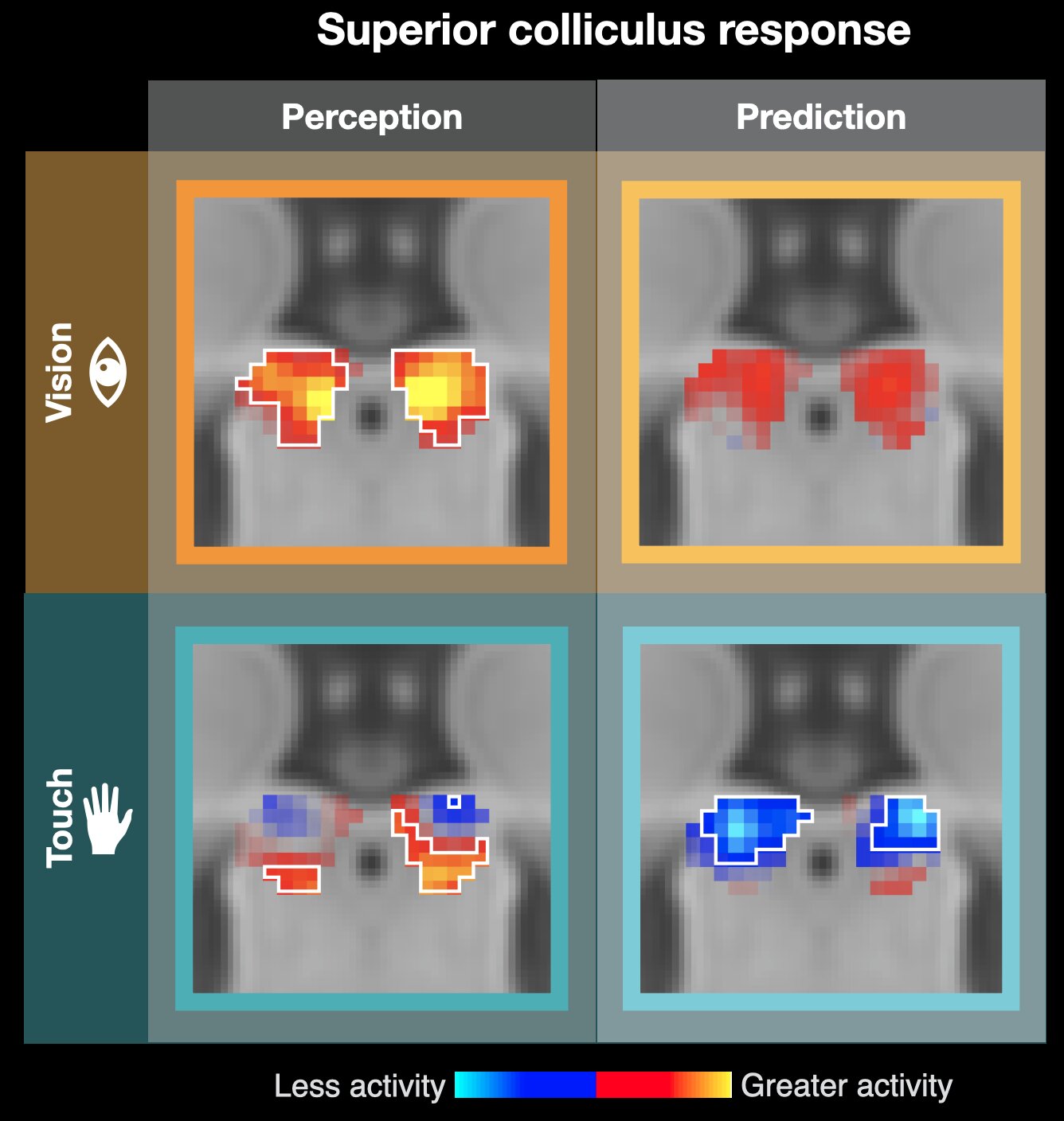
Researchers at Massachusetts Institute of Technology (MIT), Northeastern University, Massachusetts General Hospital and other institutions recently carried out a study investigating the possible role of the superior colliculus, a small structure in the midbrain, in the prediction of upcoming sensory events.
Their findings, published in Nature Neuroscience, indicate that the superior colliculus not only responds to incoming sensory information but also anticipates upcoming sensory events.
"This project grew out of a broader idea in neuroscience called predictive processing: the brain doesn't just wait for sensory input and react to it, it constantly predicts what's about to happen and prepares for it," Danlei Chen, first author of the paper, told Medical Xpress. "This matters because reacting after the fact is costly, both in energy and in time."
Preparing for imminent events could allow the brain to respond faster and use available resources more efficiently. Chen and her colleagues hypothesized that the superior colliculus could be involved in the anticipation of sensory events and set out to test this idea.
"The superior colliculus is one of the most well-studied brainstem structures, in part because it is so prominent in animal brains, and decades of animal work have shown that its anatomical layers handle different senses and functions: vision, touch and orienting the eyes and body," said Chen.
Source link