This article has been reviewed according to Science X's editorial process and policies. Editors have highlighted the following attributes while ensuring the content's credibility:
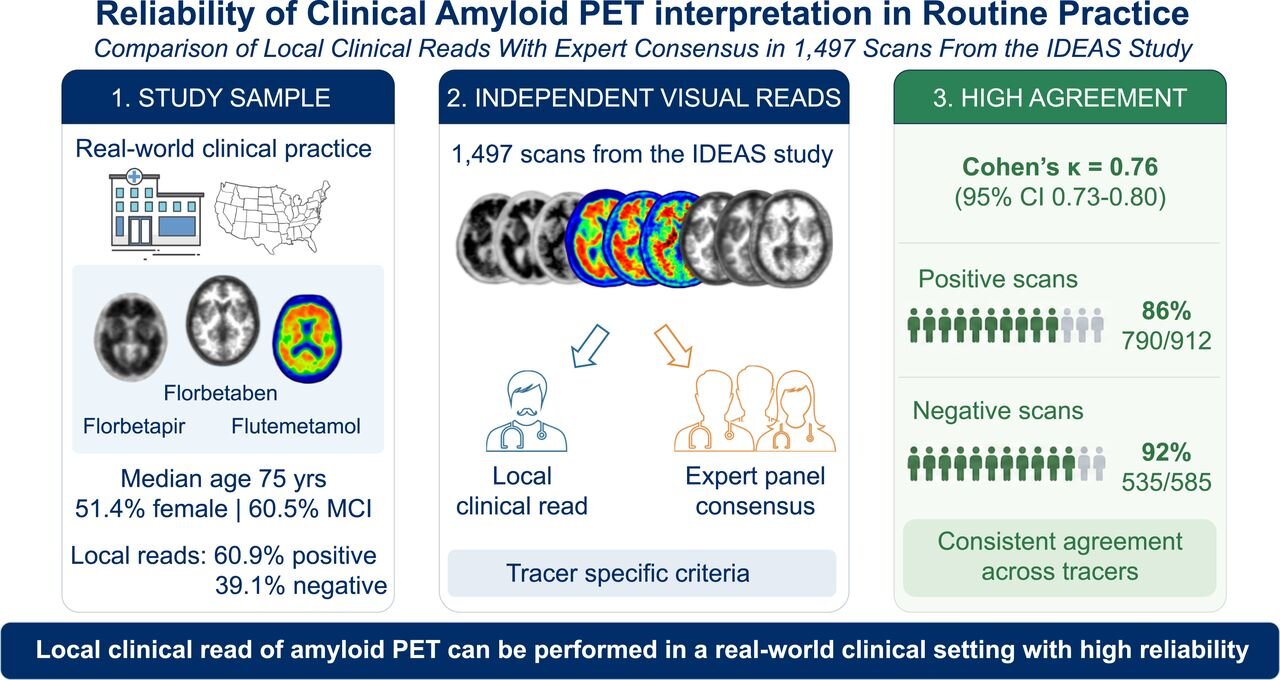
In routine clinical practice, local radiologists and nuclear medicine physicians can reliably interpret amyloid PET scans to aid in the diagnosis and management of Alzheimer's disease, showing good agreement with interpretations by amyloid PET specialists. According to a new study published in The Journal of Nuclear Medicine, local interpretations of nearly 1,500 scans showed excellent agreement with expert panel assessments, demonstrating that visual reads performed in community settings are highly reliable.
The buildup of amyloid plaques in the brain is one of the first signs of Alzheimer's disease. Amyloid-specific PET tracers have been developed to identify this buildup at its earliest stages, revolutionizing how physicians identify and monitor the disease. Today, with the advent of novel disease-modifying therapies and widening reimbursement by third-party payers, amyloid PET is playing an increasing role in the diagnosis and management of patients with suspected Alzheimer's disease.
"For many years, amyloid PET was primarily used in research and clinical trials, and real-world experience was relatively limited," said Gil Rabinovici, M.D., FAAN, FANA, professor of neurology and radiology at the University of California San Francisco. "As amyloid PET becomes more widely used, it's crucial to understand how reliably physicians can interpret the scans in everyday practice."
Rabinovici and colleagues utilized data from the Imaging Dementia—Evidence for Amyloid Scanning (IDEAS) study, which captured more than 18,000 clinical scan interpretations from local radiologists and nuclear medicine physicians in the United States.
Source link