This article has been reviewed according to Science X's editorial process and policies. Editors have highlighted the following attributes while ensuring the content's credibility:
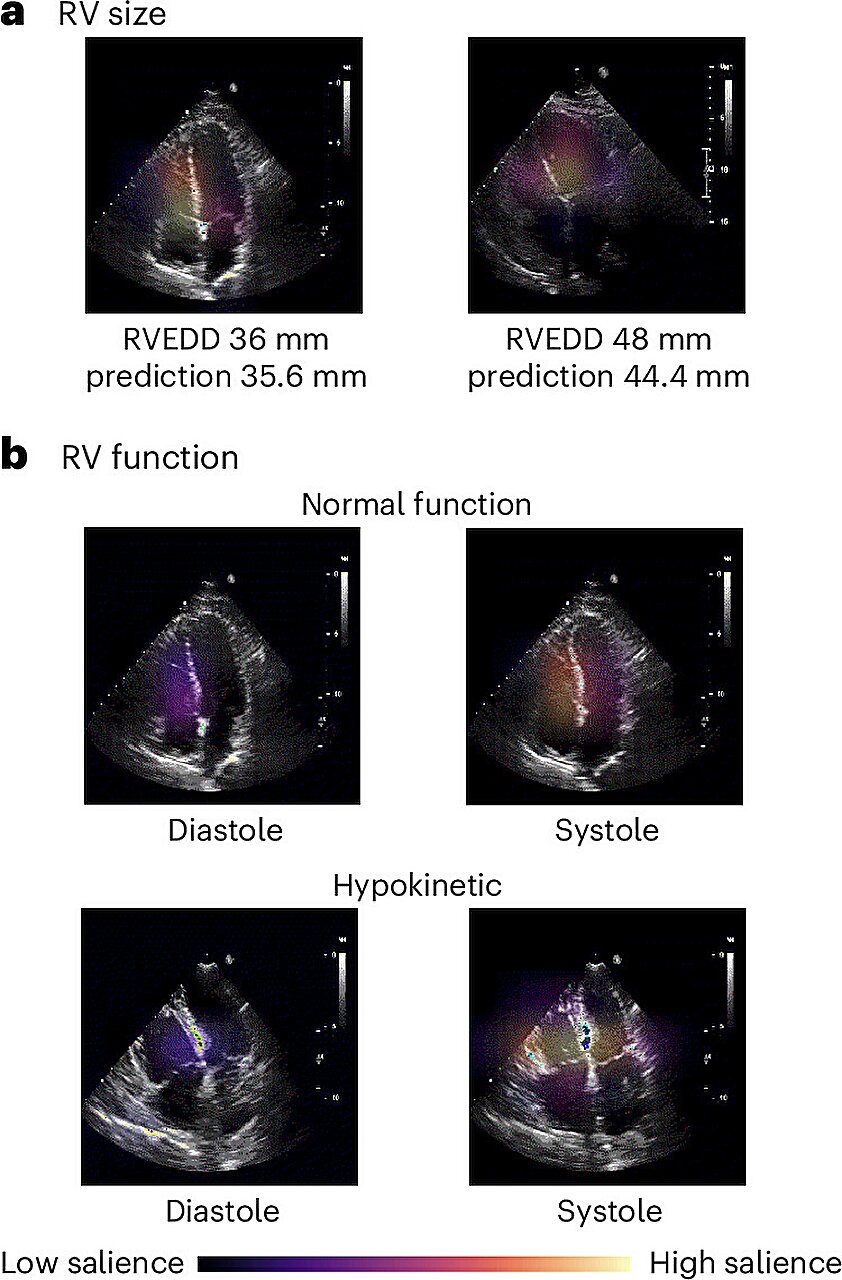
A new study develops and tests DROID-RV, a deep learning model that estimates right ventricular size and function from echocardiograms, and assesses how those estimates relate to later health outcomes. Mostafa Al-Alusi, M.D., M.S., and Patrick T. Ellinor, M.D., Ph.D., of the Mass General Brigham Heart and Vascular Institute, are the lead and senior authors of a paper published in Nature Cardiovascular Research, "Deep Learning-Enabled Assessment of Right Ventricular Size and Function is Associated with Cardiovascular Outcomes."
The right ventricle (RV)—the part of the heart that pumps blood to the lungs—is hard to assess with cardiac ultrasound because of its crescent shape and position behind the breastbone. For this reason, imaging the RV takes significant time and expertise. More advanced imaging such as cardiac MRI is more precise, but it is expensive and not as widely available.
We wanted a fast, consistent way to evaluate the right ventricle using echocardiograms, which are easier to obtain.
In our study, we asked, "Can a deep learning model automatically estimate the size of the right ventricle and detect reduced pumping function directly from routine echocardiogram videos?"
We also wanted to explore whether those automated estimates could tell us anything about a patient's risk of death or risk of developing atrial fibrillation or heart failure, conditions where RV size and function are important to prognosis.
Using a type of model that is especially good at processing image data, we developed DROID-RV and trained it on more than 380,000 echocardiogram video clips from about 17,000 patients seen in cardiology clinics.
Source link