This article has been reviewed according to Science X's editorial process and policies. Editors have highlighted the following attributes while ensuring the content's credibility:
University of South Florida researchers have discovered a previously unknown vulnerability in Plasmodium vivax (P. vivax), a malaria parasite that infects millions of people in Central and South America and Southeast Asia.
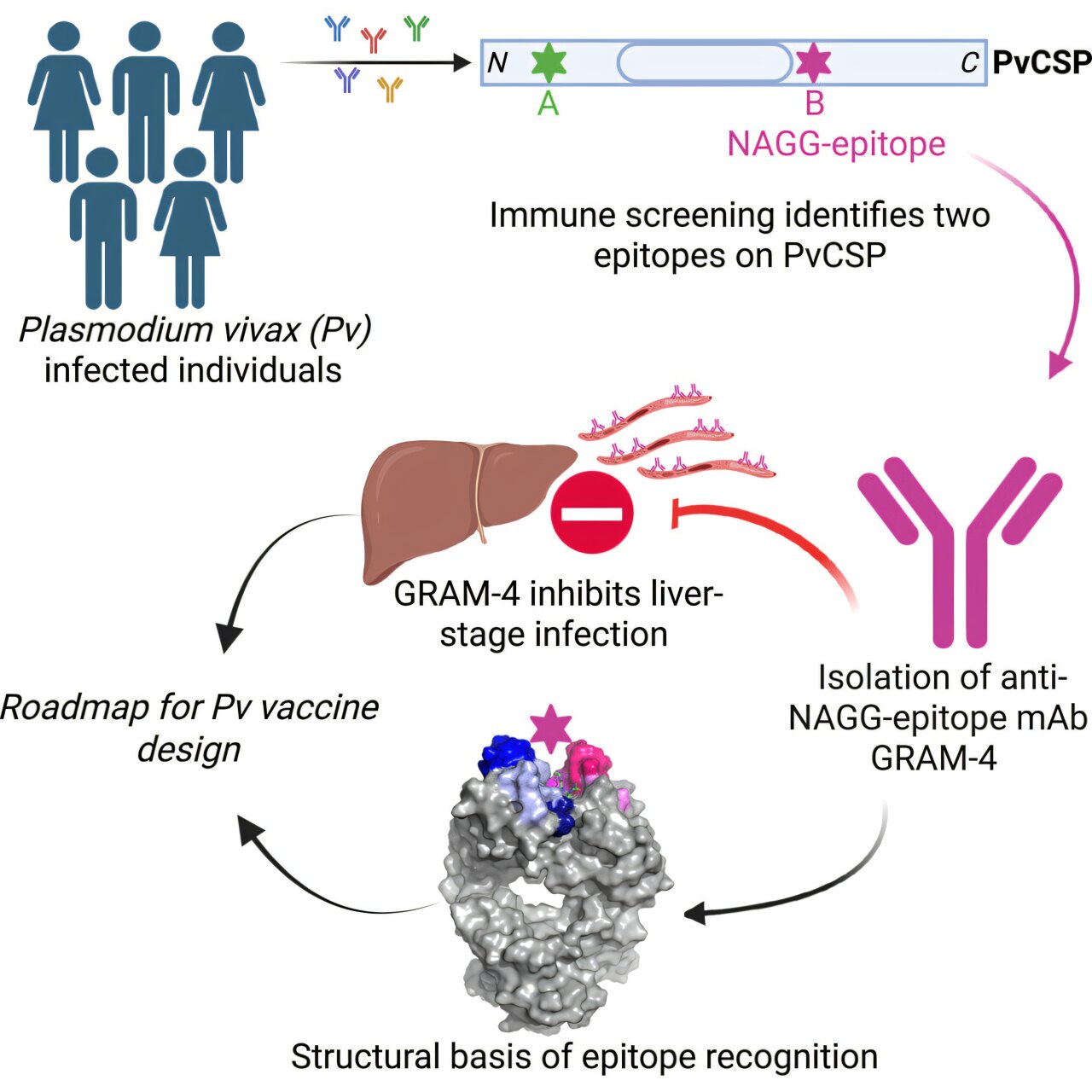
The discovery by USF Health scientists identifies a specific site on the parasite that antibodies can target to block P. vivax from invading liver cells, potentially preventing the parasite from establishing the dormant form that allows malaria to return months or even years later.
The study, "Targeting a site of vulnerability on circumsporozoite protein inhibits Plasmodium vivax malaria infection," was published today in Immunity. The findings provide a new target for developing a vaccine against P. vivax, the most widespread malaria parasite outside sub-Saharan Africa.
"Nobody has discovered a new way to target the major surface antigen, CSP, for vivax in over 40 years," said Noah Sather, a professor in the USF College of Public Health Department of Global, Environmental and Genomic Health Sciences. "This is truly a game-changing, paradigm-shifting discovery."
Sather and John Adams identified a previously uncharacterized epitope—a specific region of a malaria parasite antigen that can be recognized and targeted by antibodies—on the parasite's major surface protein, known as circumsporozoite protein, or CSP.
Their research shows that antibodies targeting this newly identified site can block the P. vivax parasite from infecting the liver.
That is particularly important for P.
Source link