This article has been reviewed according to Science X's editorial process and policies. Editors have highlighted the following attributes while ensuring the content's credibility:
One of the main ways that the APOE4 gene variant, the biggest genetic risk factor for late-onset Alzheimer's disease, undermines brain circuit function is by disrupting the process of insulating neurons with a fatty sheath that optimizes their electrical transmission.
A new study led by neuroscientists at The Picower Institute for Learning and Memory at MIT provides several lines of evidence to implicate a specific molecular pathway in that disruption and uses that insight to demonstrate an intervention for preventing it in lab experiments.
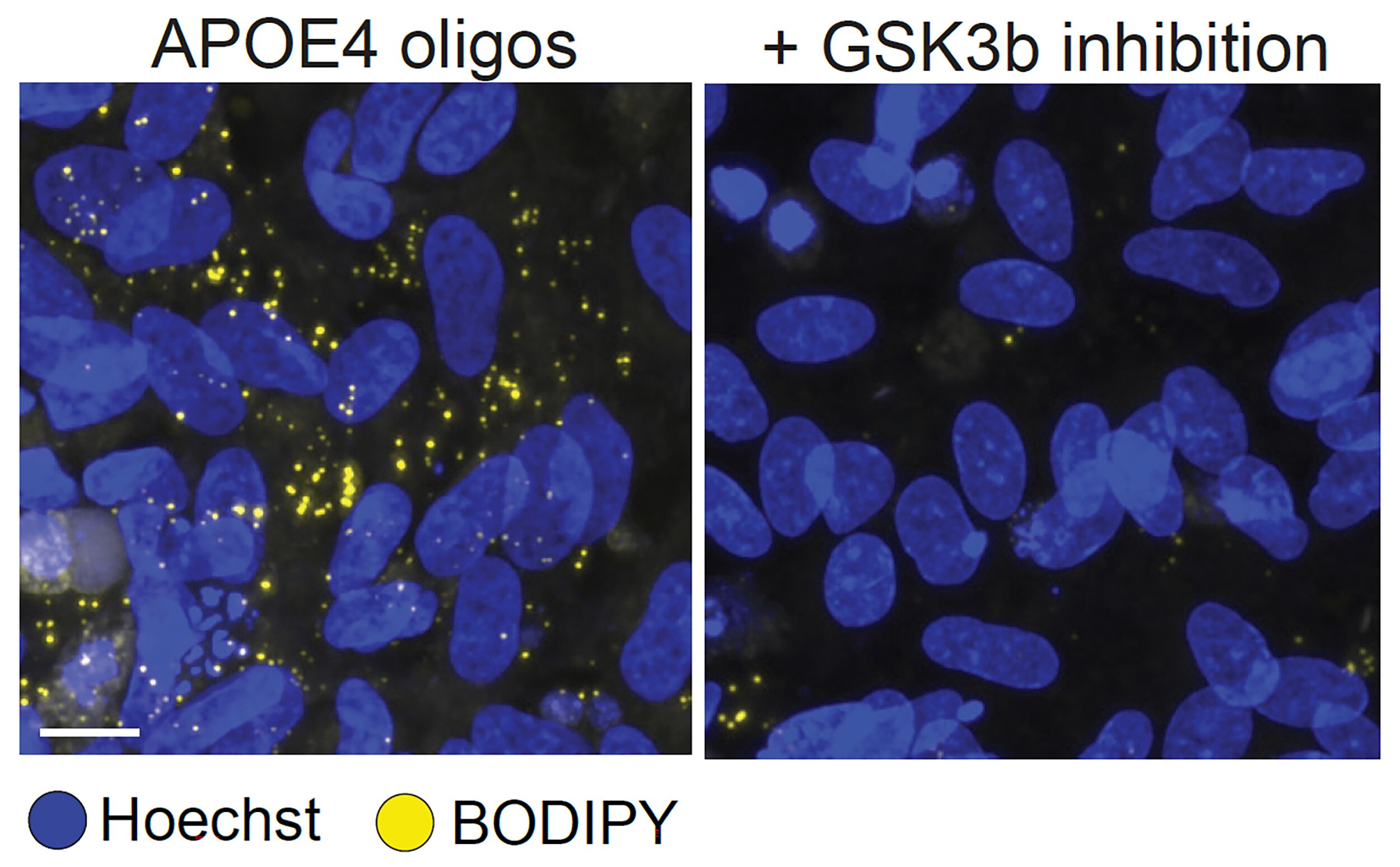
The study published in Cell Stem Cell shows that APOE4 leads to a suppression of "Wnt" signaling in the oligodendrocyte cells that provide neurons with a fatty insulation, called myelin. When Wnt signaling is deficient, they showed, the cells accumulate droplets of lipids rather than deploying fats to properly myelinate the neurons' axon branches.
When the researchers restored Wnt signaling in APOE4-carrying oligodendrocytes, myelination rebounded, both in human cell cultures and in mice modeling Alzheimer's.
The research team led by Picower professor Li-Huei Tsai and study lead author Leyla Akay, a former graduate student in Tsai's lab, discovered Wnt's key role via multiple methods including a screen in which they used CRISPR gene editing to systematically knock out each protein-coding gene in the genome, one by one, in cultures of human APOE4-carrying oligodendrocytes.
The screen showed that when genes promoting Wnt activity in oligodendrocytes were lacking, lipid droplets accumulated, and that when genes suppressing Wnt were lacking, lipid droplets were, too.
Source link