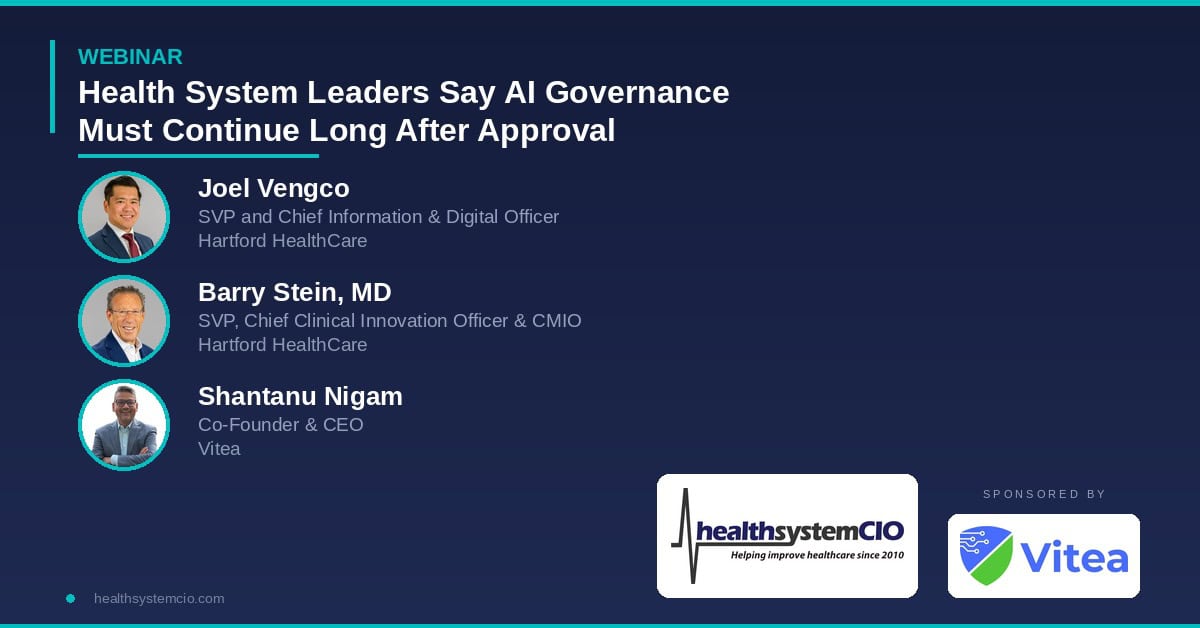
Hartford HealthCare’s technology and clinical AI leaders and Vitea’s CEO explain how health systems keep watch over AI after approving it. Watch below or on YouTube.
Approving an AI tool does not settle whether it will stay safe, panelists said during a recent healthsystemCIO Webinar. The tool can behave differently a month later, and vendors also keep adding AI to software health systems already own. Joel Vengco, SVP and Chief Information & Digital Officer at Hartford HealthCare, joined Barry Stein, MD, SVP, Chief Clinical Innovation Officer & CMIO at Hartford HealthCare, and Shantanu Nigam, co-founder and CEO of Vitea, which sponsored the event. They described the oversight that has to follow approval. It starts with checking the application inventory against what is actually running. It also covers contract terms requiring notice of AI changes and monitoring independent of the vendor’s word.
Until about four years ago, most applications were deterministic, Nigam said, behaving the same way each time. Generative AI is less predictable. Some applications can now write queries on the fly that reach data tables they were never meant to touch. As a result, behavior observed at approval says little about behavior six months later.
“The riskiest AI is probably not even what you’re looking out for in the market,” Nigam said. “It might be an app you approved two years ago that just got an upgrade, and now it’s got an LLM behind it doing something.”
As a physician, Stein compared deployed agents to new doctors joining the medical staff.
Source link