This article has been reviewed according to Science X's editorial process and policies. Editors have highlighted the following attributes while ensuring the content's credibility:
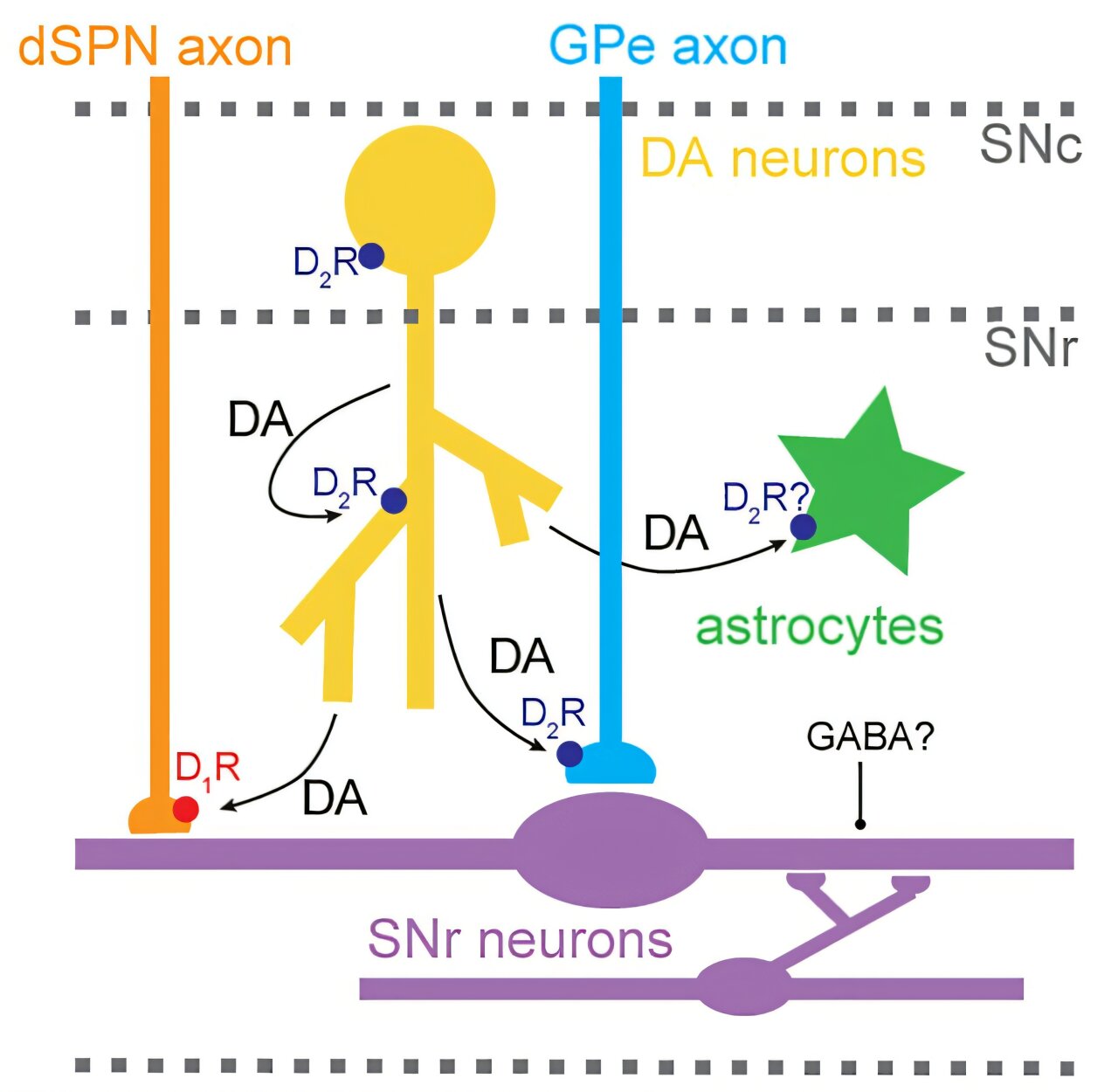
A new Northwestern Medicine study challenges traditional ideas about how dopamine influences movement, according to findings published in Science Advances. The study, led by D. James Surmeier, Ph.D., the Nathan Smith Davis Professor and chair of neuroscience, revealed an unexpected role for support cells called astrocytes and pointed to potential new therapeutic targets for Parkinson's disease.
The study found that during movement, dopamine does far more than regulate signaling in the striatum, a region of the brain traditionally viewed as the primary site of the neurotransmitter's influence on movement. Instead, the scientists discovered that dopamine also acts within another key movement-control center, the substantia nigra pars reticulata (SNr), where it works through astrocytes to shape neural activity.
"As is often the case, our experiments led to unexpected findings," said Surmeier, the study's senior author. "One of the most unexpected things that we saw was that when we engaged dopaminergic receptors, it led to an increase in the discharge rate of substantia nigra pars reticulata neurons."
The findings emerged from experiments in mouse brain tissue slices examining how dopamine affects communication within the basal ganglia, a network of brain regions essential for movement control and heavily affected in Parkinson's disease. The team initially set out to verify previous inferences about dopamine's effects on inhibitory signaling. In the process, they uncovered a surprising phenomenon.
For decades, the conventional model has suggested that dopamine promotes movement largely by suppressing activity in the SNr.
Source link